

An office relocation is one of the most complex and financially significant projects an organisation will undertake. Beyond the physical move, budgets must cover fit-out, IT infrastructure, lease overlap, furniture, and dozens of hidden line items that catch leadership off guard. Research shows the average office relocation project overruns its budget by roughly 22%, and in extreme cases cost surprises can reach 80% of the original estimate. Engaging an independent consultant is the most reliable way to prevent these overruns and turn a relocation into a strategic investment rather than a financial risk.
Why Office Relocation Budgets Spiral Out of Control
Office relocations involve simultaneous management of physical logistics, technology infrastructure, vendor coordination, and business continuity. Without structured project management, moves become chaotic, expensive, and disruptive. Missed deadlines cause lease penalties, scope creep inflates costs, and employee downtime drains revenue.
According to Zentura Workspace research, the average cost overrun for office fit-out projects is 22%. One of the most damaging causes is withheld costs: necessary scope items deliberately omitted from contractor quotes, only to reappear later as chargeable variations. Some organisations have suffered overruns of over 80% due to hidden costs alone.
These problems are preventable. An experienced consultant identifies budget risks before contracts are signed and structures procurement to eliminate surprises. This is exactly the kind of integrated advisory and management that separates strategic partners from commodity service providers.
What a Relocation Consultant Actually Does
A relocation consultant is a specialist who oversees the strategic, financial, and operational dimensions of an office move from initial needs assessment through post-move evaluation. Unlike a moving company or interior contractor, a consultant works on the client's side, fully independent from suppliers.
Organisational Needs Assessment
Before any floor plan is drawn, a good consultant analyses how your organisation works and what workplace conditions drive performance. At WIAR Workplace Performance, this starts with understanding organisational change and workplace transformation needs, not just square metres.
Vendor Tendering and Cost Control
Independent consultants leverage competitive tendering to guarantee maximum market value. WIAR, for example, operates fully independent of real estate, construction, and facility service suppliers, using procurement power to secure the best price-quality ratio for every contract.
Financial Monitoring Through Delivery
Throughout the implementation phase, a consultant monitors finances, quality, and progress on the client's behalf. This "no secrets, no surprises" approach, as practised in WIAR's contract management methodology, ensures leadership always has a clear view of spending versus budget.
Key Cost Categories You Cannot Afford to Miss
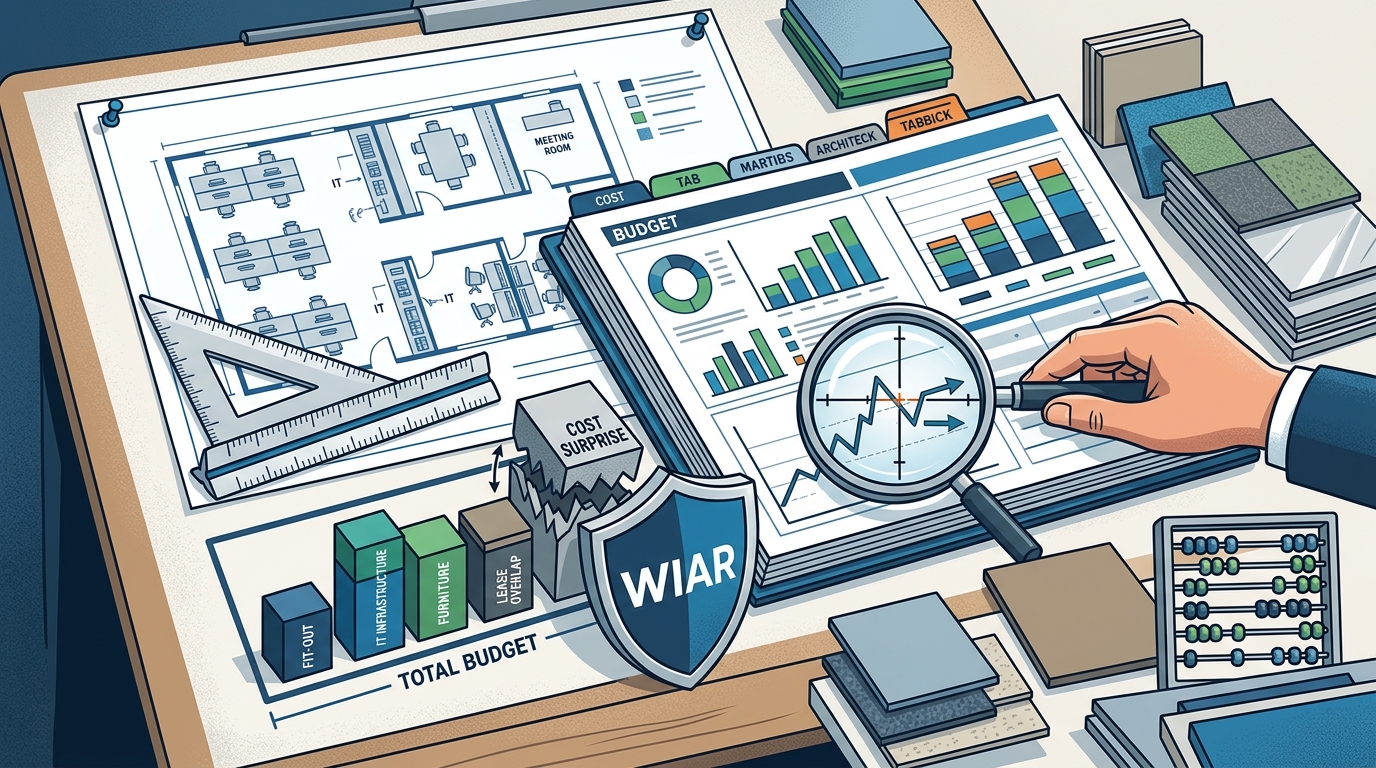
Office relocation costs vary widely depending on size, distance, and requirements. A structured budget must capture every category to avoid surprises.
| Cost Category | Typical Range | Budget Share |
|---|---|---|
| Professional moving services | €1 – €2 per sq ft | 10 – 15% |
| IT infrastructure relocation | €200 – €400 per workstation | 20 – 25% |
| Furniture and space planning | €500 – €1,000 per employee | 15 – 20% |
| Tenant fit-out / build-out | €10 – €50 per sq ft | 25 – 35% |
| Contingency reserve | 10 – 15% of total budget | 10 – 15% |
| Project management fee | 10 – 15% of total budget | 10 – 15% |
Sources: Business Moving Group, Market.biz. A hidden but critical cost is productivity loss: estimates suggest losses of €2,000 to €3,000 per employee for each day of downtime during the transition.
The Trusted Advisor Approach to Budget Management
A trusted advisor is a consultant who prioritises the client's long-term interests over transactional project fees. This distinction matters enormously in relocation budgeting, where contractors may have financial incentives to expand scope or obscure costs.
Firms like WIAR Workplace Performance operate as an independent advisory bureau at the intersection of organisation and real estate. With over 25 years of experience serving listed companies, large SMEs, and NGOs, WIAR's approach combines organisational advisory with hands-on project management. The housing budget for knowledge-intensive organisations typically represents just 4 to 5% of total expenditure, while personnel costs account for 65 to 75%. A small improvement in workplace performance can therefore generate disproportionate returns.
This organisational perspective is what separates a trusted advisor from a traditional real estate contractor. It ensures the relocation budget is not just controlled but strategically invested for measurable ROI.
Risk-Bearing Delivery: Accountability That Protects Your Bottom Line
Risk-bearing delivery is a project model in which the consultant assumes financial accountability for delivering the agreed scope on time, within budget, and at the specified quality level. This model transfers risk from the client to the advisory partner.
WIAR's design and project management methodology includes a Design/Build formula that guarantees delivery for a fixed price, on schedule, and to agreed quality standards. This is comparable to the accountability seen in top-tier management consultancies, applied specifically to workplace transformation projects.
For organisations planning a relocation in the Netherlands, especially across the Randstad region, this model provides the financial discipline and transparency needed to protect the bottom line. WIAR's portfolio of relocation and workplace transformation projects demonstrates this approach across sectors including telecom, energy, healthcare, and finance.
Key Takeaways
- Office relocations overrun budgets by an average of 22%, often due to hidden costs and poor vendor management.
- An independent consultant works on your side, free from supplier conflicts of interest.
- IT infrastructure alone accounts for 20 to 25% of the typical relocation budget.
- Productivity losses during a move can cost €2,000 to €3,000 per employee per day of downtime.
- Risk-bearing delivery models transfer financial accountability from the client to the advisory partner.
- Workplace housing costs are only 4 to 5% of total organisational spend, making strategic investment in the work environment highly leveraged.
- Companies that plan relocations at least 12 months in advance report 31% higher satisfaction.
Frequently Asked Questions
How much does it cost to hire a relocation consultant?
Hiring a relocation project manager typically adds 10 to 15% to the overall budget. However, this investment consistently saves organisations from time overruns and surprise costs that would otherwise exceed that fee many times over.
What is the biggest hidden cost in an office relocation?
Management time is often the most overlooked hidden cost. Board-level oversight, decision-making meetings, and handling unforeseen issues consume executive hours that do not appear on any contractor quote but carry a high opportunity cost.
Can a consultant guarantee my relocation stays on budget?
Yes, when the consultant offers a risk-bearing delivery model. WIAR, for example, uses a Design/Build formula that guarantees project delivery at a fixed price, on time, and to agreed quality standards.
How far in advance should I start planning an office relocation?
For large offices with 100 or more employees, planning should begin 9 to 12 months before the move date. Research suggests companies that allow at least 12 months for planning report 31% higher satisfaction with the outcome.
What makes an independent consultant different from a contractor?
An independent consultant operates on the client's side and has no financial ties to suppliers of real estate, construction, or facility services. This independence ensures procurement decisions are driven solely by the client's interests, not supplier margins.
Why is workplace strategy important during a relocation?
Because personnel costs represent 65 to 75% of most knowledge organisations' budgets, even a modest improvement in workplace performance can generate significant financial returns. A relocation is the ideal moment to align the physical environment with organisational goals.
Does WIAR only work with large corporations?
No. WIAR serves a broad client base including listed companies, large SMEs, and NGOs or foundations. Past clients range from international telecom firms to cancer research charities.
Get Started With a Free Consultation
Planning an office relocation in the Netherlands? WIAR Workplace Performance brings 25 years of independent advisory and risk-bearing project management to every engagement. Whether you are a listed company, a growing SME, or a foundation, our integrated approach keeps your budget on track and your workplace performing at its best. Contact WIAR today to discuss your relocation project with a trusted advisor.