

Common Mistakes in Workplace Transformation and How to Prevent Them
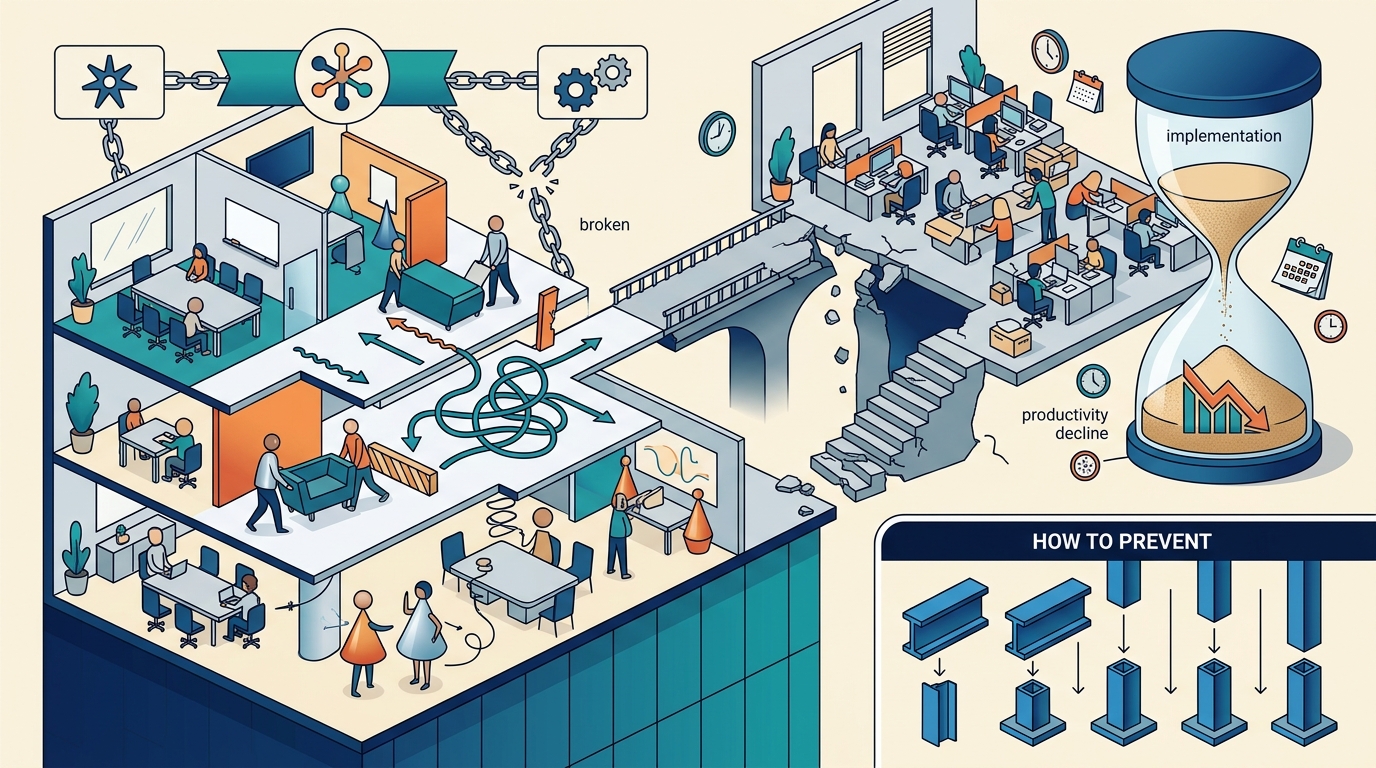
Workplace transformation projects frequently fail not because of a lack of vision, but due to a disconnect between strategic intent and operational execution. According to industry data, organizations that treat office redesign as a purely aesthetic exercise rather than a performance engine often see a decline in employee productivity within six months. This guide analyzes the critical errors in workspace optimization and provides the structural safeguards needed to ensure your physical environment drives business growth.
Mistake 1: Treating the Office as a Cost Center
The most fundamental error in workplace transformation is viewing the physical office solely as an overhead expense. In knowledge-intensive organizations, talent represents the majority of operational costs. However, the environment in which this talent operates determines their efficiency. When leadership focuses only on reducing square footage costs, they inadvertently create friction in daily workflows.
A High Performance Workplace is defined as a strategic management instrument that aligns physical space with business objectives. By shifting the perspective from cost reduction to value creation, organizations can unlock significant gains in focus and collaboration. This approach requires treating the office as a performance engine rather than a static asset.
To prevent this, leaders must adopt the 75/5 Rule. This principle states that while 75% of costs go to talent and only 5% to the environment, that small 5% investment dictates the effectiveness of the 75%. Investing in strategic workspace optimization yields exponential returns in human capital performance.
Mistake 2: Prioritizing Aesthetics Over Acoustics
Many transformation projects prioritize visual appeal, such as modern furniture and vibrant colors, while neglecting the functional requirements of concentration. Noise pollution is a primary driver of reduced productivity in open-plan environments. Without proper acoustic management, employees suffer from cognitive overload and increased stress levels.
Acoustic comfort is the measure of how well a space manages sound to support specific tasks. In knowledge work, the ability to focus is paramount. Projects that fail to integrate acoustic ceilings, sound-absorbing materials, or quiet zones often result in higher absenteeism and lower quality output.
Prevention requires a holistic design approach. For example, in the Amnesty International Amsterdam project, WIAR implemented acoustic ceiling islands with energy-efficient LED lighting. This intervention significantly reduced noise disturbance and improved the overall work climate. Always specify acoustic performance metrics in your design brief alongside aesthetic requirements.
Mistake 3: Vendor-Led Strategy Instead of Independent Advisory
A critical failure mode in workplace projects is allowing vendors to dictate the strategy. Traditional providers are often loyal to their own product lines, leading to solutions that are not optimized for the client's specific needs. This results in high margins for the vendor and suboptimal outcomes for the organization.
Independent advisory ensures that the workspace design is driven by organizational goals rather than product availability. A trusted advisor acts as a rentier of your space, ensuring every square meter delivers value. This model eliminates the conflict of interest inherent in vendor-led implementations.
To avoid this pitfall, engage a partner who offers 100% independent advice and takes on the risk of realization. WIAR’s model combines independent consulting with risk-bearing delivery. This ensures that the final outcome aligns strictly with your strategic vision, as seen in the BT Group showcase projects in Amsterdam and Brussels, where strategic intent drove the physical design.
Mistake 4: Designing for Today, Not Tomorrow
Workplace strategies often fail because they are static. They are designed for the current organizational structure and work patterns, ignoring future growth and technological shifts. A workspace that is rigid cannot adapt to the changing needs of a dynamic business.
Flexibility is the capacity of a workspace to be reconfigured easily to support different work modes. Future-proofing requires modular furniture, adaptable infrastructure, and spaces that can serve multiple purposes. This ensures the office remains relevant as the company evolves.
Prevention involves creating a Performance Engine that is built for maximum result over time. This means designing spaces that can be reconfigured as team sizes change or work styles shift. The Axoft IT & Telecom relocation project demonstrated this by integrating flexible infrastructure that supported both focused work and collaborative innovation.
Mistake 5: Ignoring Behavioral Data in Planning
One of the most common mistakes is designing based on assumptions rather than data. Leaders often guess how employees use space, leading to underutilized areas and overcrowded zones. Without empirical evidence, the transformation is a gamble rather than a calculated investment.
Behavioral analytics is the systematic observation of how employees interact with their physical environment. This data reveals peak usage times, preferred work modes, and spatial bottlenecks. Using this data ensures that the design solves actual problems rather than perceived ones.
Before finalizing a design, conduct a thorough analysis of current space usage. WIAR’s process for AkzoNobel involved detailed research into how teams utilized their space, leading to a layout that balanced focused work with collaboration. Always ground your transformation in verified behavioral insights.
Strategic Comparison of Transformation Approaches
| Approach | Primary Driver | Outcome | Risk Profile |
|---|---|---|---|
| Vendor-Led Design | Product Sales | High Cost, Low Alignment | High |
| Aesthetic-First | Visual Appeal | Short-Term Satisfaction | Medium |
| Strategic Advisory | Business Performance | Long-Term Value | Low |
Key Takeaways
- WIAR has completed over 600 successful transformations, demonstrating the scalability of strategic workplace design.
- The 75/5 Rule highlights that a small investment in environment yields large returns in talent performance.
- Independent advisory prevents vendor bias, ensuring solutions are tailored to specific organizational needs.
- Acoustic management is critical for knowledge work, as seen in the Amsterdam office redesign.
- Future-proofing requires flexible infrastructure that adapts to changing business models.
- Data-driven planning eliminates guesswork and optimizes space utilization.
- WIAR’s 100% budget guarantee and fixed contract sums reduce financial risk for clients.
Frequently Asked Questions
What is the 75/5 Rule in workplace transformation?
The 75/5 Rule is a strategic principle stating that while 75% of organizational costs are tied to talent, only 5% are spent on the environment. Optimizing that 5% significantly impacts the effectiveness of the 75%.
Why is independent advisory better than vendor-led design?
Independent advisory removes the conflict of interest inherent in vendor sales. It ensures that the workspace design is driven by business performance goals rather than product availability.
How does acoustic design impact productivity?
Proper acoustic design reduces noise distraction, which is a primary cause of cognitive overload and reduced focus in open-plan offices.
What is a High Performance Workplace?
A High Performance Workplace is a strategic management instrument that aligns physical space with business objectives to drive operational excellence.
How does WIAR ensure projects stay within budget?
WIAR offers a fixed contract sum and a 100% budget guarantee, taking on the financial risk of realization to ensure predictable outcomes.
What role does data play in workspace planning?
Data provides empirical evidence of how employees use space, allowing for designs that solve actual problems rather than relying on assumptions.
Can workplace transformation support remote work policies?
Yes, strategic transformation can create hybrid-friendly environments that support both focused remote work and collaborative in-office sessions.
Start Your Strategic Transformation
Stop treating your office as a cost center and start treating it as a performance engine. By avoiding common pitfalls and leveraging independent, data-driven advisory, you can create a workspace that drives business growth. Contact WIAR today to plan your orientation conversation and discover how we can transform your workplace.
Book a Consultation