
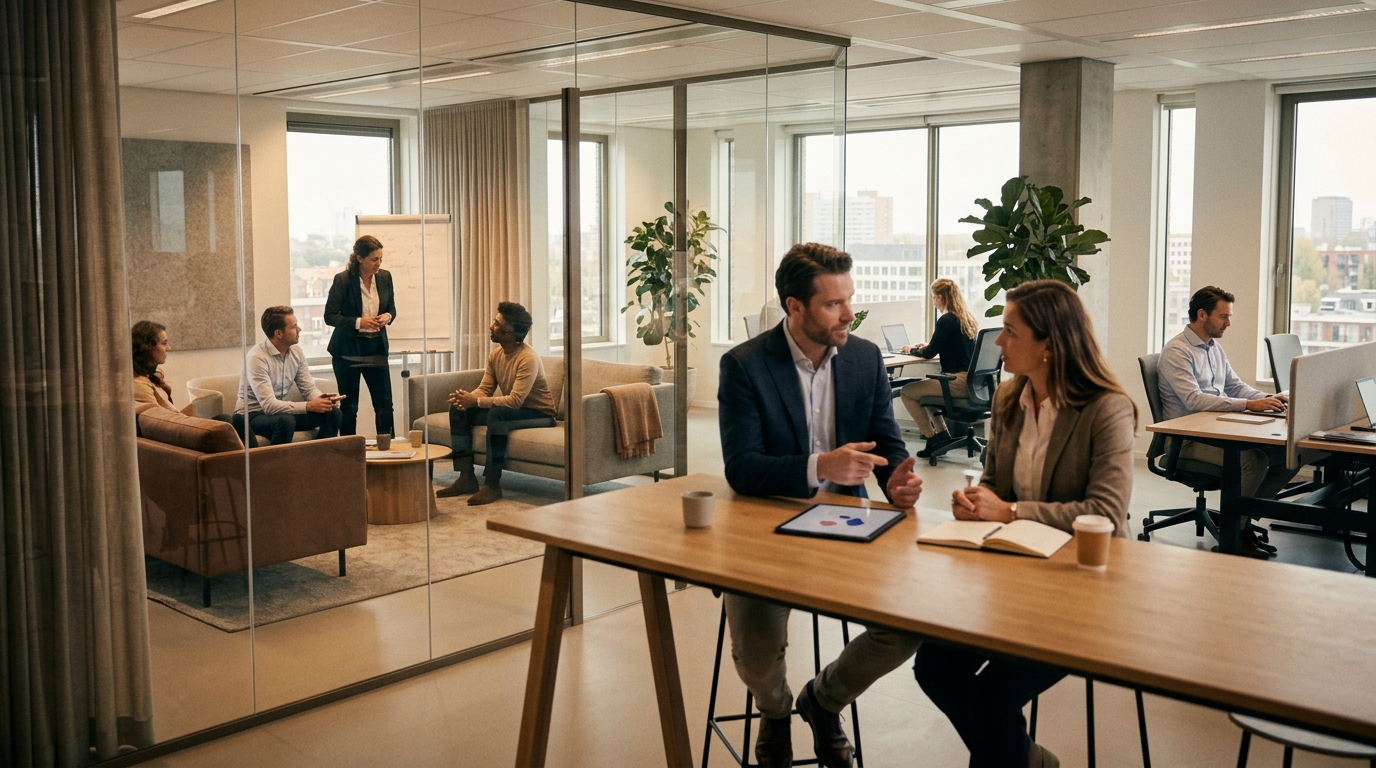
Research indicates that the physical workspace directly influences up to 75% of organizational costs through talent efficiency, yet only 5% of the budget is typically allocated to the environment itself. This imbalance creates a critical vulnerability for knowledge-intensive companies. When the office is treated merely as a cost center rather than a strategic asset, it becomes a source of friction, distraction, and wasted potential. The following guide details the most frequent operational errors in workplace design and provides the strategic frameworks necessary to transform your facility into a high-performance engine.
Mistake 1: Ignoring the 75/5 Rule
One of the most pervasive errors in corporate real estate management is the misallocation of financial resources. The 75/5 Rule is a fundamental principle in workplace strategy. It states that in knowledge-intensive organizations, approximately 75% of operational costs are tied to human capital, while only 5% is spent on the physical environment. The mistake lies in assuming that the smaller 5% budget has less impact. In reality, that 5% acts as a lever for the 75%. If the environment is poorly designed, it suppresses the productivity of the majority of your costs. Avoid this by viewing every square meter as a performance multiplier rather than a real estate expense.
When you optimize the environment, you unlock exponential gains in human capital. This approach aligns with the philosophy of WIAR Workplace Performance, which positions the office as a management instrument for strategic advantage. By focusing on the physical space, you reduce absenteeism and enhance concentration, directly impacting the bottom line.
Mistake 2: Prioritizing Aesthetics Over Acoustics
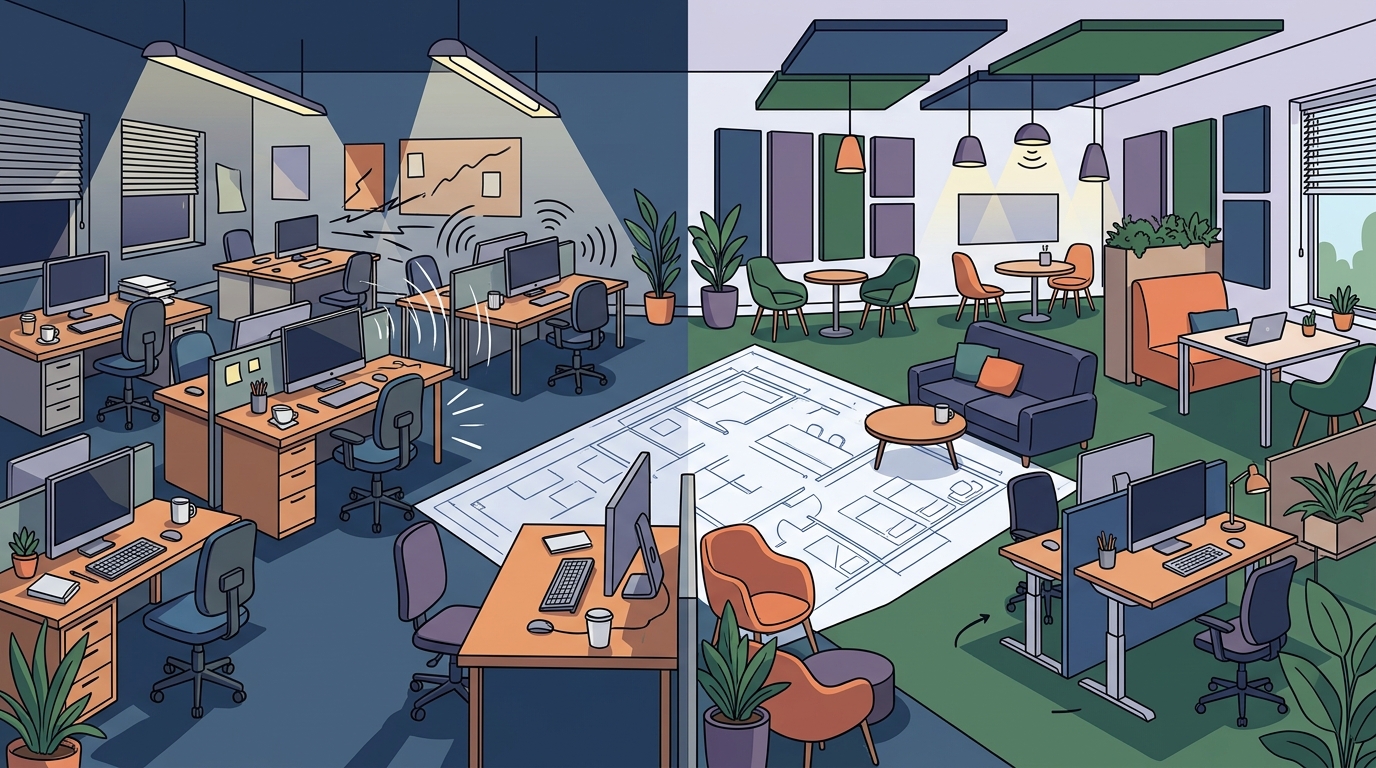
Many organizations invest heavily in visual appeal while neglecting the auditory experience. Acoustic comfort is defined as the state of being free from auditory distraction that impedes cognitive function. Open-plan offices, while trendy, often create a "sound bowl" effect where noise travels unimpeded. This leads to the "cocktail party effect," where employees struggle to filter out background chatter, resulting in significant cognitive load and reduced focus.
To avoid this, integrate acoustic ceilings and sound-absorbing materials into your design. For example, in the Amnesty International office renovation, WIAR installed acoustic ceiling islands with energy-efficient LED lighting. This specific intervention reduced noise disturbance and created a balanced environment for both focused work and collaboration. Without such measures, even the most beautiful office becomes a productivity trap.
Mistake 3: Treating the Office as a Static Asset
A critical error is designing a workspace that cannot adapt to changing business models. The modern workplace must be a Performance Engine, which is a measurable instrument that allows both individuals and the organization to excel. Static layouts fail to support hybrid work models, agile teams, or evolving technology needs.
Flexibility requires a holistic approach to housing advice and interior design. Look at the Axoft IT & Telecom relocation as a case study. The project involved not just furnishing a space, but a complete rehousing strategy that included site selection, renovation, and move management. This comprehensive approach ensured the office supported the specific operational rhythms of an IT and telecom company. Avoid static mistakes by planning for future adaptability from day one.
Mistake 4: Relying on Vendor-Led Design
Another common pitfall is allowing furniture or construction vendors to lead the design process. Vendors are inherently loyal to their own products, which often leads to high margins and solutions that do not fit the client's specific needs. This results in a "one-size-fits-all" environment that fails to address unique organizational challenges.
The solution is to engage an independent partner who guarantees loyalty to your interests. WIAR Build operates on a model of independent advice combined with risk-bearing realization. This ensures that the final design is driven by your strategic goals, not by the inventory of a supplier. By removing the vendor bias, you ensure that every element of the office serves a functional purpose.
Mistake 5: Neglecting Indoor Climate Quality
Indoor environmental quality (IEQ) is a silent killer of productivity. Poor ventilation, inadequate lighting, and incorrect temperatures lead to fatigue and decreased cognitive performance. Indoor Climate Quality refers to the aggregate state of air, thermal, and visual conditions that support human health and performance.
Upgrading climate installations is often overlooked in favor of cosmetic changes. In the Amnesty project, the upgrading of climate installations was a key component of the renovation. This ensured that the historic building provided a modern, healthy environment for its 200 employees. Regular monitoring and proactive maintenance of these systems are essential to prevent the gradual decline of workplace performance.
Comparative Analysis of Workplace Strategies
| Strategy Type | Primary Focus | Impact on Productivity | Long-Term Viability |
|---|---|---|---|
| Vendor-Led Design | Product Sales | Low | Low |
| Showcase Environment | Client Experience | Medium | Medium |
| High Performance Workplace | Operational Excellence | High | High |
Key Takeaways
- The 75/5 Rule dictates that a small investment in the environment yields high returns in human capital efficiency.
- Acoustic comfort is as critical as visual aesthetics for maintaining focus in open-plan offices.
- Independent advice prevents vendor bias and ensures solutions are tailored to specific organizational needs.
- WIAR has completed over 600 successful transformations, demonstrating the scalability of this approach.
- Indoor climate quality directly correlates with employee health and sustained cognitive performance.
- The office must be viewed as a Performance Engine rather than a static cost center.
- Strategic partners like WIAR offer a 100% budget guarantee and fixed contract sums, reducing financial risk.
Frequently Asked Questions
What is the 75/5 Rule in workplace strategy?
The 75/5 Rule is a strategic framework stating that 75% of organizational costs are related to talent, while only 5% is spent on the workspace. It highlights that optimizing the small 5% budget can significantly impact the efficiency of the 75% talent cost.
How does acoustic design affect productivity?
Acoustic design reduces cognitive load by minimizing auditory distractions. Poor acoustics force the brain to work harder to filter noise, leading to fatigue and reduced concentration. Strategic acoustic interventions, such as ceiling islands, restore focus.
Why is independent advice better than vendor-led design?
Vendor-led design is biased toward selling specific products, which may not fit the client's unique needs. Independent advice ensures that the solution is tailored to the organization's strategic goals, avoiding unnecessary costs and functional mismatches.
What is a High Performance Workplace?
A High Performance Workplace is a strategically designed environment that actively supports operational excellence. It is characterized by optimized flow, reduced stress, and enhanced collaboration, turning the office into a tool for competitive advantage.
How does WIAR guarantee project success?
WIAR combines independent advice with risk-bearing realization. This model includes a fixed contract sum, a guaranteed delivery date, and 100% independence from suppliers, ensuring the project stays within budget and meets quality expectations.
What role does indoor climate play in office performance?
Indoor climate quality, including air quality and temperature, directly affects employee health and alertness. Poor climate conditions lead to increased absenteeism and decreased cognitive function. Regular upgrading and monitoring are essential for sustained performance.
Can an office be both a cost center and a performance engine?
No. Treating an office as a cost center leads to neglect and inefficiency. Viewing it as a performance engine drives investment in strategic elements like acoustics and climate, which in turn reduces overall operational costs by boosting talent efficiency.
Transform Your Office into a Performance Engine
Stop treating your office as a passive cost center. Start treating it as the strategic asset it was designed to be. By avoiding these common mistakes and adopting a high-performance mindset, you can unlock the full potential of your organization. Contact WIAR today to schedule an orientation conversation and begin your journey toward operational excellence.