
How to Improve Office Work Environments for Performance and Retention
Your office is not just a place where people sit. It is a strategic asset that directly shapes how your teams think, collaborate, and decide whether to stay. Research consistently shows that workplace design influences cognitive function, emotional engagement, and your bottom line. Yet most organizations still treat their work environment as a facilities issue rather than a business strategy. This guide walks you through proven, actionable steps to transform your office into a high-performance workplace, backed by data and real-world advisory experience.
Why Your Office Environment Matters More Than You Think
Workplace performance is the measurable impact that a work environment has on employee productivity, engagement, and retention. According to Gallup's State of the Global Workplace 2025 Report, only 21% of employees globally are engaged, costing the economy an estimated $438 billion in lost productivity.
The physical workspace shapes behaviour, communication patterns, and how people feel about their employer. Optimized work environments can improve retention by double-digit percentages. For knowledge-intensive organizations, housing budgets typically represent only 4-5% of total costs, while personnel costs account for 65-75%. A small, strategic investment in the workplace can unlock outsized returns on your largest expense.
Step 1: Assess Your Current Workplace Performance
Before redesigning anything, you need a clear picture of where you stand. A workplace assessment is a structured evaluation of how your physical environment, workflows, and organizational culture align with business objectives.
What to Evaluate
Start with occupancy data, employee satisfaction surveys, and absenteeism rates. Map how different teams actually use the space versus how it was originally designed. WIAR Workplace Performance approaches this as an organizational advisory engagement, examining not just the building but the people, processes, and culture within it.
Involve Stakeholders Early
Working groups and steering committees should provide input from the very beginning. This ensures that the requirements of departments, teams, and individual employees are captured before any design decisions are made.
Step 2: Design for Multiple Work Modes
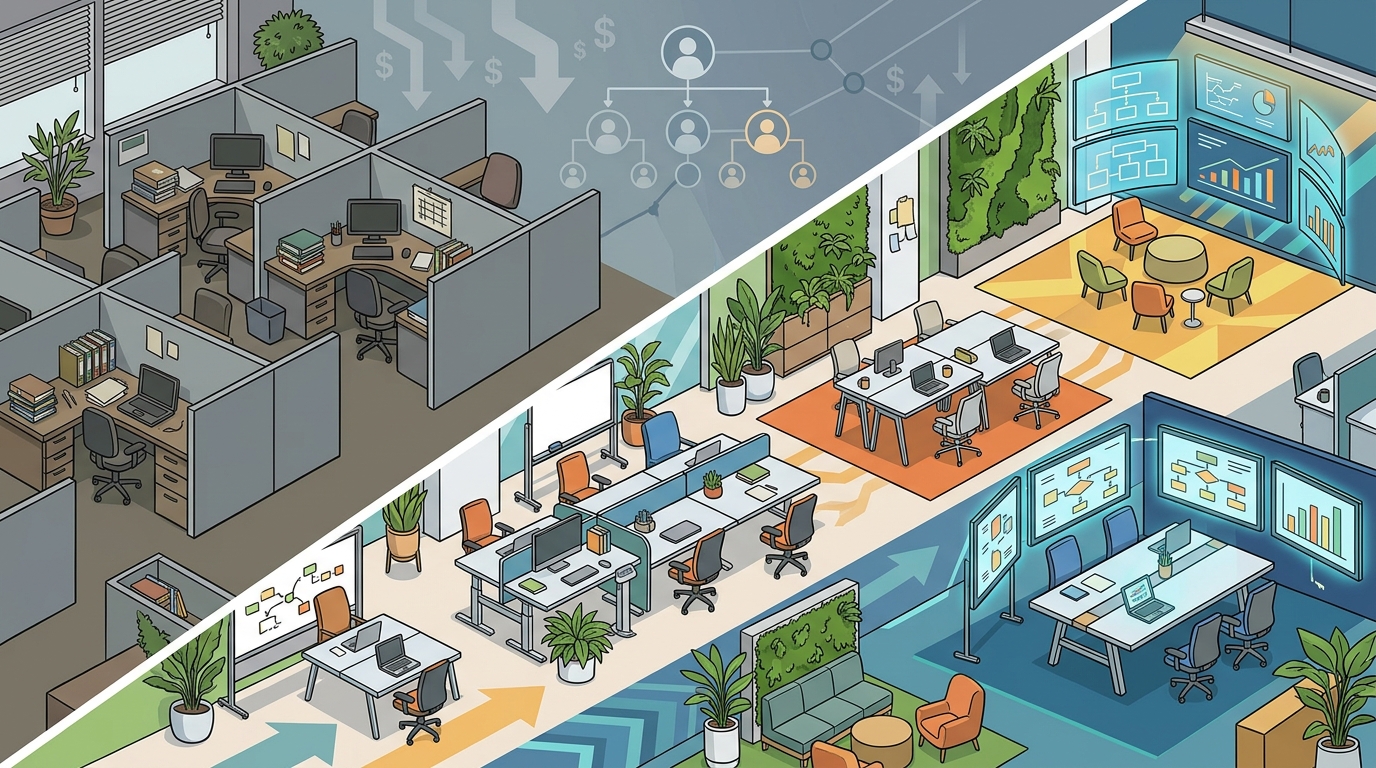
A one-size-fits-all office layout no longer works. Research published in the Journal of Management (2025) found that combining individual non-territoriality (unassigned seating) with group-level territoriality enhances both privacy and team cohesion.
Activity-based working is a design philosophy where employees choose settings based on the task at hand: quiet zones for focused work, open areas for collaboration, and social spaces for informal interaction. The key is offering variety rather than forcing uniformity.
| Work Mode | Space Type | Impact on Performance |
|---|---|---|
| Deep focus | Enclosed quiet rooms, phone booths | Reduces distractions, improves concentration |
| Team collaboration | Open project areas, meeting rooms | Boosts knowledge sharing and cohesion |
| Informal interaction | Lounges, coffee corners | Strengthens culture and cross-team connections |
| Hybrid/remote | Video-equipped rooms, home office setup | Supports flexibility and reduces burnout |
Developing a balanced workplace concept is custom work. WIAR's integrated approach ensures every setting is tailored to the specific demands of your organization.
Step 3: Optimize Ambient Conditions
Ambient conditions are the environmental factors like lighting, temperature, acoustics, and air quality that surround employees throughout the workday. Research confirms that lighting, temperature, and air quality have consistent positive effects on performance when optimized correctly.
Acoustics Require Special Attention
Background noise can be perceived as productive or disruptive depending on the type of work being done. Open-plan offices need acoustic zoning: sound-absorbing materials in focus areas and more ambient energy in collaborative zones.
Ergonomics and Home Offices
Do not forget remote workstations. Proper keyboards, screens, chairs, desks, and air circulation at home are essential. WIAR developed an award-winning, patented ergonomic home workstation that received the Prix de Innovation in Paris, ensuring compliance with Dutch Arbo (occupational health) standards even at home.
Step 4: Build a Structured Hybrid Strategy
Hybrid work is no longer experimental. According to Microsoft's 2025 Work Trend Index, employees in structured hybrid arrangements reported 23% higher focus scores than those in fully remote or fully in-office setups. The structure matters as much as the location.
Approximately 52% of U.S. employees with remote-capable jobs now work in hybrid arrangements, and hybrid workers experience 15% less burnout than fully in-office colleagues. In the Netherlands, the trend is similar: organizations that define clear in-office days with intentional collaboration time outperform those with vague flexibility policies.
Your office strategy should integrate with your workplace design and project management plan so that physical spaces support the hybrid model rather than fight against it.
Step 5: Engage a Trusted Advisory Partner
Transforming an office environment is not just a construction project. It requires organizational advisory expertise, change management, and financial discipline. The difference between a contractor and a trusted advisor is accountability: a true partner takes on risk and delivers transparent results.
What to Look For
Seek a partner who operates independently from suppliers and vendors, ensuring unbiased recommendations. Look for risk-bearing delivery, meaning the advisor guarantees outcomes on time, on budget, and at agreed quality levels. WIAR Workplace Performance, for example, operates with full independence from the supply side and provides risk-bearing project management from concept through post-delivery management.
End-to-End Capability
The best advisory firms handle the entire process: organizational needs assessment, real estate planning, interior design, vendor tendering, construction management, and facility handover. This integrated model prevents information gaps and cost overruns.
Step 6: Measure ROI and Iterate
Workplace improvement is not a one-time event. According to SHRM, replacing an employee can cost between 50% and 200% of their annual salary. Even modest improvements in retention create substantial savings.
Track metrics including retention rate, employee satisfaction scores, space utilization, absenteeism, and productivity output per team. Organizations with comprehensive measurement dashboards achieve significantly better retention outcomes. Connect your workplace investment directly to business KPIs to justify ongoing improvement.
Key Takeaways
- Your office environment is a strategic asset, not just an overhead cost. Treat it accordingly.
- Start with a thorough organizational assessment before making any design changes.
- Design for multiple work modes: focus, collaboration, social, and hybrid settings.
- Optimize ambient conditions like lighting, acoustics, and air quality for measurable performance gains.
- Structure your hybrid work policy with clear expectations and purpose-built spaces.
- Partner with an independent, risk-bearing advisory firm for transparent, accountable delivery.
- Measure ROI continuously by linking workspace metrics to retention, engagement, and productivity.
Frequently Asked Questions
What is workplace performance?
Workplace performance is the measurable effect of a work environment on employee productivity, engagement, well-being, and retention. It connects physical space design to tangible business outcomes like revenue and talent retention.
How much does a poor office environment cost?
Disengagement costs the global economy an estimated $438 billion annually. At the company level, replacing a single employee can cost 50-200% of their annual salary, making poor workplace conditions extremely expensive.
What are the most important ambient factors in an office?
Lighting, temperature, air quality, and acoustics are the four critical ambient factors. Research shows these have consistent positive effects on performance when properly optimized.
Does hybrid work actually improve productivity?
Yes. Structured hybrid arrangements lead to 23% higher focus scores compared to fully remote or fully in-office setups, according to Microsoft's 2025 Work Trend Index. The key is providing defined schedules and intentional in-office collaboration time.
What is activity-based working?
Activity-based working is a design approach where employees choose their work setting based on the task they need to perform, rather than being assigned a fixed desk. It typically includes quiet rooms, open areas, and social spaces.
How do I choose the right workplace advisory partner?
Look for independence from vendors, risk-bearing delivery commitments, organizational advisory expertise, and a proven track record with comparable organizations. A true advisor guarantees time, budget, and quality outcomes.
How long does a workplace transformation take?
Timelines depend on scope. A full transformation from assessment through design, construction, and handover typically spans 6 to 18 months. An experienced partner like WIAR streamlines this with integrated project management.
Can improving the office really help retain employees?
Absolutely. Optimized work environments can improve retention by double-digit percentages. When employees feel their workspace supports their well-being and productivity, they are far less likely to leave.
Ready to Transform Your Workplace?
Your office should drive performance, not hold it back. Contact WIAR Workplace Performance for an independent workplace assessment and discover how a strategic approach to your work environment can improve retention, boost productivity, and deliver measurable ROI.