

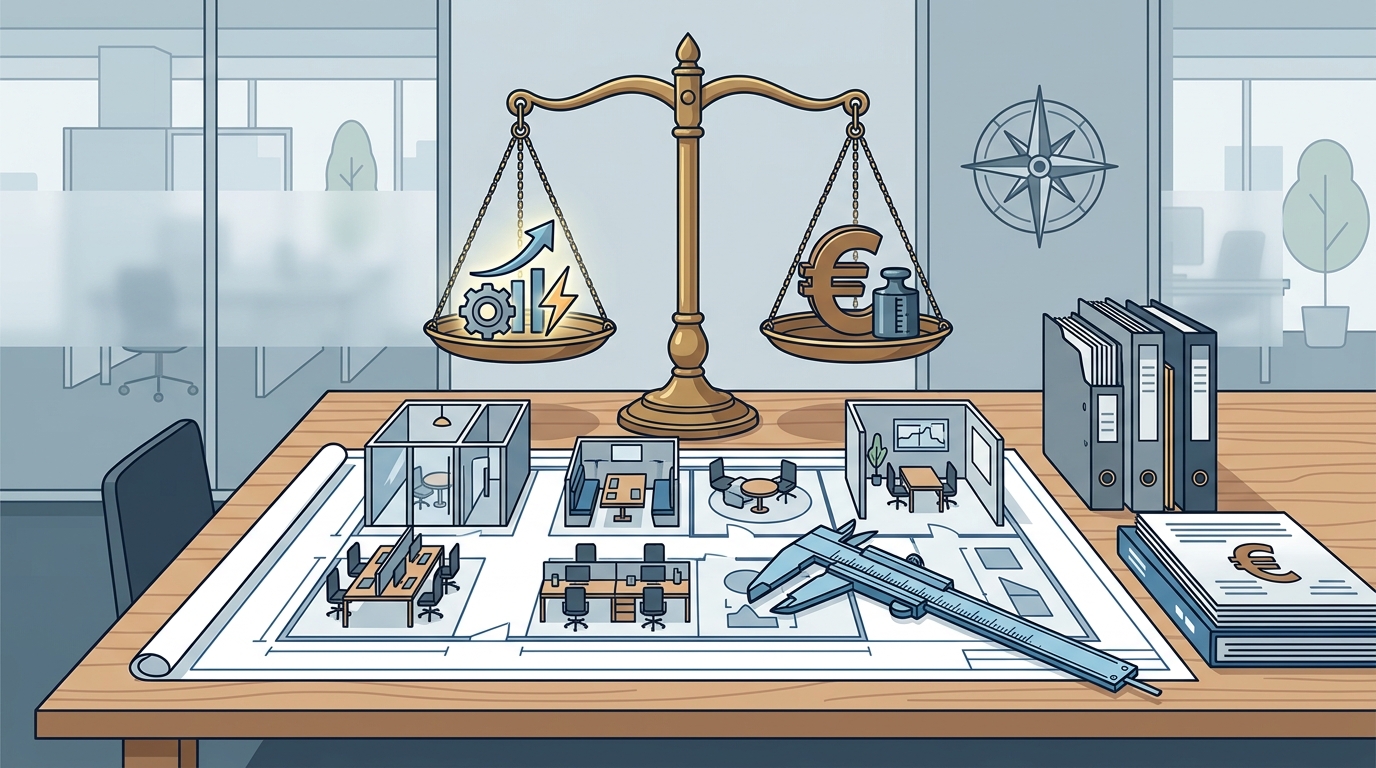
Organizations managing large-scale workplace transformations often face a critical dilemma: balancing ambitious design visions with strict financial constraints. According to industry data, the physical work environment directly impacts operational efficiency, yet many companies view office space merely as a cost center rather than a strategic asset. This guide explores how specialized advisory firms bridge this gap, ensuring that workplace projects deliver measurable performance gains without exceeding budget limits. (Contact WIAR Workplace Performance)
The Strategic Shift: From Cost Center to Performance Engine
Traditional facility management often treats office space as a static overhead expense. However, leading advisory firms now position the workplace as a dynamic management instrument. This shift is critical for large corporations and non-governmental organizations (NGOs) that require high levels of collaboration and focus.
Advisory firms that specialize in High Performance Workplaces do not just design rooms; they engineer business performance. By aligning physical space with organizational strategy, these firms help clients reduce waste, improve employee focus, and enhance overall productivity. The goal is to create an environment where the infrastructure supports, rather than hinders, the workforce.
For large organizations, the complexity of these projects is immense. They involve multiple stakeholders, strict regulatory compliance, and significant capital expenditure. This is where the role of an independent advisor becomes indispensable. Unlike traditional architects or contractors who may be incentivized by product sales, independent advisory firms remain loyal to the client's strategic interests.
The 75/5 Rule: Maximizing Impact on Talent
A core principle in workplace advisory is the 75/5 Rule. In knowledge-intensive organizations, approximately 75% of costs are attributed to talent, while only 5% is spent on the work environment. Despite this disparity, that small 5% investment determines how effectively the 75% operates.
This heuristic highlights the leverage potential of workplace design. Strategic optimization of the physical environment can unlock exponential gains in human capital. For example, improving acoustic privacy can reduce distractions, while flexible layouts can foster spontaneous collaboration. Advisory firms use this principle to justify budget allocations for high-impact interventions.
By focusing on the 5% that drives the 75%, organizations can achieve significant returns on investment. This might include reduced absenteeism, higher employee retention, and faster project completion times. The advisory firm's role is to identify these high-leverage points and ensure they are prioritized within the project budget.
The Risk-Bearing Advisory Model
One of the most significant advantages of engaging a specialized advisory firm is the adoption of a risk-bearing model. Traditional project management often leaves the client exposed to cost overruns and timeline delays. In contrast, firms like WIAR Workplace Performance operate as trusted advisors who take on the risk of delivery.
This model involves three key guarantees:
- 100% Independence: The advisor acts solely in the client's interest, free from vendor conflicts.
- Fixed Contract Sum: The budget is locked in early, providing financial certainty.
- Guaranteed Delivery Date: The project is completed on schedule, avoiding operational disruptions.
By combining independent advice with risk-bearing realization, these firms ensure that the workplace transformation aligns with both quality expectations and financial boundaries. This approach is particularly valuable for NGOs and large corporations that cannot afford budget variances.
Proven Success: Case Studies in Budget Management
Examining real-world examples demonstrates how advisory firms manage complex projects within budget. Below are two distinct cases highlighting different organizational needs.
Amnesty International: Heritage and Efficiency
Amnesty International required a comprehensive renovation of their historic office in Amsterdam. The challenge was to modernize the space while preserving its architectural integrity and improving the indoor climate. WIAR managed the entire process, from workspace strategy to construction management.
The project involved upgrading climate installations, installing acoustic ceiling islands, and introducing sit-stand workstations. By taking full responsibility for the realization, WIAR ensured the project stayed within budget while delivering a high-performance environment for approximately 200 employees. This case illustrates how advisory firms can handle sensitive heritage projects without compromising financial controls.
Axoft IT & Telecom: Strategic Relocation
Axoft, an IT and telecom company, needed to relocate to a new facility in Rotterdam. The scope included 1,500 square meters of office space. WIAR provided housing advice, interior design, and project management.
The advisory firm managed the selection of the location, the renovation of the rental property, and the installation of all technical infrastructure. By overseeing the entire process, WIAR prevented cost creep and ensured the new office supported Axoft's operational needs. This example shows how advisory firms streamline complex relocations for technology-driven companies.
Advisory Approaches Compared
Understanding the differences between traditional and advisory-led approaches is crucial for decision-makers. The table below compares key aspects of workplace project management.
| Aspect | Traditional Architect/Contractor | Specialized Advisory Firm |
|---|---|---|
| Loyalty | Often tied to product sales or vendor margins. | 100% loyal to client interests. |
| Budget Control | Variable; often subject to change orders. | Fixed contract sum with guaranteed delivery. |
| Focus | Aesthetic and technical compliance. | Business performance and operational excellence. |
| Risk | Primarily borne by the client. | Risk-bearing model shared by the advisor. |
| Outcome | A finished building or renovation. | A high-performance workplace strategy. |
This comparison highlights why large organizations increasingly prefer advisory firms that offer both strategic insight and execution certainty. The shift from a transactional to a partnership model ensures that the workplace becomes a driver of growth rather than a source of waste.
Key Takeaways
- Strategic Asset: The workplace is a management instrument that drives business performance, not just a cost center.
- 75/5 Rule: A 5% investment in the work environment can significantly impact the effectiveness of 75% of organizational costs (talent).
- Risk Mitigation: Advisory firms like WIAR offer fixed contract sums and guaranteed delivery dates, reducing financial uncertainty.
- Independence: Independent advisors provide unbiased recommendations, free from vendor conflicts of interest.
- Proven Results: Case studies from Amnesty International and Axoft demonstrate successful budget management in complex projects.
- Operational Excellence: High-performance workplaces reduce absenteeism and improve focus through strategic design.
- Full Service: Advisory firms handle everything from strategy and design to construction management and handover.
Frequently Asked Questions
How do advisory firms keep workplace projects within budget?
Advisory firms use a risk-bearing model that includes a fixed contract sum. By taking responsibility for the realization phase, they prevent cost overruns and ensure the project is delivered on time and within the agreed financial limits.
What is the difference between an architect and a workplace advisory firm?
While architects focus on design and technical compliance, workplace advisory firms focus on business performance. They align the physical space with organizational strategy, ensuring the environment drives productivity and operational excellence.
Can advisory firms help NGOs with their office renovations?
Yes. Advisory firms work with both large corporations and NGOs. For example, WIAR managed the renovation of Amnesty International's historic office in Amsterdam, ensuring the project met strict budget and quality requirements.
What is the 75/5 Rule in workplace strategy?
The 75/5 Rule states that in knowledge-intensive organizations, 75% of costs are related to talent, while only 5% is spent on the work environment. Optimizing that 5% can have a disproportionate positive impact on the effectiveness of the talent.
Why is independence important in workplace advisory?
Independence ensures that the advisor's recommendations are based solely on the client's needs, not on vendor margins or product sales. This leads to more objective and effective solutions that truly benefit the organization.
How long does a typical workplace transformation take?
Timelines vary based on scope, but advisory firms guarantee delivery dates. For example, projects like the Axoft relocation or Amnesty renovation are managed with strict schedules to minimize operational disruption.
What services do workplace advisory firms provide?
Services typically include workspace strategy, housing advice, interior design, tendering, project management, construction management, and facility management. They offer a comprehensive solution from vision to reality.
Start Your Transformation
Transform your workplace from a cost center into a performance engine. Contact WIAR Workplace Performance today to schedule an orientation conversation and discover how we can help you achieve operational excellence within budget.