

Organizations that treat their physical office as a cost center rather than a strategic asset often leave significant value on the table. Data indicates that while talent accounts for approximately 75% of operational costs, the workspace itself represents only 5% of that expenditure. Yet, this small fraction dictates the effectiveness of the larger investment. Evaluating strategic workplace performance is no longer optional for knowledge-intensive industries. It is a critical lever for unlocking operational excellence and driving sustainable growth. (Contact WIAR Workplace Performance)
Defining High Performance Workplaces
A High Performance Workplace is a strategically designed environment that aligns physical infrastructure with business objectives to maximize employee productivity and well-being. It moves beyond aesthetic considerations to focus on functional outcomes. The goal is to create a space that acts as a management instrument, reducing friction in daily operations and enhancing cognitive focus. (Herinrichting BT Amsterdam BT)
Traditional office evaluations often rely on superficial metrics like square footage per employee or furniture age. Strategic evaluation requires a deeper dive into behavioral patterns and operational bottlenecks. Organizations must ask how the layout influences collaboration, how lighting affects energy levels, and how acoustic privacy supports deep work. The definition of success shifts from "does it look good?" to "does it perform?" (Herhuisvesting Axoft IT Telecom)
When evaluating your current setup, consider the concept of Operational Excellence. This is not just about efficiency; it is about creating an environment where processes flow naturally. A well-evaluated workplace reduces the cognitive load on employees, allowing them to focus on high-value tasks rather than navigating a poorly designed space.
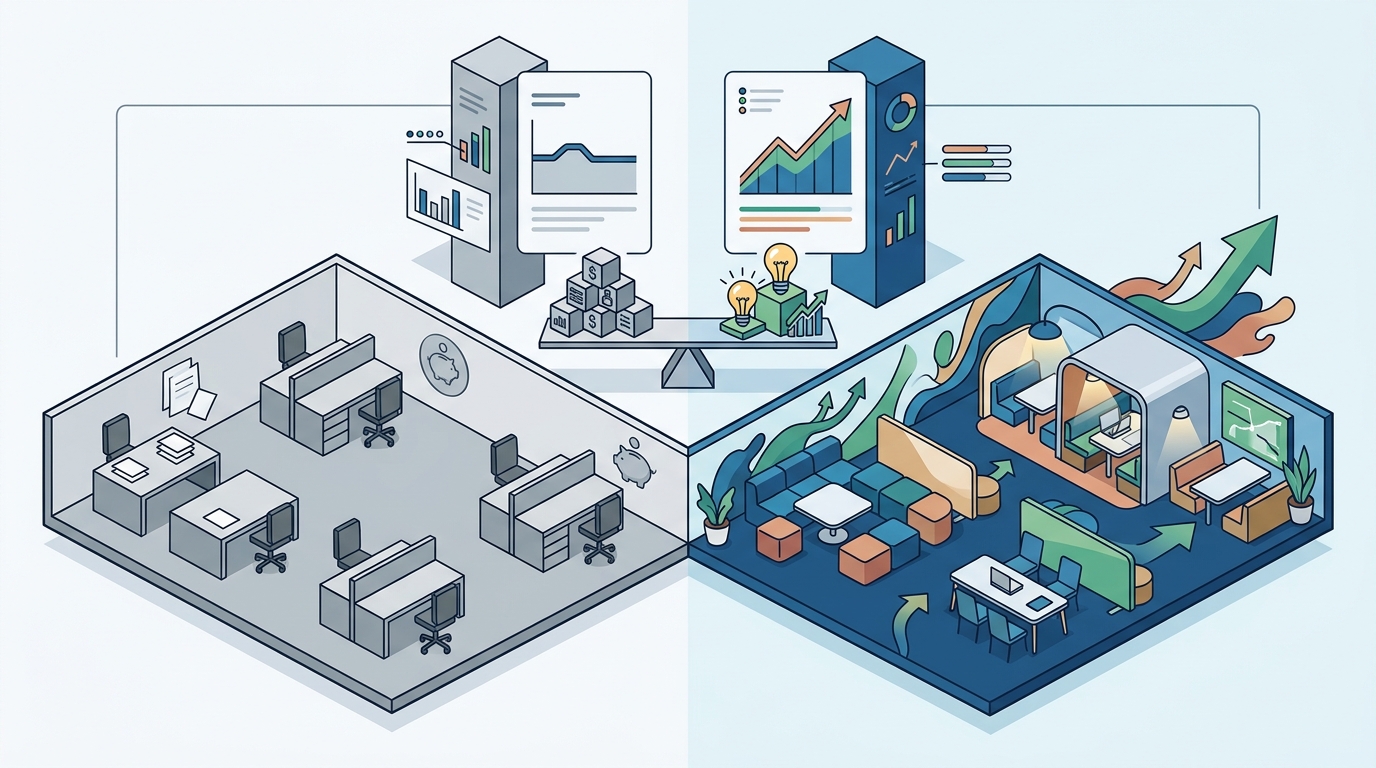
The 75/5 Rule: Leveraging Workspace Impact
The 75/5 Rule is a fundamental principle in workplace strategy. It states that 75% of organizational costs are tied to talent, while only 5% are tied to the workspace. However, that 5% determines how effectively the 75% operates. This heuristic highlights the disproportionate impact of the physical environment on human capital.
Evaluating strategic performance through this lens reveals that minor investments in workspace optimization can yield exponential returns. For instance, improving acoustic privacy can reduce distractions, leading to faster task completion. Enhancing natural light can improve mood and reduce fatigue. These are not just comfort features; they are performance drivers.
Many organizations fail to recognize this leverage point. They view the office as a static cost that must be minimized. A strategic evaluation flips this narrative. It positions the workspace as a dynamic engine for growth. By optimizing the 5%, you unlock the potential of the 75%. This approach requires a shift in mindset from cost containment to value creation.
Key Metrics for Strategic Evaluation
To evaluate workplace performance effectively, you need robust metrics. Traditional real estate metrics like cost per square foot are insufficient. You need data that reflects human behavior and business outcomes. Here are the critical dimensions to assess:
| Metric Category | Key Indicators | Strategic Impact |
|---|---|---|
| Utilization | Desk occupancy rates, room booking frequency | Identifies underused assets and informs space reduction or redesign. |
| Engagement | Employee satisfaction scores, collaboration frequency | Links physical environment to morale and team cohesion. |
| Productivity | Task completion times, error rates, focus hours | Measures the direct correlation between workspace design and output. |
| Well-being | Sick leave rates, reported stress levels, air quality | Assesses the health impact of the environment on long-term sustainability. |
Evaluating these metrics requires a combination of technology and human insight. Sensor data can track utilization, but surveys and interviews provide context. For example, a desk may be unused not because it is unnecessary, but because it lacks the necessary tools for specific tasks. Strategic evaluation uncovers these nuances.
Furthermore, consider the Return on Experience (ROE). This is the value generated by the employee experience in the workplace. It includes factors like brand perception, talent attraction, and retention. A workspace that supports strategic goals will have a high ROE, justifying the investment through tangible business benefits.
Real-World Transformations
Theoretical frameworks are valuable, but real-world examples provide proof of concept. Several organizations have successfully evaluated and transformed their workplaces to drive strategic outcomes. These cases illustrate the power of aligning physical space with business goals.
AkzoNobel: Global Mobility and Collaboration
AkzoNobel, a global paints and coatings company, faced challenges in maintaining cohesion across its distributed teams. WIAR designed and built team bases for the Volvo Ocean Race, creating hubs in 13 ports worldwide. These spaces were not just rest stops; they were strategic nodes for communication and brand engagement. The evaluation of these spaces focused on their ability to support rapid decision-making and team bonding in high-pressure environments. The result was a network of spaces that enhanced global connectivity and operational resilience.
Amnesty International: Optimizing Heritage Spaces
Amnesty International needed to adapt its historic Amsterdam office to support a modern, hybrid workforce. The challenge was to balance heritage preservation with contemporary needs for collaboration and acoustic privacy. WIAR conducted a thorough evaluation of space usage, leading to a redesign that included acoustic ceiling islands and flexible meeting areas. The strategic impact was a significant improvement in focus and collaboration, despite the constraints of a listed building. This case demonstrates that strategic evaluation can unlock value even in challenging physical contexts.
BT Group: The Power of Showcases
BT Group, a telecommunications giant, struggled to convey the complexity of its solutions to clients. Traditional sales pitches were insufficient. WIAR helped BT design and build showcase environments in Amsterdam and Brussels. These spaces allowed clients to experience BT's technology firsthand. The evaluation of these showcases focused on their ability to shorten sales cycles and increase client engagement. The result was a powerful tool for commercial success, proving that the workspace can be a direct driver of revenue.
Axoft: IT Infrastructure Alignment
Axoft, an IT and telecom company, relocated to Rotterdam and required a workspace that reflected its technical expertise. WIAR managed the entire process, from housing advice to interior design and project management. The evaluation criteria included the flexibility of the infrastructure to support evolving tech needs. The resulting office is a testament to the importance of aligning physical space with technical capabilities, ensuring that the workspace supports, rather than hinders, innovation.
Frequently Asked Questions
What is the primary difference between traditional office management and strategic workplace evaluation?
Traditional office management focuses on cost control and asset maintenance. Strategic workplace evaluation focuses on performance, behavior, and business outcomes. It treats the office as a tool for achieving organizational goals rather than just a place to work.
How does the 75/5 rule influence workplace strategy?
The 75/5 rule highlights that a small investment in the workspace (5%) can have a large impact on the effectiveness of talent (75%). It encourages organizations to prioritize workspace optimization as a high-leverage strategy for improving productivity and well-being.
What are the most important metrics for evaluating workplace performance?
Key metrics include space utilization, employee engagement, productivity indicators, and well-being data. These metrics provide a holistic view of how the workspace is performing in terms of both operational efficiency and human impact.
Can strategic workplace evaluation be applied to hybrid work models?
Yes, it is essential for hybrid models. Evaluation helps determine which activities require physical presence and which can be done remotely. It informs the design of spaces that support collaboration and connection, which are often lacking in remote settings.
How long does a typical workplace transformation take?
The timeline varies based on the scope and complexity of the project. However, WIAR guarantees fixed contract sums and delivery dates, ensuring predictability. Projects can range from several months for smaller offices to over a year for large-scale transformations.
What is the role of a trusted advisor in workplace strategy?
A trusted advisor, like WIAR, provides independent advice without bias toward specific vendors. They focus on the client's best interests, ensuring that the solution is tailored to the organization's unique needs and strategic goals.
How does acoustic design impact productivity?
Acoustic design reduces distractions and noise pollution, which are major contributors to cognitive fatigue. By improving acoustic privacy, organizations can enhance focus and reduce errors, leading to higher overall productivity.
Next Steps for Your Organization
Evaluating strategic workplace performance is the first step toward unlocking your organization's full potential. By aligning your physical environment with your business goals, you can drive growth, enhance employee well-being, and gain a competitive advantage. Do not let your office be a cost center. Let it be your engine for success.
Contact WIAR today to schedule an orientation conversation. Our team of certified management consultants is ready to help you transform your workplace into a high-performance asset. Visit our contact page to get started.