

Cost-Value Alignment in Integrated Workplace Strategy and Project Delivery
Organizations often treat office space as a static cost center, yet data indicates that the physical environment directly influences operational efficiency and talent retention. According to industry benchmarks, knowledge-intensive firms allocate approximately 75% of their operational costs to talent, while only 5% goes to the workspace itself. This disparity highlights a critical misalignment where the environment that supports the majority of expenses is under-optimized. By integrating workplace strategy with rigorous project delivery, companies can transform real estate from a liability into a high-performance engine. This guide explores how to align financial discipline with strategic value creation.
The 75/5 Rule: Understanding the Leverage Point
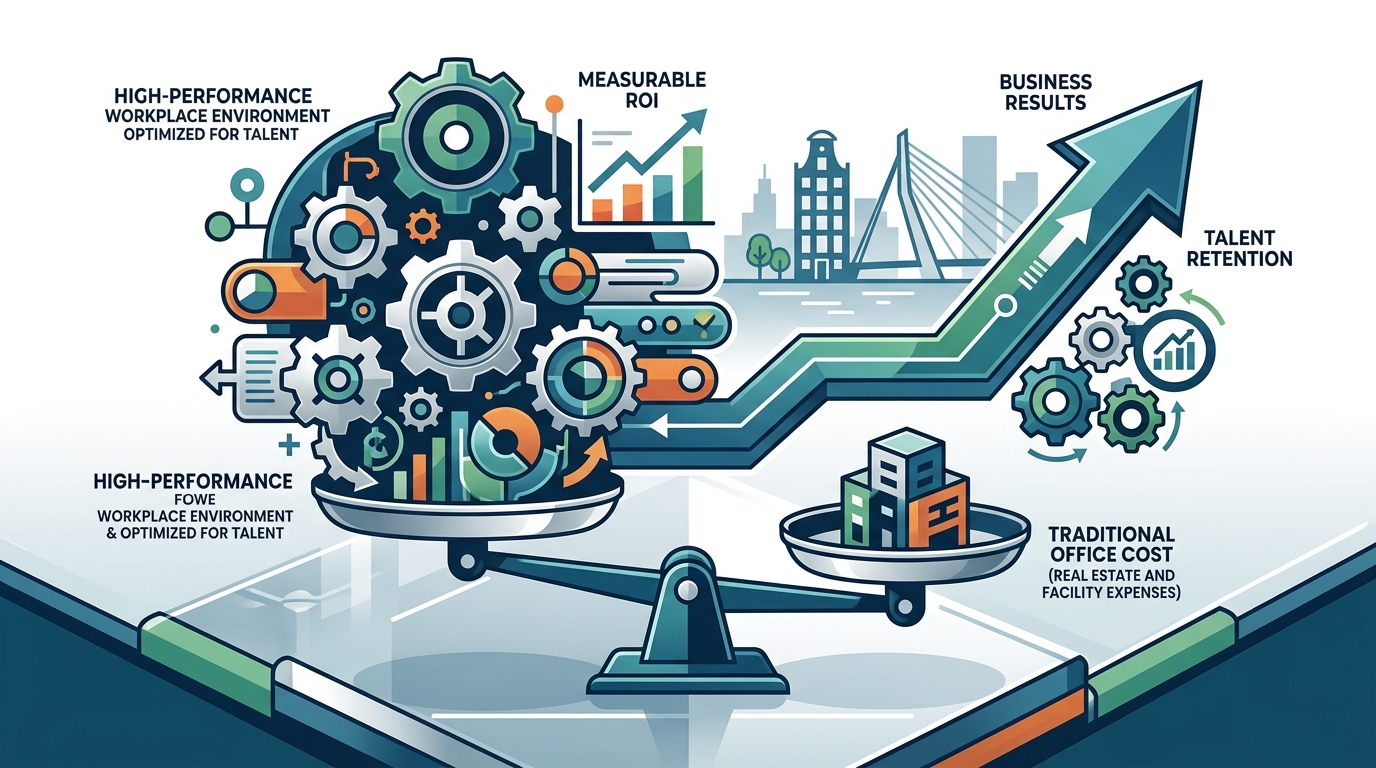
In the landscape of corporate finance and human resources, a fundamental imbalance exists. Workplace strategy is the systematic planning of physical and digital environments to support business goals. When organizations fail to recognize the leverage of this 5% investment, they miss opportunities for exponential returns in human capital.
The 75/5 Rule posits that a marginal increase in the quality of the workspace yields disproportionate gains in productivity. This is not merely about aesthetics. It is about acoustic privacy, ergonomic health, and the flow of information. When the workspace is optimized, it acts as a silent manager, reducing friction in daily operations.
Consider the cost of absenteeism. Poor indoor air quality and inadequate lighting contribute to fatigue and reduced cognitive function. By aligning the budget with these functional needs, companies reduce hidden costs associated with low engagement. This approach shifts the narrative from "spending on furniture" to "investing in performance." Well-being standards provide the framework for these decisions, ensuring that health metrics are prioritized alongside financial ones.
Integrated Delivery vs. Traditional Procurement
Traditional procurement models often silo design, engineering, and construction. This fragmentation leads to scope creep, budget overruns, and a final product that may not align with the initial strategic vision. Integrated delivery, often referred to as Design-Build, unifies these disciplines under a single contract.
Project delivery is the execution phase where strategic plans are translated into physical reality. In an integrated model, the team responsible for the build is involved from the earliest strategic phases. This ensures that cost constraints are considered during the design process, not after.
The Role of the Trusted Advisor
Many organizations struggle with vendor loyalty. Traditional consultants may have ties to specific suppliers, leading to recommendations that benefit the vendor rather than the client. An independent partner acts as a fiduciary for the client's interests. This independence ensures that every square meter is optimized for the client's specific operational needs.
By removing the conflict of interest, the focus shifts to value engineering. This involves finding the most cost-effective solutions that do not compromise on quality or functionality. For example, selecting materials that offer durability and low maintenance rather than just initial low cost. This long-term view aligns with the total cost of ownership (TCO) model. Construction industry standards emphasize the importance of lifecycle costing in sustainable building practices.
Operational Excellence in Realization
Operational excellence is not just a post-occupancy goal. It must be baked into the project delivery process. This means designing for flexibility, ease of maintenance, and adaptability. A workspace that cannot evolve with the business becomes a liability within five years.
Integrated delivery allows for rapid prototyping and feedback loops. Stakeholders can visualize changes before they are built, reducing the risk of costly rework. This transparency builds trust between the client and the delivery team. It also ensures that the final outcome matches the strategic intent defined in the initial workplace strategy.
Risk Management in Workplace Transformation
Workplace transformations are inherently risky. Delays, budget overruns, and technical failures are common pitfalls. A robust risk management framework is essential for successful cost-value alignment.
High Performance Workplace is a state where the environment actively enhances employee productivity and well-being. Achieving this state requires mitigating the risks associated with change management. Employees must be prepared for new workflows and spaces. Resistance to change can undermine even the best-designed environment.
Fixed-Price Contracts and Certainty
One of the most effective ways to manage financial risk is through fixed-price contracts. This model transfers the risk of cost overruns from the client to the provider. For the client, this provides budget certainty, allowing for accurate financial planning.
However, fixed-price contracts require a well-defined scope. This is where the integrated workplace strategy is crucial. A clear strategy defines the requirements precisely, reducing ambiguity in the contract. This clarity protects both parties and ensures that the project stays on track.
Guaranteed Completion Dates
Time is money. Delays in opening a new workspace can disrupt business operations and delay revenue generation. Guaranteed completion dates provide a contractual obligation for the provider to meet the timeline.
This guarantee incentivizes efficient project management and resource allocation. It also allows the client to plan for the move-in date with confidence. Project management best practices highlight the importance of schedule adherence in delivering value to stakeholders.
Real-World Applications and Case Studies
Theoretical frameworks are valuable, but real-world examples demonstrate the tangible benefits of cost-value alignment. Several organizations have successfully implemented these principles to transform their workplace performance.
AkzoNobel: Global Mobility and Brand Experience
AkzoNobel, a global paints and coatings company, required a consistent brand experience across its global race team bases. WIAR designed and built team bases for the Volvo Ocean Race in 13 ports worldwide. This project required precise cost control and logistical coordination.
The result was a scalable design that could be replicated across different locations while maintaining brand integrity. This approach minimized costs through standardization while maximizing impact through consistent messaging. AkzoNobel case study details the execution of this complex global project.
Amnesty International: Heritage and Modernization
Amnesty International moved into a historic building in Amsterdam. The challenge was to modernize the workspace while respecting the heritage constraints. WIAR managed the renovation, including climate control upgrades and acoustic improvements.
The project balanced the high cost of heritage compliance with the need for modern functionality. By optimizing the layout for 200 employees, the company achieved a high density of collaboration spaces without sacrificing privacy. Amnesty International project highlights the successful integration of old and new.
BT Group: The Showcase Model
BT Group needed a way to demonstrate its technological capabilities to clients. WIAR designed a showcase environment in Amsterdam and Brussels. This space allowed sales teams to interact with live prototypes, shortening sales cycles.
The investment in the showcase was justified by the increase in conversion rates. The workspace became a tool for revenue generation, not just a place for work. BT Group showcase illustrates the power of experiential design.
Axoft: IT Infrastructure Integration
Axoft, an IT and telecom company, required a workspace that reflected its technical expertise. WIAR managed the relocation and fit-out of a 1,500 square meter office in Rotterdam. The project included complex data and electrical infrastructure.
The alignment of IT strategy with workplace design ensured that the office supported hybrid work models effectively. This integration reduced downtime and improved employee satisfaction. Axoft relocation demonstrates the importance of technical precision in workplace strategy.
Key Takeaways
- The 75/5 Rule: A 5% investment in the workplace can yield exponential returns in the 75% spent on talent.
- Integrated Delivery: Combining design and construction under one contract reduces risk and improves cost control.
- Independence: Working with an independent partner ensures loyalty to the client's interests, not vendor margins.
- Risk Transfer: Fixed-price contracts and guaranteed dates protect the client from budget and schedule overruns.
- Strategic Alignment: The workspace must support specific business goals, such as innovation or sales.
- Scalability: Designs should be adaptable to future changes in workforce size and structure.
- Operational Excellence: The goal is not just a pretty office, but a high-performance engine for the business.
Frequently Asked Questions
What is the difference between workplace strategy and interior design?
Workplace strategy focuses on how the environment supports business goals and employee behavior. Interior design focuses on the aesthetic and functional aspects of the space. Strategy comes first, guiding the design.
How does integrated delivery reduce costs?
Integrated delivery allows for early cost estimation and value engineering. It eliminates the gaps between design and construction, reducing change orders and rework. This leads to a more predictable final price.
Why is independence important in workplace consulting?
Independent consultants do not have ties to specific vendors. This allows them to recommend the best solutions for the client, rather than the most profitable ones for the vendor. It ensures unbiased advice.
Can a fixed-price contract work for complex projects?
Yes, if the scope is well-defined. A clear workplace strategy provides the necessary detail to create a fixed-price contract. This provides budget certainty for the client.
How do you measure the value of a workplace transformation?
Value is measured through metrics such as employee engagement, absenteeism rates, and operational efficiency. Financial returns come from reduced costs and increased productivity.
What is the role of technology in workplace strategy?
Technology enables hybrid work, data collection, and automation. It must be integrated into the physical space to support seamless workflows and enhance the user experience.
How long does a workplace transformation take?
The timeline varies based on scope and complexity. However, integrated delivery can accelerate the process by overlapping design and construction phases. Typical projects range from 6 to 18 months.
Next Steps for Your Organization
Awaiting the right moment to transform your workplace is a costly decision. The alignment of cost and value is not a theoretical exercise. It is a practical necessity for competitive advantage. WIAR provides the strategic insight and operational execution to deliver high-performance workplaces.
Stop searching for individual vendors. Choose a strategic partner who guarantees results. Contact WIAR today to schedule an orientation conversation. Let us help you turn your office into a motor for growth.