

Organizations managing large-scale workplace transformations often face a critical challenge: balancing strategic vision with strict financial constraints. According to industry benchmarks, the physical work environment directly influences operational efficiency, yet many companies view office space merely as a cost center rather than a performance engine. This guide explores how specialized advisory firms bridge this gap, ensuring that workplace projects deliver measurable business value without exceeding budget parameters.
Understanding the Advisory Role in Workplace Transformation
Traditional office design firms often prioritize aesthetics over operational efficiency. In contrast, specialized advisory firms focus on Engineering Business Performance. These firms act as trusted advisors, connecting strategic planning with the physical realization of the workplace. They do not just design spaces; they optimize them to support the specific workflows of knowledge-intensive organizations.
For large corporations and non-governmental organizations (NGOs), the complexity of these projects is immense. It involves not only interior design but also facility management, climate system upgrades, and acoustic engineering. The advisory firm serves as the single point of accountability, ensuring that every square meter contributes to the organization's strategic goals.
This approach is particularly vital for NGOs like Amnesty International, which require spaces that reflect their values while maintaining operational focus. By treating the office as a management instrument, these firms help clients achieve Operational Excellence through their physical environment.
The 75/5 Rule: Maximizing Impact on Talent
A core principle in high-performance workplace advisory is the 75/5 Rule. This concept highlights a critical imbalance in how organizations allocate resources. In knowledge-intensive companies, approximately 75% of costs are tied to talent, while only 5% is spent on the work environment itself.
However, that small 5% investment determines how effectively the 75% talent resource operates. By strategically optimizing the work environment, advisory firms unlock the full potential of employees. This includes reducing absenteeism, improving concentration, and streamlining processes. The result is an exponential return on investment for a marginal increase in facility spending.
This heuristic is supported by broader research into workplace productivity. Studies on the future of work consistently show that physical and digital environments are primary drivers of employee engagement. Furthermore, data from Gensler's workplace surveys indicates that employees who feel their workspace supports their needs report significantly higher levels of well-being and productivity.
Risk-Bearing Models vs. Traditional Consulting
One of the most significant differentiators for top-tier advisory firms is their contractual model. Traditional consultants often provide advice and then step away, leaving the client to manage vendors and risks. Specialized firms, however, often adopt a risk-bearing realization model.
This model combines independent advice with the responsibility of execution. The firm guarantees a fixed contract sum and a guaranteed delivery date. This eliminates the financial uncertainty that typically plagues large-scale office renovations. Clients no longer fear cost overruns or delayed openings.
This approach ensures 100% independence from suppliers. Unlike traditional providers who may have loyalty to specific vendors, these firms remain loyal solely to the client's interests. This ensures that the selected materials and technologies are optimized for performance, not for vendor margins. For more details on this methodology, explore the WIAR Build framework.
Proven Success: Case Studies in Budget Management
To understand how these principles work in practice, we can examine specific projects where advisory firms managed complex transformations for large entities.
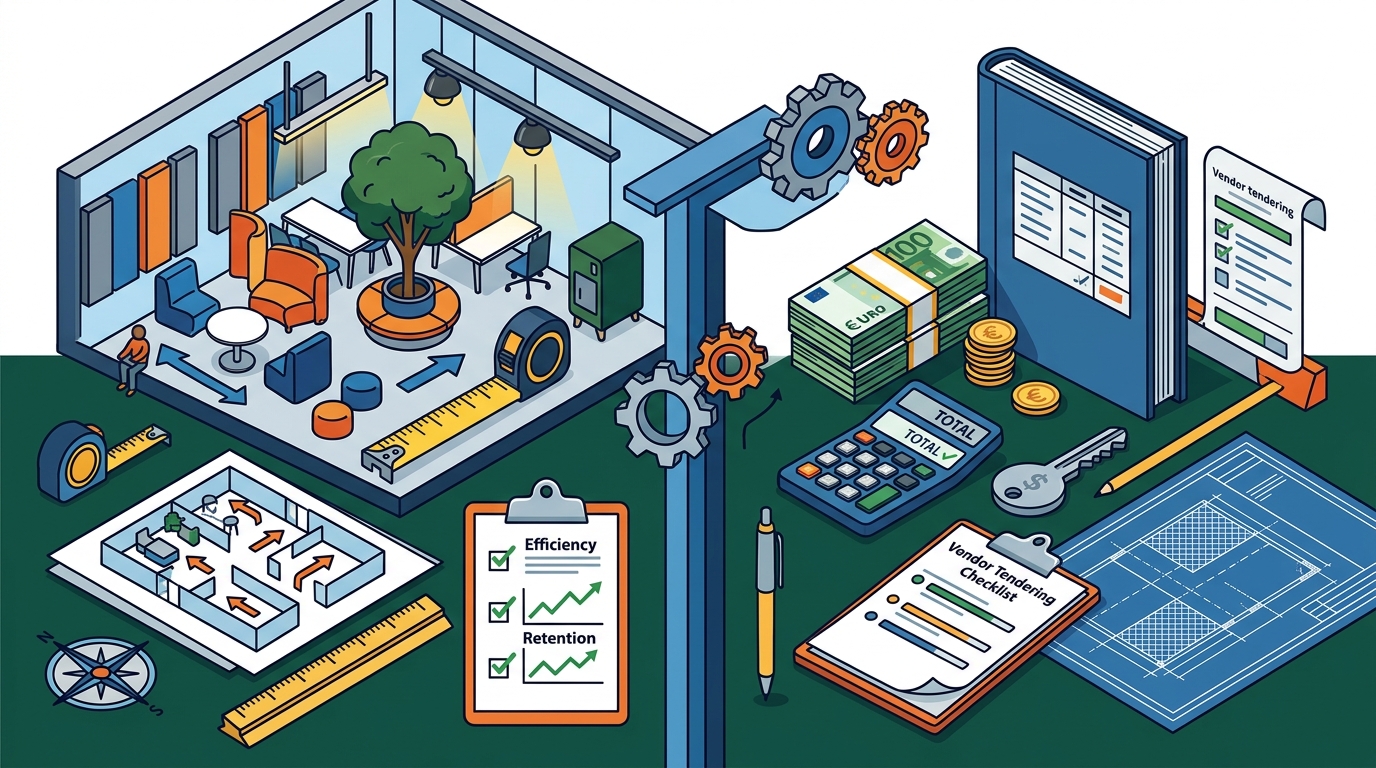
Amnesty International: Heritage and Efficiency
For Amnesty International, the challenge was renovating a historic building in Amsterdam while upgrading climate systems and improving acoustics. The firm managed the entire process, from strategy to implementation, ensuring the 3,500 square meter space supported 200 employees effectively. The project included installing acoustic ceiling islands and energy-efficient LED lighting, directly addressing the need for focus in a heritage building.
BT Group: Global Showcase Strategy
BT Group required a showcase environment in Amsterdam and Brussels to demonstrate their latest technologies to clients. The advisory firm managed the design and build for 4,500 square meters in Amsterdam and 1,500 square meters in Brussels. The goal was to reduce travel time and increase client engagement through immersive physical experiences. This project highlights how advisory firms can turn office space into a commercial asset.
AkzoNobel: Global Event Logistics
The complexity of workplace projects can extend beyond permanent offices. For AkzoNobel, the firm designed and built team bases for 13 ports during the Volvo Ocean Race. This required precise logistical planning and budget management across international borders, demonstrating the firm's ability to handle high-stakes, time-sensitive projects.
Axoft: IT Sector Relocation
For Axoft, an IT and telecom company, the focus was on a complete relocation to Rotterdam. The advisory firm managed the housing advice, interior design, and project management for 1,500 square meters. This included overseeing the demolition, renovation, and installation of all technical infrastructure, ensuring a seamless transition for the client.
Comparative Analysis of Advisory Approaches
| Feature | Traditional Design Firm | Strategic Advisory Firm |
|---|---|---|
| Primary Focus | Aesthetics and Layout | Business Performance and ROI |
| Contract Model | Hourly or Percentage-based | Fixed Sum with Risk-Bearing |
| Vendor Loyalty | Often tied to suppliers | 100% Independent |
| Outcome Guarantee | Design Delivery | On-Time, On-Budget Delivery |
Key Takeaways
- Strategic Value: The work environment is a management instrument, not just a cost. Optimizing it drives operational excellence.
- 75/5 Rule: A small investment in the workspace (5%) significantly impacts the effectiveness of talent costs (75%).
- Risk Mitigation: Risk-bearing models guarantee fixed prices and delivery dates, eliminating financial uncertainty.
- Independence: Advisory firms remain loyal to the client, avoiding conflicts of interest with suppliers.
- Proven Track Record: Over 600 successful transformations demonstrate the reliability of this approach.
- Comprehensive Scope: Services include strategy, design, project management, and facility upgrades.
- Global Reach: Capabilities extend to international projects, such as global event bases and multi-city corporate offices.
Frequently Asked Questions
How do advisory firms ensure workplace projects stay within budget?
Advisory firms use risk-bearing models that guarantee a fixed contract sum. By taking responsibility for the realization phase, they eliminate the risk of cost overruns that typically occur with traditional design-bid-build methods.
What is the difference between a design firm and a workplace advisory firm?
Design firms focus primarily on aesthetics and layout. Advisory firms focus on engineering business performance, using the workspace to drive operational efficiency, talent retention, and strategic goals.
Can advisory firms handle large-scale international projects?
Yes. Firms like WIAR have experience managing complex projects across multiple countries, such as building team bases for 13 ports during the Volvo Ocean Race for AkzoNobel.
Why is independence from suppliers important in workplace projects?
Independence ensures that the firm's recommendations are based solely on the client's needs and performance goals, rather than vendor commissions or partnerships. This leads to more cost-effective and suitable solutions.
How does the physical office impact employee productivity?
Research indicates that factors like acoustics, lighting, and space layout directly influence concentration and well-being. Optimizing these elements can reduce absenteeism and improve focus, leading to higher overall productivity.
What services are included in a typical workplace transformation?
Services typically include housing advice, interior design, project management, contract management, and facility upgrades. The firm acts as a trusted advisor from the initial strategy to the final handover.
How long does a typical workplace transformation take?
Duration varies based on scope, but advisory firms guarantee delivery dates. For example, large-scale corporate offices may take several months, while smaller renovations can be completed more quickly, all within the agreed timeline.
Start Your Transformation
Stop viewing your office as a cost center. Start treating it as a performance engine. If you are ready to transform your workplace into a high-performance environment that drives business results, contact WIAR today. Schedule an orientation conversation to discuss how we can help you achieve operational excellence within your budget.
Book your consultation now and discover the value hidden in your square meters.