

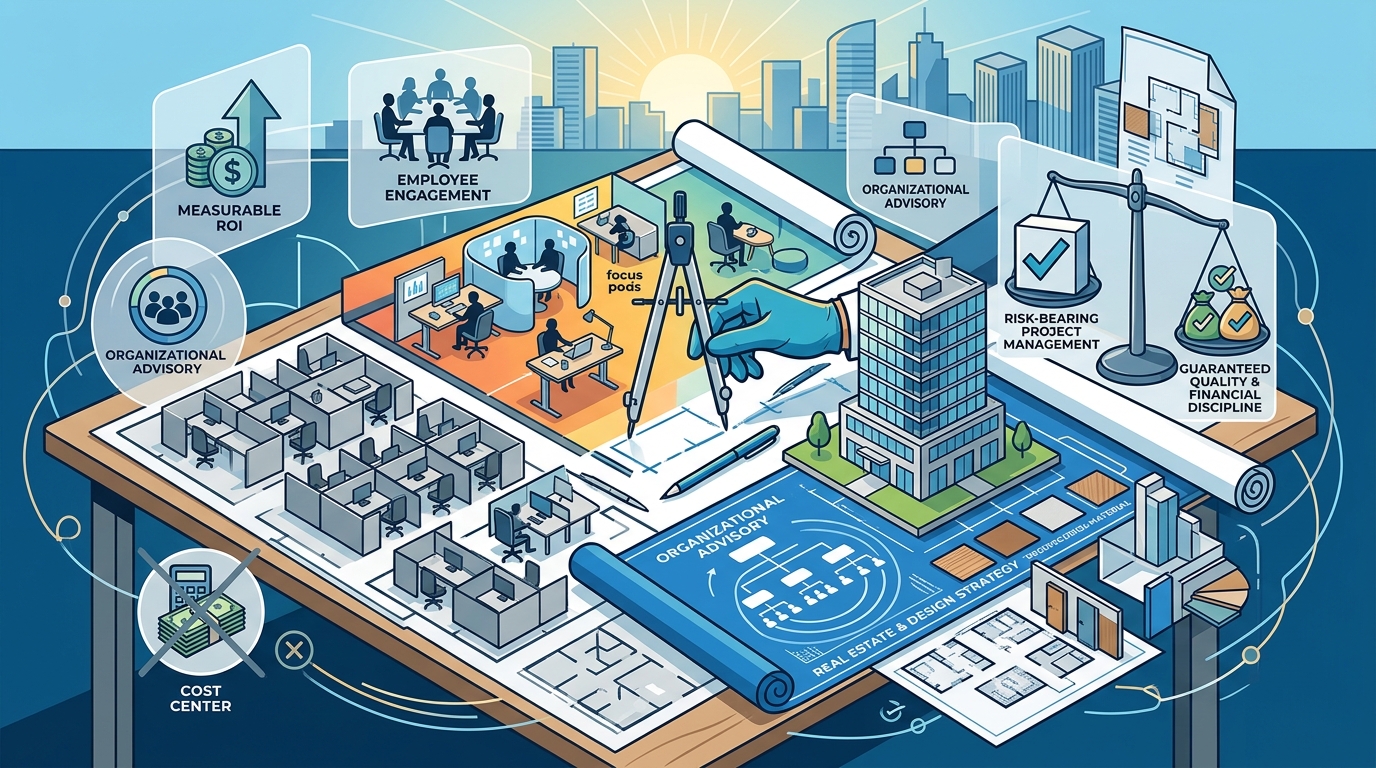
The modern corporate office has shifted from a static cost center to a dynamic engine for business performance. Organizations seeking to optimize their physical footprint must engage specialized advisors who bridge the gap between strategic human capital goals and tangible real estate execution. According to recent industry analyses on workplace efficiency, companies that align their physical environment with operational strategy see significantly higher employee engagement and reduced operational waste. This guide details how to identify and partner with firms that deliver high-performance workspaces through independent advisory, risk-bearing project management, and strategic interior design.
The Shift from Cost to Performance
For decades, corporate real estate was managed purely as a financial liability. The focus was on minimizing square footage costs and maximizing occupancy density. This traditional approach ignored the critical link between the physical environment and employee productivity. Today, leading organizations recognize that the office is a strategic management instrument. It is the primary tool for fostering culture, innovation, and operational excellence.
Workplace transformation is not merely about aesthetics. It is about engineering a High Performance Workplace where energy flows and stress diminishes. This requires a fundamental shift in how companies view their four walls. Instead of seeing empty desks, leaders must see opportunities to unlock human capital potential. The goal is to create an environment that works for the organization, rather than against it. This involves optimizing everything from acoustic privacy to collaborative zones.
Advisors who specialize in this domain understand the "75/5 Rule." In knowledge-intensive organizations, approximately 75% of costs are tied to talent, while only 5% is spent on the workplace itself. However, that small 5% investment determines how effectively the 75% operates. By strategically optimizing the physical workspace, companies can achieve exponential gains in focus, collaboration, and overall business results. This leverage effect is why top-tier firms are now prioritizing workplace transformation as a core business strategy.
Core Advisory Services Explained
Selecting the right partner requires understanding the specific services that drive transformation. Effective workplace advisors do not just sell furniture or blueprints. They provide a holistic framework that connects business objectives to physical execution. The following sections detail the essential components of this advisory model.
Workplace Strategy & Space Planning
Workplace strategy is the foundational step in any transformation. It involves analyzing how employees currently use space and identifying gaps between current usage and future needs. This process includes conducting employee surveys, observing workflow patterns, and modeling different occupancy scenarios. The output is a clear roadmap for space utilization that supports both individual focus and team collaboration.
Effective space planning goes beyond headcount. It considers the nature of the work. For example, a technology firm may require more quiet zones for deep coding work, while a creative agency might prioritize open brainstorming areas. The strategy must also account for hybrid work models, ensuring that the office offers value that remote work cannot replicate. This is where the concept of a "Performance Engine" comes into play. The office becomes a curated experience that draws people in because it enhances their ability to do their best work.
Independent Advisory vs. Vendor Bias
One of the most critical distinctions in workplace advisory is independence. Many traditional real estate brokers or interior design firms are tied to specific vendors. They may recommend products or layouts that maximize their own margins rather than the client's operational needs. This vendor bias can lead to suboptimal outcomes where the physical space does not align with the strategic goals.
Independent advisors operate with 100% loyalty to the client's interests. They act as trusted advisors who evaluate all market options objectively. This independence allows them to recommend the best solutions regardless of the supplier. For instance, an independent advisor might suggest a mix of modular furniture from one vendor and fixed joinery from another, based purely on performance criteria. This approach ensures that the final design is tailored to the organization's unique culture and workflow, rather than being constrained by vendor catalogs.
Risk-Bearing Project Management
Transforming a workplace is a complex project with significant financial and operational risks. Delays, budget overruns, and quality issues are common in traditional construction projects. To mitigate these risks, leading advisors offer risk-bearing project management services. This means they take full responsibility for the delivery of the project, guaranteeing completion dates and fixed budgets.
This model provides peace of mind for corporate leaders. It eliminates the uncertainty of open-ended contracts and hidden costs. The advisor manages all contractors, suppliers, and timelines, ensuring that the project stays on track. This is particularly important for organizations that need to minimize disruption to their daily operations during the transition. By taking on the risk, the advisor aligns their incentives with the client's success, ensuring a seamless handover of the new high-performance environment.
Design-Build Integration
The most successful workplace transformations integrate strategy, design, and construction into a single cohesive process. This is known as the Design-Build model. In this approach, the same team handles both the creative vision and the physical realization of the project. This eliminates the friction that often occurs when separate entities handle design and construction.
Design-Build ensures that the strategic intent is faithfully executed in the final build. If a design element proves too costly or impractical during construction, the team can adjust the design in real-time without breaking the contract. This agility leads to better outcomes and faster delivery. Furthermore, it fosters innovation, as designers and builders collaborate from day one to find the most effective solutions.
For organizations, this means a single point of contact for the entire journey. From the initial concept sketches to the final cleaning, the process is streamlined and transparent. This integration is essential for achieving the "High Performance Workplace" standard, where every detail, from lighting to layout, contributes to the overall goal of operational excellence.
Real-World Implementation Examples
Understanding the theory is important, but seeing it in action provides clarity. Several organizations have successfully partnered with specialized advisors to transform their workplaces. These case studies illustrate the diverse applications of workplace strategy.
| Organization | Challenge | WIAR Solution | Outcome |
|---|---|---|---|
| Amnesty International | Monumental building with poor acoustics and limited collaboration space. | Complete reconfiguration, acoustic ceilings, and climate upgrading. | Enhanced focus and modernized heritage space. |
| BT Group | Need for a dynamic showcase to demonstrate telecom innovations. | Design & Build of immersive showcase environments in Amsterdam and Brussels. | Increased client engagement and brand visibility. |
| AkzoNobel | Global team bases for the Volvo Ocean Race. | Design & Build of 13 teambases worldwide. | Unified global brand experience and team cohesion. |
| Axoft IT | Relocation and fit-out for a growing IT firm. | Full project management and interior design for 1,500 m². | Seamless transition and optimized tech workspace. |
These examples highlight the versatility of workplace advisory. Whether it is a non-profit in a historic building, a global telecom giant, or a tech startup, the principles remain the same. The physical space must serve the people and the mission. By working with experts who understand these dynamics, organizations can avoid costly mistakes and create spaces that truly drive performance.
Key Takeaways
- Strategic Alignment: Workplace transformation must start with business strategy, not interior trends.
- Independence Matters: Choose advisors who are not tied to specific vendors to ensure unbiased recommendations.
- Risk Mitigation: Opt for risk-bearing project management to guarantee fixed budgets and completion dates.
- The 75/5 Rule: A small investment in the workplace yields exponential returns in human capital productivity.
- Design-Build Efficiency: Integrated design and construction teams deliver faster, more cohesive results.
- High Performance Focus: The goal is to create an environment that reduces stress and enhances focus.
- Proven Track Record: Look for partners with decades of experience and hundreds of successful transformations.
Frequently Asked Questions
What is workplace transformation?
Workplace transformation is the strategic process of redesigning and reconfiguring an organization's physical environment to better support its business goals, culture, and employee needs.
Why is independent advisory important?
Independent advisors prioritize the client's interests over vendor margins, ensuring that recommendations for space, furniture, and technology are truly optimized for performance rather than profit.
How does risk-bearing project management work?
In this model, the advisory firm guarantees the final cost and completion date, absorbing the financial and operational risks associated with construction and renovation delays.
What is a High Performance Workplace?
A High Performance Workplace is an environment specifically engineered to maximize employee productivity, collaboration, and well-being through strategic design and operational excellence.
Can advisors help with historic buildings?
Yes, specialized firms can transform historic or monumental buildings by upgrading climate systems, improving acoustics, and reconfiguring layouts while preserving architectural integrity.
What is the 75/5 Rule in workplace strategy?
The 75/5 Rule states that while 75% of organizational costs are tied to talent, only 5% is spent on the workplace, yet that 5% significantly impacts the effectiveness of the 75%.
How long does a workplace transformation take?
Timelines vary based on scope, but risk-bearing partners typically provide guaranteed delivery dates, ensuring the project is completed on schedule without open-ended extensions.
Partner with WIAR for Your Transformation
Stop searching for disparate vendors and start working with a strategic partner who understands the full lifecycle of workplace performance. WIAR offers a unique combination of independent advisory, risk-bearing project management, and high-impact design. With over 25 years of experience and 600+ successful transformations, we help organizations turn their offices into engines of growth.
Whether you are planning a new headquarters, renovating an existing space, or creating a global showcase, our team is ready to guide you from vision to reality. We guarantee 100% independence, fixed contracts, and on-time delivery. Contact WIAR today to schedule an orientation conversation and discover how we can unlock the value in your four walls.