

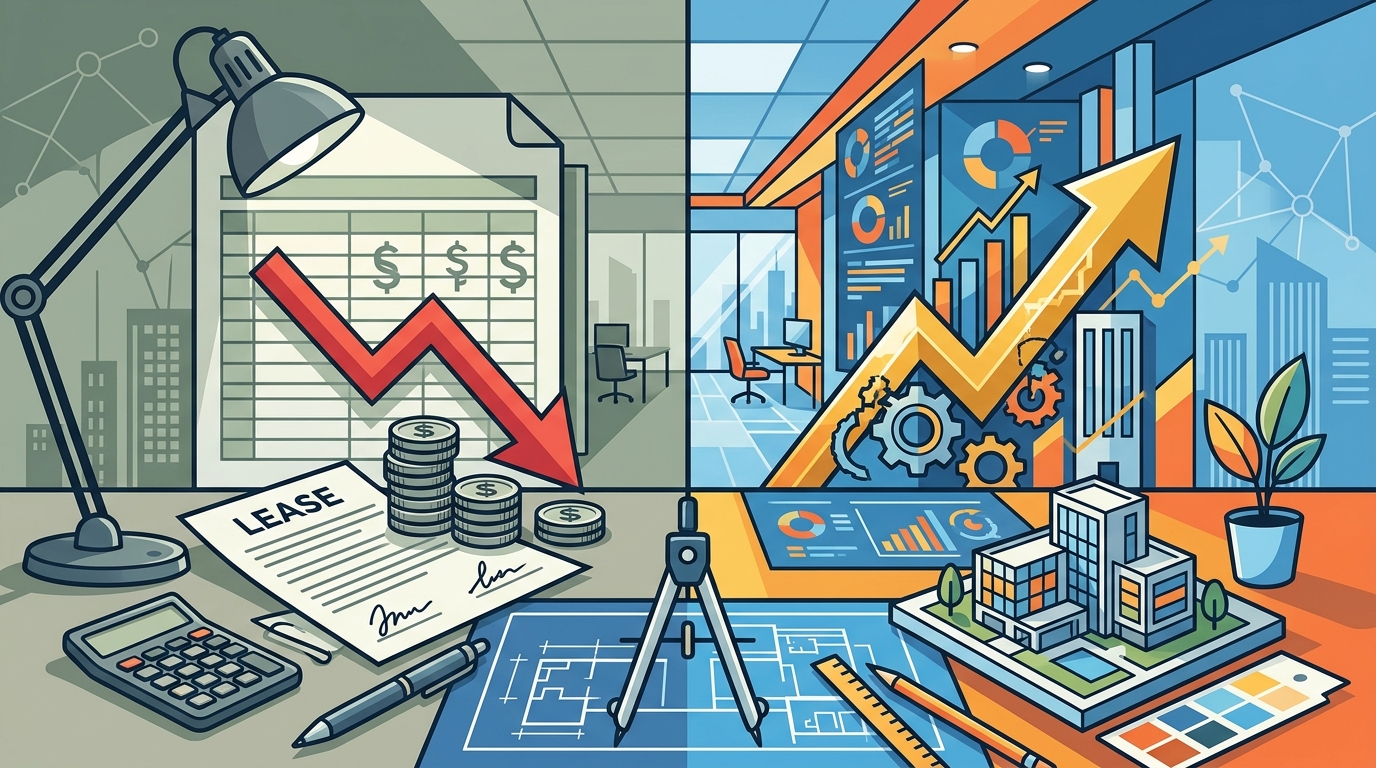
Most companies treat office space as a line item on a spreadsheet. A lease to manage, a cost to contain. But what happens when you flip that perspective and treat your workspace as a strategic instrument—one that actively advances your mission, culture, and bottom line? The benefits are measurable and far-reaching.
Why Alignment Matters More Than Aesthetics
A beautiful office that ignores how your teams actually work is a missed opportunity. Workplace strategists and interior designers today integrate organisational goals, employee needs, space utilisation, technology, and sustainability to create environments where people are engaged and work flourishes. An effective workplace strategy starts with a clear understanding of an organisation's goals and objectives—aligning the physical workspace with the company's mission, vision, and values.
This is a fundamentally different discipline from traditional fit-out. Rather than selecting paint colours and furniture catalogues, it requires asking: What does our organisation need to achieve, and how can the physical environment accelerate that outcome?
Benefit 1: Measurable Productivity Gains
Research consistently links intentional design to output. According to the Gensler Research Institute's U.S. Workplace Survey, employees who rate their workplaces highly for space effectiveness are twice as likely to see impactful innovation. A comprehensive ASID study found that workplace design positively influences health, wellness, employee satisfaction, and work performance—with a reported 16% productivity increase at their own redesigned headquarters.
The mechanics are practical: better lighting reduces eye strain, ergonomic furniture supports sustained focus, and zoned layouts let employees choose settings that match their current task—whether collaborative brainstorming or deep individual work.
Biophilic elements alone can drive significant returns. Research on indoor plants in the workplace suggests that incorporating greenery can lead to a 12% increase in productivity and a 19% improvement in concentration.
Benefit 2: Stronger Brand Identity and Client Perception
Your office space communicates company values to employees and visitors before anyone speaks a word. Consistent colour schemes, logo placement, and material choices reinforce brand identity throughout the workplace. Award displays, company history timelines, and mission statements become natural focal points when incorporated thoughtfully—reminding employees of organisational goals while impressing clients and potential hires.
However, effective branding in interiors is subtle. Branding should complement rather than dominate the workspace. A professional environment that feels authentic rather than overwhelming creates lasting positive impressions without becoming a corporate theme park.
Benefit 3: Improved Employee Retention
Turnover is one of the largest hidden costs for knowledge-intensive organisations. Research confirms that office design, especially when job demands or the office culture supports the messages communicated through the design, results in significant cost savings. Findings from a Cornell University study confirm that perceived environmental quality has a significant effect on turnover intention.
When employees feel that their workspace reflects the values they were sold during recruitment, trust deepens. When it doesn't, dissonance grows—and talented people leave for environments that walk the talk.
Benefit 4: Cost Savings Through Strategic Space Utilisation
Aligning design with goals forces you to analyse how space is actually used rather than how it was originally planned. By carefully analysing space utilisation and implementing efficient layouts, strategic office interior design can result in significant cost savings. An optimised layout considers factors such as traffic flow, zoning, and efficiency—often revealing that organisations can do more with less square footage or repurpose underused areas for high-value functions.
Specialist workplace consultancies frequently achieve 25–40% reductions in investment costs and operational expenses through smarter, evidence-based spatial planning.
Benefit 5: Better Employee Health and Well-Being
Strategic workplace design aligns the work environment with the long-term goals of the organisation—and in a tight labour market, employee well-being is a strategic goal. Exposure to natural light enhances mood, reduces eye strain, and positively affects circadian rhythms, improving sleep quality and productivity. Health-oriented design features such as sit/stand workstations, filtered air and water, wellness rooms, and centralised common areas that encourage movement all contribute to a healthier workforce.
Acoustic design deserves special attention. Research shows that 70% of office workers are unhappy with sound levels in their workplace. Designated quiet zones and sound-absorbing materials directly address one of the most common workplace complaints.
Benefit 6: A Tangible Expression of Company Culture
Culture is often described in mission statements, but it is experienced in physical space. A well-designed workspace should facilitate seamless workflow, strengthen company culture, and embody an organisation's values and goals. When a company that preaches collaboration puts everyone in isolated cubicles, the contradiction undermines trust. When the space genuinely supports the stated culture—open areas for teamwork, private pods for focused work, informal zones for serendipitous conversation—the culture becomes lived rather than laminated.
Integrating organisational culture into office interior design makes the workspace a tangible representation of the company's identity and aspirations.
Benefit 7: Sustainability That Attracts Talent
Sustainability should be a key element in every modern organisation's interior design. If employees don't believe in your core values, they are less likely to be engaged—and younger candidates in particular seek out companies that reflect their belief in eco-friendly practices. Energy-efficient windows, recycled materials, durable flooring, and low-emission finishes demonstrate environmental commitment while often reducing long-term operating costs.
This alignment between stated sustainability goals and the physical evidence in the workspace creates credibility that no CSR report alone can achieve.
The 75/5 Leverage Principle
In knowledge-intensive organisations, roughly 75% of operating costs go to talent and only about 5% to the work environment. Yet that small 5% determines how effectively the large 75% operates. By strategically optimising the workspace, organisations unlock the full potential of their people. A marginal increase in workplace investment translates directly into lower absenteeism, sharper concentration, and streamlined processes—yielding exponential returns in human-capital performance.
This leverage principle reframes every euro spent on the workplace from a facility cost into a performance investment.
How to Start: From Vision to High Performance Workplace
- Define organisational objectives first. Before selecting a single material, articulate what the business needs to achieve in the next 3–5 years. Growth? Innovation? Retention? Each goal shapes different design decisions.
- Audit current space utilisation. Use occupancy sensors and employee surveys to understand how space is really used versus how it was planned.
- Engage employees in the design process. Gathering input and feedback creates a workspace that reflects their preferences and increases adoption of new layouts.
- Integrate technology infrastructure. Modern workplaces must support seamless communication and collaboration through cutting-edge technology and robust infrastructure.
- Partner with an independent strategic advisor. Working with an independent consultancy—rather than a furniture supplier or fit-out contractor—ensures recommendations serve your goals, not a product catalogue.
- Measure outcomes post-occupancy. Track productivity metrics, employee satisfaction scores, and space utilisation data to validate design decisions and inform future adjustments.
Key Takeaways
- Interior design aligned with organisational goals drives measurable improvements in productivity, retention, health, and brand perception.
- Strategic space utilisation can reduce real-estate costs by 25–40% while improving employee experience.
- The workspace is a leverage point: a small percentage of total costs that determines the effectiveness of your largest cost—your people.
- Sustainability in design is no longer optional; it is a talent-attraction and credibility imperative.
- Effective alignment requires starting with business objectives, not aesthetic preferences.
Frequently Asked Questions
How does interior design affect employee productivity?
Thoughtful design impacts productivity through multiple channels: natural lighting boosts mood and reduces eye strain, ergonomic furniture supports sustained focus, biophilic elements like plants can increase productivity by 12%, and flexible layouts allow employees to choose settings suited to their tasks.
What is meant by aligning interior design with organisational goals?
It means starting every design decision from a business objective—whether that is fostering innovation, reducing turnover, strengthening brand identity, or supporting hybrid work—rather than beginning with aesthetics alone. The physical space becomes a deliberate tool for achieving strategic outcomes.
Can office design really reduce employee turnover?
Yes. Research from Cornell University confirms that perceived environmental quality has a significant effect on turnover intention. When the workspace reinforces the culture and values employees were promised, satisfaction and loyalty increase.
What is the 75/5 rule in workplace strategy?
In knowledge-intensive organisations, approximately 75% of costs go to people and only 5% to the work environment. The 75/5 rule highlights that optimising that small 5% has an outsized impact on how effectively the 75% performs—making workspace investment a high-leverage move.
How do I measure the ROI of a workplace redesign?
Track metrics before and after the redesign: employee satisfaction surveys, absenteeism rates, space utilisation data (via sensors), energy costs, and productivity indicators relevant to your industry. Organisations like ASID have demonstrated that design investments can be recouped within the first half of a standard lease term.
Why should sustainability be part of workplace design?
Sustainable design reduces long-term operating costs, reflects core values that attract younger talent, and demonstrates corporate responsibility in a tangible way. Eco-friendly materials, energy-efficient systems, and durable finishes create credibility that strengthens both internal culture and external reputation.