

Successful companies treat their physical workspace as a strategic asset rather than a fixed cost. They align real estate planning with organizational goals to drive measurable productivity and retention. WIAR Workplace Performance helps organizations execute this shift through a rigorous, risk-bearing advisory model that ensures financial discipline and operational excellence.
Strategic Alignment Over Aesthetic Upgrades
Many organizations view office renovation as a cosmetic exercise. However, high-performing firms recognize that the physical environment directly influences employee behavior and output. A workspace that does not support the current way of working creates friction, reduces focus, and can accelerate talent attrition. WIAR approaches this by starting with a deep organizational analysis before any design work begins. This ensures that every square meter serves a specific business function. For additional details, review the Herinrichting KWF Hybride Office.
The distinction is critical. Aesthetic upgrades look good but may not solve operational bottlenecks. Strategic alignment ensures that the space facilitates collaboration, deep work, and client engagement as required by the business model. By treating the office as a management instrument, companies can create a competitive advantage that is difficult for competitors to replicate quickly.
The 75/5 Rule and Cost Efficiency
Financial discipline is a cornerstone of successful workplace transformation. WIAR utilizes a framework often referred to as the 75/5 Rule. This principle highlights that in knowledge-intensive organizations, personnel costs typically account for approximately 75% of the total budget, while housing and workplace costs represent only about 5%. Despite this small percentage, the workplace has a disproportionate impact on the productivity of that 75%.
By optimizing the 5% housing budget, organizations can unlock significant value in the 75% talent budget. WIAR achieves this through rigorous procurement and contract management. Their approach often results in a 25 to 40% reduction in investment and operating costs compared to traditional methods. This is not achieved by cutting corners on quality, but by leveraging independent tendering and transparent, open-book financial management. The implication is clear: smart real estate strategy pays for itself many times over in improved employee performance.
Risk-Bearing Delivery and Accountability
One of the biggest fears in workplace transformation is the risk of budget overruns and timeline delays. Traditional contracting models often shift this risk back to the client. WIAR operates differently. They adopt a risk-bearing delivery model where they take full responsibility for the project outcome. This means they act as the contracting party for all subcontractors and guarantee delivery within the agreed budget and timeline.
This level of accountability is rare in the real estate and facility management sector. It mirrors the rigor of top-tier management consultancies but applied to physical space. For the client, this removes the stress of managing multiple vendors and dealing with unforeseen costs. The implication is a smoother transition process that allows leadership teams to focus on business strategy rather than construction logistics. WIAR has completed over 600 successful transformations with 100% of projects delivered within budget, demonstrating the effectiveness of this accountable model.
Case Study: BT Group’s Showcase Environments
To illustrate the impact of strategic workplace transformation, consider the case of BT Group. BT operates in a fast-moving telecom market where demonstrating innovation is crucial. Their traditional sales process relied heavily on account managers traveling to client sites, which was inefficient and often lacked the necessary 'wow factor' to close deals. according to The Impact of
WIAR helped BT design and build showcase environments in Amsterdam and Brussels. These spaces were not just offices; they were immersive environments where clients could experience the latest technologies and solutions firsthand. The results were measurable and significant. BT reported a 35% reduction in travel time for their sales teams, a 50% increase in client visits, and a 15% shorter sales cycle. This case demonstrates how a well-designed physical space can directly drive commercial success and improve the efficiency of the sales organization.
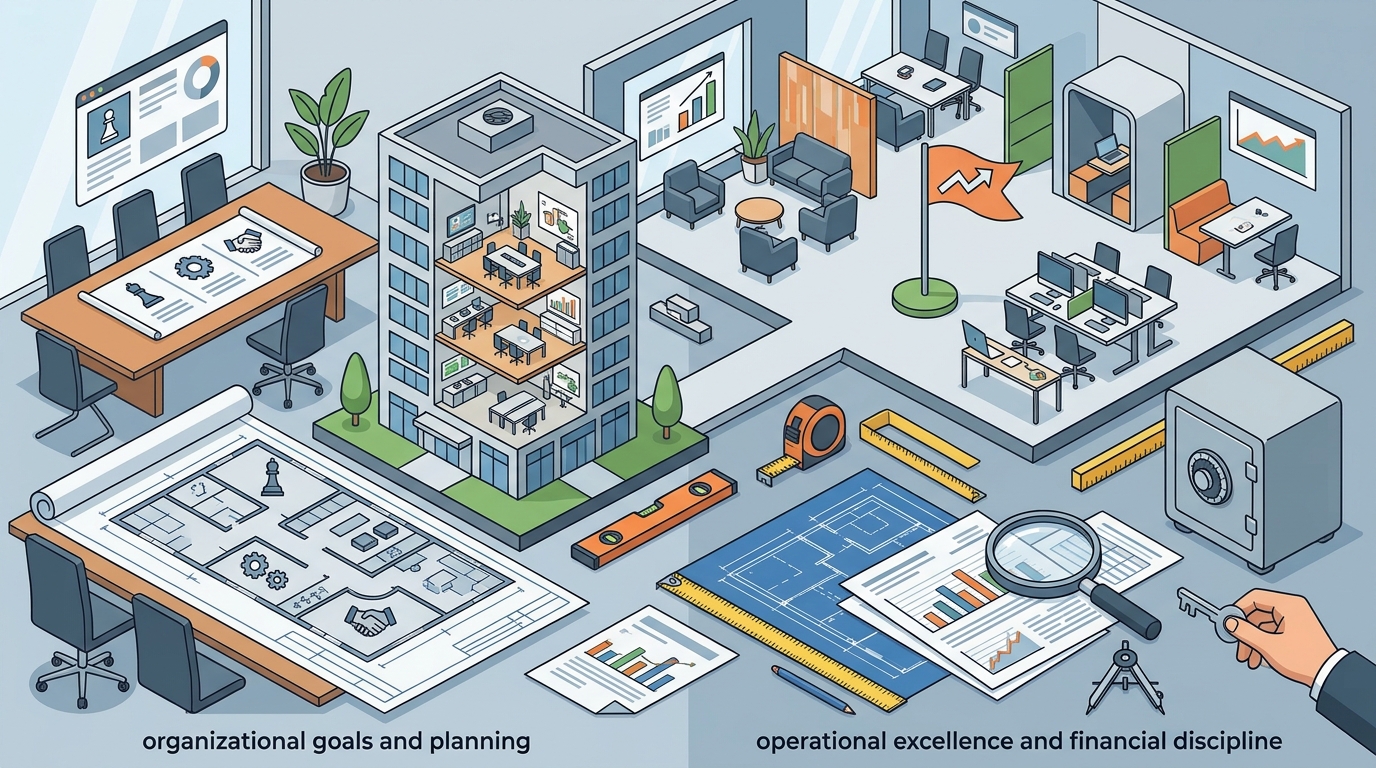
The Develop, Design, Build & Maintain Approach
Successful transformation requires a holistic approach that covers the entire lifecycle of the workplace. WIAR employs a structured methodology known as Develop, Design, Build & Maintain. This ensures that the strategy, design, construction, and ongoing management are all aligned and integrated.
Key Takeaways
- Treat the workplace as a strategic asset that drives productivity, not just a cost center.
- Apply the 75/5 Rule to understand the leverage of housing costs on talent performance.
- Choose partners who offer risk-bearing delivery to protect your budget and timeline.
- Ensure financial transparency through open-book management and independent tendering.
- Align physical space with business goals to support specific operational workflows.
- Measure success through business KPIs like sales cycle length and client engagement.
Frequently Asked Questions
What is the primary goal of workplace transformation?
The primary goal is to align the physical environment with organizational strategy to enhance productivity, employee retention, and business performance.
How does WIAR ensure projects stay within budget?
WIAR uses a risk-bearing delivery model with open-book financial management and independent tendering, guaranteeing delivery within the agreed budget.
What is the 75/5 Rule?
The 75/5 Rule states that personnel costs are typically 75% of a knowledge organization's budget, while housing is 5%, highlighting the high leverage of workplace investment.
Can a new office design improve sales performance?
Yes, as seen with BT Group, immersive showcase environments can reduce travel time, increase client visits, and shorten sales cycles.
What is the Develop, Design, Build & Maintain approach?
It is a holistic methodology that covers the entire lifecycle of workplace transformation, from strategic analysis to ongoing facility management.
How does WIAR differ from traditional contractors?
WIAR acts as a strategic advisor and risk-bearing partner, focusing on organizational performance and financial discipline rather than just construction execution.