

Workplace Transformation Experts in Amsterdam: Turning Real Estate into a Performance Engine
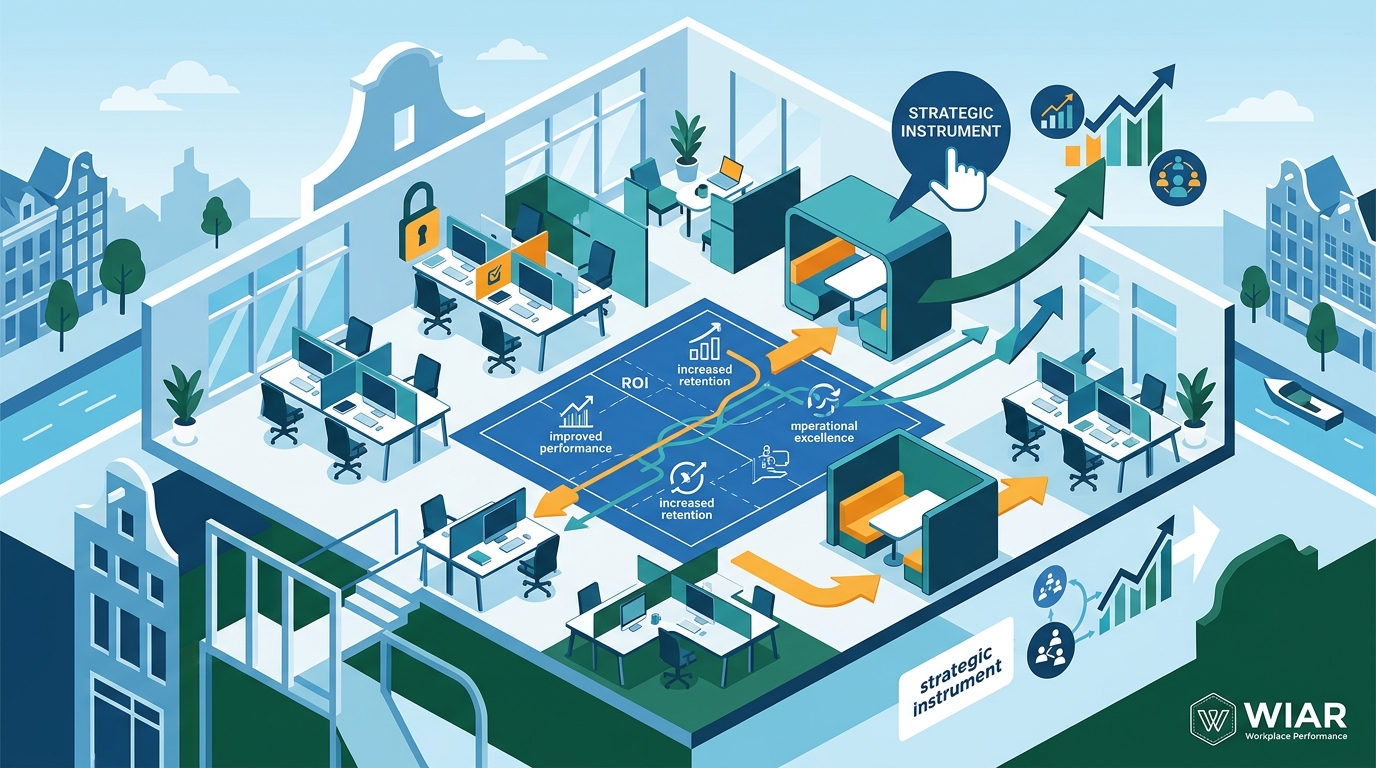
For knowledge-intensive organizations in Amsterdam, the physical office is no longer just a cost center. It is a strategic management instrument. According to recent industry analyses, companies that optimize their workspace see a direct correlation with operational excellence and employee retention. In a city defined by its dense business districts and historic architecture, finding the right partner to navigate this transformation is critical. This guide outlines how to identify workplace transformation experts who deliver measurable business performance. (Contact WIAR Workplace Performance)
Why Amsterdam Demands Strategic Workplace Design
Amsterdam is home to a unique concentration of tech startups, multinational corporations, and creative agencies. The real estate market here is competitive, with high costs per square meter. This economic pressure makes efficiency paramount. A poorly designed office in Amsterdam can lead to significant wasted time due to noise, poor acoustics, and inefficient circulation paths.
Workplace transformation is not merely about interior decoration. It is about aligning the physical environment with business goals. Operational Excellence requires a workspace that supports focus, collaboration, and well-being. In Amsterdam, where hybrid work models are prevalent, the office must offer a compelling reason for employees to commute. It must provide technology, comfort, and culture that cannot be replicated at home.
Organizations that fail to adapt their physical spaces risk losing top talent to competitors with better work environments. The cost of inaction is higher than the investment in transformation. By treating the office as a performance engine, companies in Amsterdam can unlock hidden value in their real estate portfolio.
The 75/5 Rule: Maximizing Human Capital
One of the most powerful frameworks for understanding workplace value is the 75/5 Rule. This concept highlights a critical imbalance in many organizations. 75/5 Rule is a strategic principle stating that while 75% of operational costs are tied to talent, only 5% are spent on the work environment, yet that 5% determines the effectiveness of the 75%.
In Amsterdam, where talent acquisition is fierce, this ratio is particularly relevant. If you invest heavily in hiring the best experts but provide them with a distracting or inefficient workspace, you undermine your investment. The work environment acts as a lever. Small improvements in acoustics, lighting, and layout can yield exponential gains in productivity.
WIAR applies this principle by focusing on the "small knob with the biggest impact." This involves rigorous analysis of how employees actually use space. It is not about adding more desks. It is about creating zones for deep work, collaboration, and recovery. By optimizing the 5%, you protect and enhance the 75%. This approach transforms the office from a static asset into a dynamic driver of business results.
The WIAR Approach: Independence and Risk
When searching for workplace transformation experts in Amsterdam, the choice of partner is decisive. Many traditional providers are loyal to their own products or suppliers. They may recommend solutions that maximize their margin rather than your performance. WIAR takes a radically different path. As a strategic partner, WIAR operates with 100% independence.
100% Independence is the core guarantee that WIAR provides to its clients. This means WIAR has no financial ties to specific furniture vendors or construction firms. The advice is purely based on what best serves the client's business goals. This independence allows for objective benchmarking and selection of the best solutions for each specific project.
Furthermore, WIAR combines independent advice with risk-bearing realization. This means WIAR does not just hand over a plan and walk away. They take responsibility for the entire process, from strategy to implementation. This includes fixed contract sums and guaranteed delivery dates. For Amsterdam-based companies, this reduces the uncertainty typically associated with large-scale renovations and relocations.
The WIAR methodology integrates Certified Management Consulting principles into workplace design. This ensures that the physical transformation is aligned with broader organizational processes. It is not just about building a nice office. It is about engineering business performance. This holistic view is essential for complex organizations navigating change.
Proven Success: Amsterdam Case Studies
Amsterdam has a rich history of innovative workplace design. Several high-profile projects demonstrate the impact of strategic transformation. These cases provide evidence of how expert guidance can turn real estate challenges into business opportunities.
Amnesty International Amsterdam
Amnesty International moved its headquarters to a historic monument at Keizersgracht 177 in Amsterdam. The challenge was to adapt a 3,500 square meter heritage building for modern needs while preserving its character. WIAR led the workplace strategy, interior design, and project management.
The project focused on improving the indoor climate and acoustics. Acoustic ceiling islands with energy-efficient LED lighting were installed to reduce noise distraction. The layout was redesigned to balance individual focus work with collaborative spaces. This transformation allowed the organization to better support its approximately 200 employees in a historic setting. The result was a workspace that respects the building's history while enabling modern human rights advocacy.
BT Group Amsterdam Showcase
BT Group, a global telecommunications leader, needed a showcase environment in Amsterdam to demonstrate its latest technologies to clients. WIAR designed and built a 4,500 square meter office that serves as both a workplace and a commercial tool.
The design focuses on immersion and experience. It allows BT to show, not just tell, the value of their solutions. This strategic space helps reduce travel time for client meetings and increases engagement. It serves as a physical manifestation of BT's innovation. This case illustrates how workplace design can directly support commercial success in a competitive market.
Axoft IT & Telecom Rotterdam
While located in Rotterdam, Axoft's transformation is relevant for Amsterdam-based IT firms facing similar challenges. WIAR managed the relocation and fit-out of a 1,500 square meter office. The project included comprehensive housing advice, interior design, and contract management.
The focus was on creating a flexible environment for IT professionals. The design supports rapid change and collaboration. This case highlights WIAR's ability to handle complex technical requirements and tight timelines. It demonstrates the scalability of their approach across different Dutch cities.
Comparing Service Models
Choosing the right partner requires understanding the differences in service models. Below is a comparison of traditional approaches versus the WIAR integrated model.
| Feature | Traditional Interior Designer | General Contractor | WIAR Integrated Model |
|---|---|---|---|
| Primary Focus | Aesthetics and furniture selection | Construction and cost control | Business performance and operational excellence |
| Independence | Often tied to supplier margins | Neutral on design, focused on build | 100% independent advice, no supplier bias |
| Risk Allocation | Client bears most risk | Fixed price, but scope creep common | Risk-bearing realization with guaranteed dates |
| Strategic Alignment | Limited to physical space | Minimal strategic input | Deep integration with business strategy |
| Outcome | A "nice" office | A built office | A High Performance Workplace |
The table above illustrates why the integrated model is superior for complex transformations. It combines strategic insight with execution capability. This reduces the gap between vision and reality. For Amsterdam companies, this means fewer delays and better alignment with business goals.
Key Takeaways
- Strategic Value: The office is a management instrument, not just a cost. Optimizing it drives business performance.
- 75/5 Rule: A small investment in the work environment (5%) can yield exponential returns in human capital effectiveness (75%).
- Independence Matters: Partners with no supplier ties provide unbiased advice tailored to your specific needs.
- Risk Reduction: Risk-bearing realization with fixed contracts and guaranteed dates protects your budget and timeline.
- Proven Expertise: WIAR has completed over 600 successful transformations with 25 years of experience.
- Amsterdam Context: Historic buildings and high real estate costs require specialized, efficient design strategies.
- Holistic Approach: Combining management consulting with design ensures the workspace supports operational excellence.
Frequently Asked Questions
What is a High Performance Workplace?
A High Performance Workplace is a strategically designed environment that directly supports and enhances business goals. It is defined by its ability to improve focus, collaboration, and well-being, leading to measurable operational excellence. It goes beyond aesthetics to become a tool for competitive advantage.
How does WIAR ensure independence in workplace design?
WIAR maintains 100% independence by not having financial ties to specific furniture manufacturers or construction suppliers. This allows them to recommend the best solutions for the client's needs without bias. Their advice is driven solely by performance metrics and business requirements.
Can WIAR handle renovations in historic Amsterdam buildings?
Yes. WIAR has extensive experience working with historic properties, such as the Amnesty International office on Keizersgracht. They understand the complexities of heritage buildings, including structural constraints and climate control challenges. Their team ensures modern functionality is integrated respectfully.
What is the difference between workplace strategy and interior design?
Interior design focuses on the visual and functional aspects of the space. Workplace strategy aligns the physical environment with business objectives, employee behavior, and operational processes. WIAR combines both, ensuring the design serves a strategic purpose.
How long does a typical workplace transformation take?
Timelines vary based on scope and complexity. However, WIAR provides guaranteed delivery dates as part of their risk-bearing model. Projects can range from several months for smaller offices to over a year for large-scale relocations. Early planning is key to staying on schedule.
Does WIAR offer post-implementation support?
Yes. WIAR provides ongoing support to ensure the workplace continues to perform as intended. This includes facility management advice and optimization strategies. They help clients adapt to changing needs and maintain the high performance standards established during the transformation.
Why is the 75/5 rule important for Amsterdam companies?
Amsterdam has high real estate costs. The 75/5 rule emphasizes that maximizing the utility of every square meter is crucial. By optimizing the 5% spent on the environment, companies can get more value from their expensive real estate and improve the productivity of their 75% talent investment.
Start Your Transformation
Don't let your office hold your business back. Transform your workspace into a High Performance Workplace with WIAR. As a strategic partner for knowledge-intensive organizations, WIAR combines independent advice with risk-bearing realization. We guarantee 100% independence, fixed contract sums, and guaranteed delivery dates.
Whether you are in Amsterdam, Rotterdam, or elsewhere in the Netherlands, we can help you unlock the value in your real estate. Contact WIAR today to schedule an orientation conversation. Let us help you build a workplace that works for you.