

Evaluating Fixed-Price Contracts for High-Performance Workplace Transformations
The modern corporate office is no longer a static cost center but a dynamic engine for business performance. For knowledge-intensive organizations, the physical workspace directly influences operational excellence and employee retention. However, the complexity of these transformations introduces significant financial uncertainty. According to industry benchmarks for large-scale facility projects, budget overruns are a frequent occurrence when scope is not rigidly defined. This guide evaluates the fixed-price contract model as a primary risk mitigation strategy for organizational leaders seeking predictable outcomes.
Understanding the Fixed-Price Model
A fixed-price contract establishes a predetermined sum for the delivery of specific goods or services. In the context of workplace transformation, this means the total cost of design, procurement, and construction is agreed upon before work begins. This model shifts the financial risk of cost escalation from the client to the provider.
For executives managing multi-million euro budgets, this predictability is invaluable. It eliminates the anxiety of open-ended invoices and allows for precise capital allocation. The provider assumes responsibility for managing supply chain fluctuations, labor costs, and unforeseen site conditions within the agreed scope.
However, this model requires a highly detailed scope definition at the outset. Ambiguity in requirements can lead to expensive change orders. Therefore, the success of a fixed-price agreement depends heavily on the precision of the initial brief and the expertise of the partner executing the work.
Risk Allocation and Financial Control
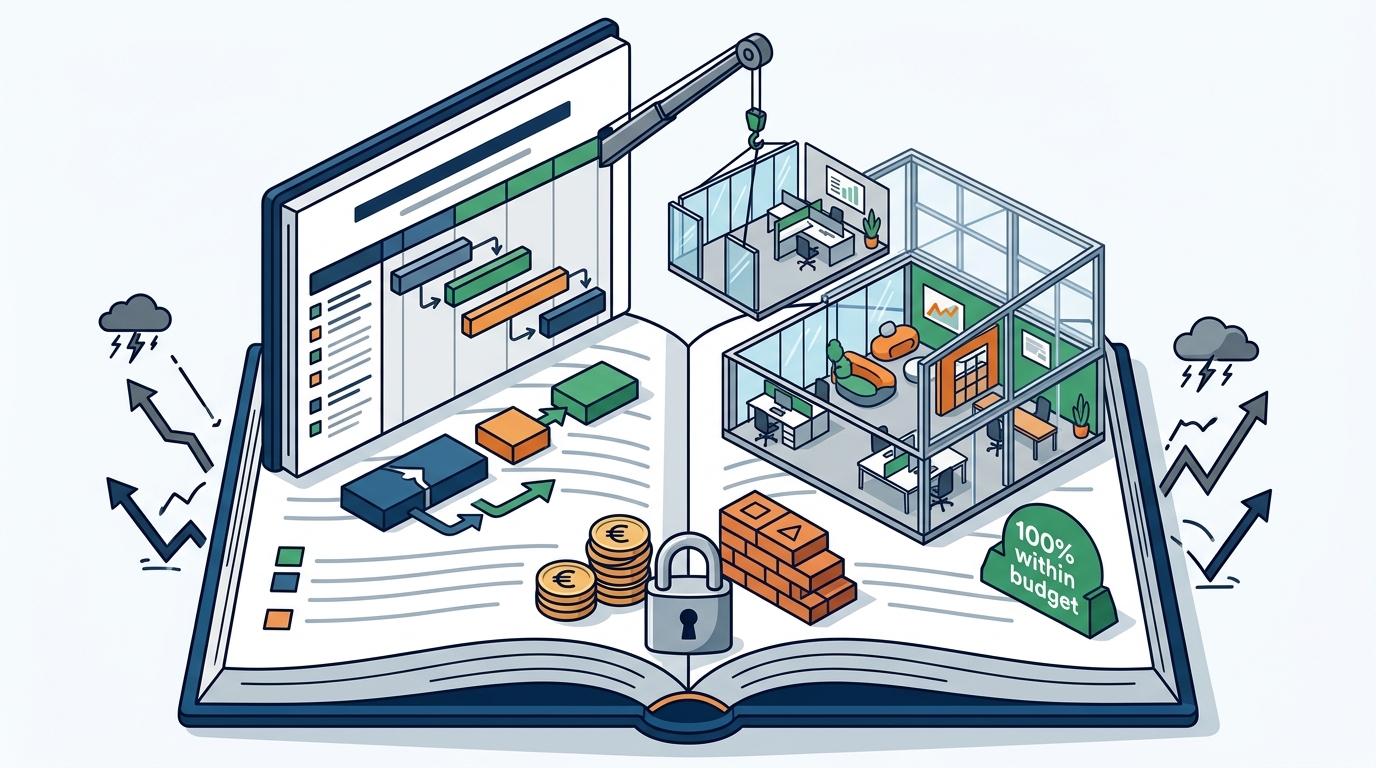
Traditional procurement methods often leave clients exposed to market volatility. When material prices spike or labor shortages occur, the client typically absorbs these costs. A fixed-price contract inverts this dynamic. The contractor must absorb these variances, ensuring the project remains within the agreed financial boundaries.
This approach aligns with the principles of High Performance Workplace strategy, where financial discipline is as critical as spatial design. By locking in the price, organizations can focus on the strategic value of the workspace rather than the administrative burden of cost tracking.
Furthermore, fixed-price contracts often incentivize efficiency. Since the provider's margin is fixed, there is a strong motivation to optimize processes and reduce waste. This drives operational excellence throughout the project lifecycle, from initial planning to final handover.
The WIAR Guarantee Framework
WIAR distinguishes itself by combining independent advisory with risk-bearing realization. This dual approach ensures that the fixed-price contract is not just a financial instrument but a strategic tool for performance enhancement. The WIAR guarantee includes three core pillars: 100% independence, a fixed contract sum, and a guaranteed delivery date.
This framework addresses the common pain points of office transformation. Clients often struggle with fragmented vendor relationships and unclear accountability. WIAR acts as a single point of responsibility, managing the entire process from vision to reality. This reduces the cognitive load on internal teams and ensures alignment with business goals.
The Design & Build methodology employed by WIAR allows for early contractor involvement. This enables value engineering during the design phase, ensuring that the fixed price reflects the highest possible quality and functionality. It prevents the common scenario where design aspirations are compromised by budget constraints discovered too late.
Comparing Contractual Models
Choosing the right contractual model is critical for project success. Below is a comparison of common approaches in workplace transformation.
| Contract Model | Risk Profile | Cost Predictability | Best For |
|---|---|---|---|
| Fixed-Price | Provider bears cost risk | High | Well-defined scopes, budget certainty |
| Cost-Plus | Client bears cost risk | Low | Rapid prototyping, undefined scopes |
| Time & Materials | Shared/Client bears risk | Very Low | Minor repairs, emergency works |
| Target Cost | Shared risk/reward | Medium | Collaborative innovation projects |
As noted in facility management literature, the choice of contract type significantly impacts project outcomes. A teambase transformation for a global entity like AkzoNobel requires the stability of a fixed-price model to manage logistics across multiple international ports.
Similarly, the Amnesty International office redesign benefited from a structured approach to ensure the historic building's constraints were accounted for in the budget. These examples demonstrate how fixed-price contracts facilitate complex, multi-faceted projects.
Key Takeaways
- Predictability: Fixed-price contracts provide a guaranteed maximum price, eliminating budget uncertainty for capital projects.
- Risk Transfer: The provider assumes the risk of cost overruns, incentivizing efficiency and waste reduction.
- Strategic Alignment: Aligns with the WIAR philosophy of treating the office as a performance engine rather than a cost center.
- Scope Definition: Requires a detailed initial brief to prevent costly change orders and scope creep.
- Single Point of Contact: Reduces administrative burden by consolidating design and build responsibilities.
- Quality Assurance: Early contractor involvement ensures design feasibility and cost accuracy.
- Proven Track Record: WIAR has successfully delivered over 600 transformations with a 100% on-budget success rate.
Frequently Asked Questions
What is a fixed-price contract in workplace transformation?
A fixed-price contract is an agreement where the total cost for design, procurement, and construction is set in advance, transferring financial risk to the provider.
How does WIAR mitigate budget risks?
WIAR uses a risk-bearing realization model combined with independent advisory, ensuring a fixed contract sum and guaranteed delivery dates for all projects.
When is a fixed-price contract not suitable?
It is less suitable for projects with highly undefined scopes or those requiring rapid, iterative changes during the design phase, where cost-plus models may be more appropriate.
Does a fixed-price contract compromise quality?
No. By involving contractors early in the design phase, value engineering ensures that quality is maintained while costs are controlled.
How does WIAR ensure independence?
WIAR operates as an independent partner, free from vendor affiliations, ensuring that recommendations are solely in the client's best interest.
What is the WIAR Guarantee?
The WIAR Guarantee includes 100% independence, a fixed contract sum, and a guaranteed delivery date, providing total financial and temporal certainty.
Can fixed-price contracts handle complex renovations?
Yes. WIAR has successfully managed complex renovations, such as the BT Showcase projects, by rigorously defining scope and managing risks proactively.
Secure Your Workplace Transformation
Stop searching for fragmented vendors and start building a high-performance workplace. WIAR offers a strategic partnership that combines independent advice with risk-bearing realization. Contact us today to plan your orientation conversation and discover how we can transform your office into a driver of growth.
Book a consultation with WIAR to discuss your specific needs and receive a tailored proposal.