

Organizations today face a critical inflection point where physical office spaces are no longer just cost centers but strategic assets. According to recent industry analyses, workplace strategy has become a primary driver for operational excellence and talent retention. Companies that fail to align their real estate portfolios with their evolving business models risk significant inefficiencies and decreased employee engagement. This guide explores how specialized advisory firms bridge the gap between corporate vision and physical execution, turning four walls into a high-performance engine. (Contact WIAR Workplace Performance)
The Shift from Cost to Strategy
For decades, corporate real estate was managed through a lens of cost reduction. Space was viewed as a necessary overhead, minimized to improve the bottom line. However, this traditional approach has proven flawed in the knowledge economy. The modern workplace is a management instrument. It dictates how information flows, how collaboration happens, and how culture is sustained. (Herinrichting BT Amsterdam BT)
Advisory firms now specialize in redefining this relationship. They help organizations understand that the physical environment directly impacts the future of work. By treating the office as a platform for performance, companies can unlock value that was previously invisible. This shift requires a partner who understands both the financial implications of real estate and the psychological needs of the workforce. (Herhuisvesting Axoft IT Telecom)
Leading consultants argue that the workplace transformation is not merely about aesthetics. It is about creating an ecosystem that supports the specific operational rhythms of the business. This involves rigorous data analysis, stakeholder engagement, and a clear roadmap for implementation.
The WIAR Difference: Independent Advisory
Many traditional real estate providers are tied to specific vendors. They may recommend furniture or construction services that benefit their own margins rather than the client's best interest. This conflict of interest can lead to suboptimal solutions that look good on paper but fail in practice. Independent advisory firms operate differently. They act as trusted advisors, guaranteeing loyalty to the client's strategic goals.
WIAR Workplace Performance exemplifies this independent approach. As a strategic partner, WIAR combines management consulting with risk-bearing realization. This means they do not just hand over a plan and walk away. They take responsibility for the entire journey from vision to reality. This model ensures that the final outcome aligns perfectly with the initial business case.
By removing the bias of vendor loyalty, independent advisors can identify the true needs of the organization. They look beyond surface-level trends to find the structural issues that hinder performance. This includes analyzing workflow inefficiencies, acoustic privacy needs, and the specific technological requirements of different teams. The result is a workspace that is tailored to the unique DNA of the company.
Core Methodology: The 75/5 Rule
A fundamental concept in workplace transformation is the culture building ratio often referred to as the 75/5 Rule. In knowledge-intensive organizations, approximately 75% of costs are attributed to talent, while only 5% is spent on the physical workplace. This disparity is misleading. The small 5% investment in the environment has a disproportionate impact on the effectiveness of the 75% talent investment. (40 Essential Thought)
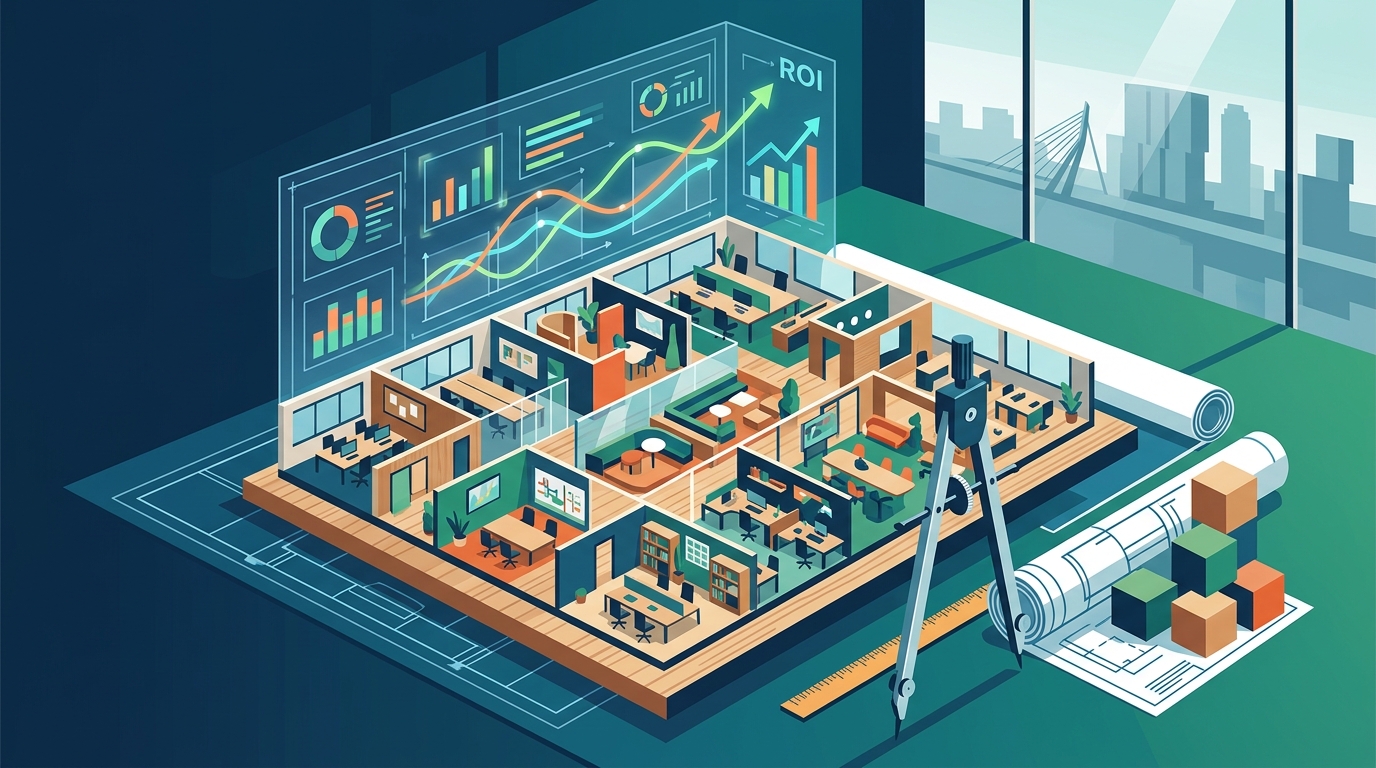
Optimizing this 5% acts as a lever for exponential gain. When the workspace is designed to reduce friction, it allows employees to focus deeper and collaborate more effectively. This leads to lower absenteeism, higher productivity, and improved well-being. Advisory firms use this principle to justify the ROI of transformation projects to executive boards.
The methodology involves a diagnostic phase where the current state is analyzed against best practices. This includes measuring space utilization, assessing the quality of the indoor environment, and evaluating the alignment of the layout with business processes. The findings are then used to create a strategic blueprint that maximizes the impact of every square meter.
Proven Transformations
Theoretical frameworks are important, but real-world application is what matters. Successful transformations share common traits: clear objectives, strong leadership support, and a focus on user experience. Let us look at how these principles have been applied in diverse sectors.
Amnesty International: Heritage and Function
Amnesty International needed to rethink its historic office in Amsterdam. The challenge was to modernize a monument while improving the working conditions for its staff. The focus was on creating a balance between concentrated work and collaboration. Acoustic improvements and flexible layouts were key to this transformation. The result was a space that respects the building's history while supporting modern advocacy work.
Axoft: IT and Telecom Relocation
For Axoft, the transformation involved a complete relocation and redesign. The goal was to create a workspace that reflected their identity as an IT and telecom provider. This required robust technical infrastructure and flexible zones for different types of work. The project demonstrated how physical space can reinforce brand identity and operational efficiency.
BT Group: Global Showcase Strategy
BT Group required a solution that could showcase their technology to clients in a tangible way. The advisory firm helped design showcase environments in Amsterdam and Brussels. These spaces are not just offices; they are interactive platforms for demonstrating innovation. This approach turns the office into a sales tool, enhancing client engagement and trust.
Advisory Models Compared
Choosing the right partner is critical. The market offers different models of engagement. Understanding the differences helps organizations make an informed decision.
| Advisory Model | Primary Focus | Pros | Cons |
|---|---|---|---|
| Vendor-Tied Consultants | Selling specific products or services | Seamless integration of recommended vendors | Potential bias; may not offer the best overall solution |
| Independent Strategy Firms | Strategic alignment and optimization | Unbiased advice; holistic view of business needs | May require more client effort in implementation |
| Design-Build Partners | End-to-end realization | Single point of responsibility; risk-bearing | Less flexibility in changing requirements mid-project |
| Hybrid Advisory (e.g., WIAR) | Strategy plus risk-bearing realization | Guaranteed outcomes; independent yet hands-on | Higher initial commitment required |
The hybrid model is gaining traction because it combines the rigor of independent strategy with the accountability of a delivery partner. This ensures that the vision is not just documented but executed with precision. Organizations benefit from a partner who is financially invested in the success of the project.
Key Takeaways
- Strategic Asset: The office is a management instrument, not just a cost center.
- Independent Advice: Unbiased advisors prioritize client goals over vendor margins.
- 75/5 Rule: A small investment in the workplace yields exponential returns in talent performance.
- Risk Sharing: Partners who bear risk are more aligned with successful outcomes.
- Customization: One size does not fit all; solutions must match organizational DNA.
- Proven Track Record: Look for firms with diverse case studies across industries.
- Full Lifecycle: The best support covers strategy, design, and realization.
Frequently Asked Questions
What is the role of a workplace transformation advisor?
A workplace transformation advisor helps organizations align their physical space with their business strategy. They analyze current operations, identify inefficiencies, and design a roadmap for change that improves performance and culture.
How do independent advisors differ from real estate brokers?
Independent advisors focus on the client's strategic needs without being tied to specific vendors. Real estate brokers primarily focus on leasing or selling properties. Advisors provide holistic solutions that include design, technology, and operational strategy.
What is the 75/5 Rule in workplace strategy?
The 75/5 Rule states that while 75% of costs are talent-related, only 5% is spent on the workplace. Optimizing this 5% can significantly enhance the effectiveness of the 75% talent investment by improving focus and collaboration.
Why is risk-bearing important in workplace projects?
Risk-bearing ensures that the partner is financially accountable for the project's success. This alignment of incentives motivates the partner to deliver on time and within budget, reducing uncertainty for the client.
Can workplace transformation improve employee retention?
Yes. A well-designed workspace that supports employee needs and reflects company values can significantly boost engagement and satisfaction. This leads to lower turnover rates and attracts top talent.
How long does a typical transformation take?
The timeline varies based on scope and complexity. Strategic planning may take a few months, while full realization can take 6 to 18 months. A clear roadmap helps manage expectations and milestones.
What industries benefit most from workplace advisory?
All industries benefit, but knowledge-intensive sectors like technology, finance, and professional services see the highest ROI. These sectors rely heavily on collaboration and innovation, which are directly supported by the physical environment.
Start Your Transformation
Ready to turn your workplace into a performance engine? Contact WIAR Workplace Performance to schedule an orientation conversation. Discover how we can help you achieve operational excellence and strategic advantage. Visit our contact page to begin the journey.