

Yes, an experienced consultant can help manage an office relocation budget—but the greatest value is not simply producing a spreadsheet. The right consultant connects organizational requirements, workplace strategy, real estate decisions, design, procurement, construction, relocation logistics, and post-occupancy performance into one controlled process.
That matters because an office move is rarely just a transport exercise. It may involve a new lease, fit-out works, technical infrastructure, furniture, employee communication, temporary accommodation, business continuity, and the disposal or reuse of existing assets. If these workstreams are managed separately, small assumptions can become expensive variations, programme delays, or an office that does not support the way people actually work.
WIAR approaches relocation as a workplace performance investment. Its role can range from strategic advisor to delegated client representative and risk-bearing delivery partner, with transparent control of budget, planning, procurement, quality, and realization. WIAR describes this integrated approach across workplace strategy, design, tendering, project management, relocation management, and facility services. ([wiar.nl](https://wiar.nl/werkplekstrategie/?utm_source=openai))
The short answer: what consultants actually control
A relocation consultant can help manage an office budget in six connected ways:
- Define the brief: establish headcount, work patterns, growth assumptions, collaboration needs, technical requirements, and service expectations before the design is priced.
- Test the space: verify that the proposed building and workplace concept can accommodate the organization without paying for unnecessary square metres or discovering late technical constraints.
- Build a complete cost plan: include design, approvals, landlord requirements, construction, building services, furniture, information technology, moving, temporary measures, professional fees, taxes where applicable, and contingency.
- Run objective procurement: compare suppliers and contractors on scope, quality, programme, risk, and price rather than accepting a vendor's preferred package.
- Control changes: document decisions, price variations before approval, maintain a live forecast, and escalate risks while there is still time to respond.
- Take accountability for delivery: where contractually appropriate, use a fixed-fee, guaranteed-maximum-price, or other risk-bearing structure so responsibilities are clear and financial exposure is not hidden.
This is different from asking a mover, furniture dealer, architect, or contractor to coordinate only its own part of the project. A relocation consultant represents the client's interests across the full chain.
Why budget control starts before design
The most important budget decisions are often made before anyone selects a finish, desk, or meeting-room chair. The organization first needs to decide what the workplace must achieve. Is the move intended to reduce occupancy cost, support hybrid work, attract scarce talent, consolidate teams, improve client experience, or create a more flexible platform for growth?
WIAR frames workplace strategy around the relationship between the physical environment and organizational performance. Its published workplace strategy material states that accommodation costs in knowledge-intensive organizations are often a relatively small share of the total budget compared with personnel costs, which is why workplace decisions should be evaluated for their effect on performance and operating efficiency—not only on rent and fit-out cost. ([wiar.nl](https://wiar.nl/werkplekstrategie/?utm_source=openai))
This does not mean that every relocation should become more expensive. It means the budget should be directed toward the conditions that matter most. For example, a professional-services firm may obtain more value from acoustic privacy, reliable video conferencing, and a varied mix of focus and collaboration settings than from a highly decorative reception area. A growing technology company may prioritize adaptable infrastructure and modular furniture over a dense fixed layout that becomes obsolete after its next recruitment cycle.
Questions to answer before requesting quotations
- How many people will the workplace support on a normal and peak day?
- Which activities require concentration, confidentiality, collaboration, or client interaction?
- What level of growth or contraction should the space accommodate?
- Which existing furniture, equipment, or finishes can be reused safely and economically?
- Which building systems, landlord approvals, sustainability requirements, or compliance issues could affect cost?
- What must be operational on day one, and what can be delivered in a later phase?
The cost architecture of an office relocation
A reliable relocation budget separates known costs, allowances, risks, and decisions still to be made. A single headline figure can create false certainty if it excludes items that sit outside the fit-out contractor's quotation.
| Cost group | Examples | How a consultant adds control |
|---|---|---|
| Real estate and occupancy | Lease-related works, deposits, landlord contributions, reinstatement, legal and technical due diligence | Tests the total occupancy case instead of comparing rent alone |
| Workplace strategy and design | Briefing, test fits, concept design, interior design, technical design, engineering, visualization, approvals | Aligns the design with measurable operational requirements before detailed pricing |
| Construction and building services | Partitions, ceilings, floors, lighting, HVAC modifications, power, data, security, fire safety, accessibility | Coordinates scope and identifies interfaces that commonly create variations |
| Furniture and specialist items | Desks, seating, storage, meeting-room technology, kitchens, acoustic elements, signage, joinery | Procures according to performance, durability, lead time, and total value |
| Relocation and continuity | Crating, transport, packing, IT cutover, temporary workspaces, phasing, employee communications | Plans the move around business continuity and operational readiness |
| Professional and project costs | Project management, surveys, permits, inspections, insurance, testing, commissioning, aftercare | Makes indirect costs visible and assigns responsibility for each deliverable |
| Contingency and risk allowances | Unknown existing conditions, market movement, late decisions, damaged assets, programme changes | Uses a documented risk register rather than an unexplained percentage |
Early procurement is particularly important for furniture, custom joinery, lighting, specialist finishes, and technical equipment. Current fit-out guidance from CBRE notes that early engagement can help identify requirements, place orders sooner, and reduce exposure to sourcing and lead-time problems. ([cbre.com](https://www.cbre.com/insights/books/global-office-fit-out-cost-guide-2022-2023/-/media/f596c6c3bdac4f228f7c68ee25fdd537.ashx?utm_source=openai))
The practical implication is simple: a consultant should not report only what has already been spent. The client should receive an up-to-date forecast of the final cost, including committed orders, approved changes, pending decisions, remaining allowances, and identified risks.
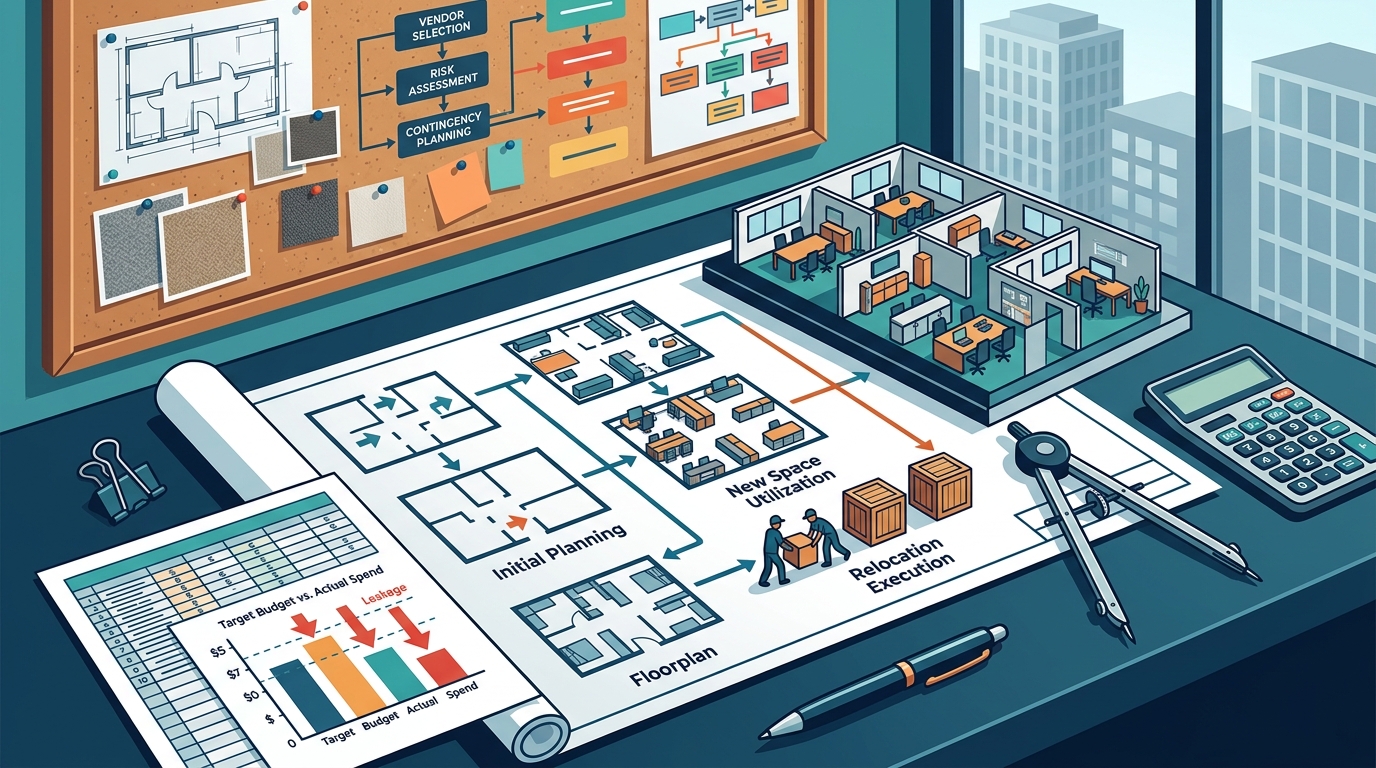
A consultant's method for preventing overruns
1. Establish a decision-ready brief
The brief converts broad ambitions such as “a modern office” into requirements that can be measured and priced. It should cover occupancy, adjacencies, privacy, meeting capacity, storage, technology, accessibility, sustainability, brand expression, employee experience, and future flexibility.
2. Compare location and layout options
A consultant can model different scenarios: refurbishing the current office, moving to a smaller or larger building, adopting more shared settings, phasing the project, or reusing existing assets. The comparison should include capital expenditure, occupancy cost, operational cost, disruption, programme, and residual value—not merely the initial fit-out quotation.
3. Test capacity and technical feasibility
Test-fit drawings and technical reviews expose issues while changes are still inexpensive. Examples include insufficient electrical capacity, inadequate cooling, restricted deliveries, fire-compartmentation constraints, landlord design standards, poor access for materials, or a meeting-room count that cannot be supported by the proposed floorplate.
4. Create a cost plan with clear assumptions
Each cost line should identify its scope, quantity basis, unit rate or allowance, owner, timing, and confidence level. This allows the leadership team to distinguish between a firm quotation and an early estimate. It also makes value engineering more intelligent: decision-makers can reduce cost by changing scope or specification rather than making arbitrary cuts late in the programme.
5. Tender packages with comparable information
Competitive tendering only creates useful evidence when bidders receive sufficiently clear and comparable information. A consultant coordinates drawings, specifications, schedules, performance requirements, exclusions, programme assumptions, and commercial conditions so that a low initial price does not simply conceal omissions.
6. Maintain a live risk and change register
Every material risk should have a probability, potential financial effect, mitigation, owner, and trigger date. Every proposed change should show its cost, time effect, quality effect, and business rationale before approval. This prevents the common pattern in which individually small changes accumulate without anyone seeing the total exposure.
7. Report in language the board can use
Senior decision-makers need more than invoices. A useful monthly report answers four questions: What has been committed? What is forecast at completion? What has changed since the previous report? Which decisions are required now? Transparent reporting makes financial discipline part of governance rather than an after-the-fact accounting exercise.
8. Commission, hand over, and review
Budget protection does not end when the furniture arrives. Defects, incomplete documentation, unresolved technical issues, and poorly configured services can create operating costs after occupancy. A consultant can coordinate snagging, commissioning, handover documentation, facility-management setup, and an early post-occupancy review.
Why independence matters in procurement
A supplier-led project can be efficient when the supplier's scope matches the client's requirements. The risk arises when the party recommending a solution also benefits commercially from selling a particular product, package, or installation method. The client may receive a technically acceptable result without knowing whether it represents the best value.
An independent advisor starts with the organization's needs and then determines which combination of reuse, repair, purchase, lease, standardization, customization, or phased delivery is appropriate. The evaluation can include purchase price, installation, maintenance, replacement cycles, warranty, ergonomics, sustainability, lead time, and compatibility with the building.
For example, the Amnesty International project illustrates how a workplace intervention can address the use of a historic Amsterdam property rather than treating relocation as a generic furniture package. Likewise, the Axoft IT & Telecom project demonstrates the importance of coordinating demolition, renovation, infrastructure, and workplace requirements in a Rotterdam setting.
Independence also improves difficult conversations. A trusted advisor can recommend removing an attractive but low-value feature, challenge an optimistic programme, reject an incomplete quotation, or advise the client to spend more on a building system that protects long-term performance.
Fixed fees, guarantees, and risk-bearing delivery
Not every project can or should be priced as a fully fixed lump sum from day one. Existing-building conditions may be uncertain, the brief may still be developing, or the client may deliberately want options during design. The commercial structure should therefore match the level of definition and risk.
Possible structures include:
- Advisory fee: suitable for strategy, feasibility, workplace analysis, or procurement support where the client retains delivery contracts.
- Fixed professional fee: useful when the advisory scope and deliverables are clearly defined.
- Open-book delivery: costs are visible, but the client retains more cost risk and must govern changes carefully.
- Guaranteed maximum price: provides an agreed ceiling subject to clearly defined assumptions, exclusions, and change procedures.
- Fixed contract sum or risk-bearing realization: the delivery partner assumes agreed risks for a defined scope, programme, and quality standard.
The benefit of a risk-bearing model is not that risk disappears. It is that risk is identified, priced, allocated, and governed explicitly. A credible guarantee should state what is included, what is excluded, how client changes are treated, how unknown conditions are handled, and what evidence is required for an adjustment.
WIAR presents risk-bearing project management as part of its integrated service model and describes the realization phase as delegated client representation with transparent control of budget, planning, and quality. ([wiar.nl](https://wiar.nl/werkplekstrategie/?utm_source=openai))
The BT Group showcase project is a relevant example of the need for coordinated financial and operational control when a workplace must support a large, complex organization across locations such as Amsterdam and Brussels. The lesson for any organization is that accountability should be designed into the delivery model, not assumed because several suppliers attend the same project meeting.
What this looks like in practice
Scenario A: a growing consultancy in Amsterdam
The company initially asks for a larger office with more meeting rooms. A consultant first analyzes attendance patterns, confidential work, client meetings, and growth. The resulting plan may reduce permanent desks while increasing high-quality project rooms and quiet settings. The capital budget is redirected from excess floor area toward acoustic treatment, technology, and adaptable furniture. The saving is not simply a lower fit-out price; it is a better match between space and work.
Scenario B: an SME moving into a technical building
The headline rent appears attractive, but a survey identifies limitations in cooling, power, delivery access, and landlord approvals. Before the lease is finalized, the consultant quantifies the required upgrades and compares them with an alternative building. The organization can then negotiate from evidence instead of discovering the technical cost after signing.
Scenario C: a charity or NGO with strict financial accountability
The organization needs a welcoming, functional workplace but must demonstrate responsible use of funds. A consultant creates a transparent cost plan, separates essential works from optional enhancements, tenders the major packages, and provides decision logs. Reuse and lifecycle value are considered alongside appearance. This approach supports both operational quality and governance requirements.
Scenario D: a corporate relocation with a fixed opening date
The business cannot tolerate an uncertain handover because the lease termination, employee communication, IT migration, and client commitments are linked to the opening date. The consultant works backward from operational readiness, orders long-lead items early, coordinates suppliers, and establishes formal change control. Where suitable, a risk-bearing contract makes responsibility for programme and cost explicit.
Office relocation budget checklist
Before appointing a consultant or approving a relocation budget, ask for evidence that the following items will be addressed:
- A written workplace and organizational brief
- Capacity analysis and test-fit options
- A building due-diligence and technical-risk review
- A cost plan divided into clear work packages
- Separate identification of committed, estimated, provisional, and contingency costs
- A procurement strategy for furniture, technology, construction, and specialist suppliers
- A tender comparison that normalizes exclusions and assumptions
- A risk register with owners and mitigation actions
- A formal variation and approval process
- A programme linked to procurement lead times and operational readiness
- Monthly reporting that shows forecast final cost, not only historical spend
- Quality inspections, commissioning, snagging, and handover procedures
- Post-occupancy review and facility-management support
For smaller organizations, the consultant's role can be scaled. A focused Workplace Performance Check or total-cost-of-ownership exercise may be enough to improve the business case before a full project team is formed. WIAR lists these types of workplace products and services alongside broader strategy, design, tendering, realization, relocation management, and facility-management support. ([wiar.nl](https://wiar.nl/en/services/?utm_source=openai))
Key takeaways
- Consultants help manage relocation budgets by controlling decisions, interfaces, procurement, risk, and change—not just by monitoring invoices.
- The best budget decisions begin with organizational requirements and workplace performance, before detailed design starts.
- A complete budget includes real estate, design, construction, technical systems, furniture, relocation, professional fees, continuity measures, and risk allowances.
- Independent procurement can reduce conflicts of interest and make reuse, specification, supplier choice, and lifecycle value easier to evaluate objectively.
- Risk-bearing or guaranteed delivery models can improve cost and programme certainty, but only when scope, assumptions, exclusions, and change rules are explicit.
- A relocation should be judged by the value it creates for people, operations, and the organization—not solely by whether the fit-out invoice is low.
Frequently asked questions
How much does an office relocation consultant cost?
There is no universal price. Fees depend on the number of locations, building complexity, project size, required design services, procurement scope, relocation logistics, and the level of delivery accountability. Ask for a defined scope, deliverables, assumptions, and fee basis. A fixed advisory fee can provide predictability during strategy and design; delivery fees may be fixed, open-book, or linked to a risk-bearing arrangement.
Can a consultant guarantee that an office move will stay within budget?
A consultant can offer a contractual cost guarantee or agreed maximum price when the scope is sufficiently defined and the contract clearly describes assumptions, exclusions, client responsibilities, unknown conditions, and change control. No responsible advisor can guarantee an undefined brief without qualification. The quality of the guarantee depends on the quality of the scope and risk allocation.
What is the difference between a relocation consultant and a project manager?
A project manager may coordinate a plan that has already been defined. A relocation consultant can work earlier and more broadly: clarifying organizational needs, evaluating locations, shaping the workplace strategy, testing capacity, managing procurement, coordinating delivery, and connecting the project to business performance. Many effective projects combine both roles, or appoint one integrated partner with the required capabilities.
Do consultants only work with large corporations?
No. The same principles apply to SMEs, professional practices, NGOs, foundations, and corporate departments. Smaller organizations may benefit especially from independent capacity because they often lack internal specialists in workplace strategy, technical due diligence, procurement, and construction governance. Large organizations may use a consultant to coordinate multiple stakeholders or provide additional client-side accountability.
How should consultants select office-relocation suppliers?
They should begin with the approved scope and evaluate suppliers against comparable criteria such as price, quality, technical compliance, programme, capacity, sustainability, warranty, service, references, and risk. The process should document exclusions and commercial assumptions. Supplier recommendations should be based on client value and project fit, not undisclosed commission or inventory pressure.
What is a High Performance Workplace?
A High Performance Workplace is an environment intentionally designed and managed to support effective work, employee well-being, collaboration, focus, flexibility, and organizational goals. It is more than attractive furniture or a new interior. It connects workplace choices with operational requirements and seeks an appropriate balance between people, work, place, technology, and cost.
Can a consultant help after the relocation?
Yes. Post-relocation support can include snagging, commissioning, facility-services setup, space-utilization reviews, employee feedback, workplace adjustments, supplier warranty coordination, and total-cost-of-ownership monitoring. This helps the organization confirm whether the new workplace is delivering the intended operational and performance benefits.
Turn relocation cost control into a strategic advantage
An office relocation budget is most reliable when one accountable team can see the whole picture: organizational needs, real estate, design, construction, furniture, technology, suppliers, programme, quality, and operational readiness.
WIAR helps organizations in the Netherlands turn workplace transformation into a controlled business investment. As an independent strategic partner, WIAR combines organizational advisory, workplace strategy, real estate expertise, design, procurement, project realization, and facility-management thinking. The result is not simply a completed move, but a workplace designed to support performance, retention, flexibility, and measurable value.
Contact WIAR to discuss your relocation objectives, budget risks, and the level of advisory or accountable delivery support your organization needs.