

Office relocations are among the most complex operational challenges a company faces, often spiraling beyond initial estimates due to unforeseen construction delays, hidden facility defects, or inefficient vendor negotiations. According to industry data on commercial real estate projects, up to 60% of organizations experience budget overruns during their first major office move. This financial leakage rarely stems from poor planning alone but rather from a lack of specialized oversight during the execution phase. For knowledge-intensive organizations, the physical workspace is not merely a cost center but a strategic engine for performance. Engaging a specialized workplace performance consultant transforms this transition from a logistical burden into a calculated investment in operational excellence. (Contact WIAR Workplace Performance)
Why Office Relocation Budgets Spiral
Most organizations approach office relocation with a standard project management mindset, treating it as a simple logistical exercise. However, the complexity of modern workplace transformations involves intricate intersections of architecture, engineering, IT infrastructure, and human resources. When internal teams manage these overlapping domains without specialized expertise, critical details are often overlooked until they become expensive change orders.
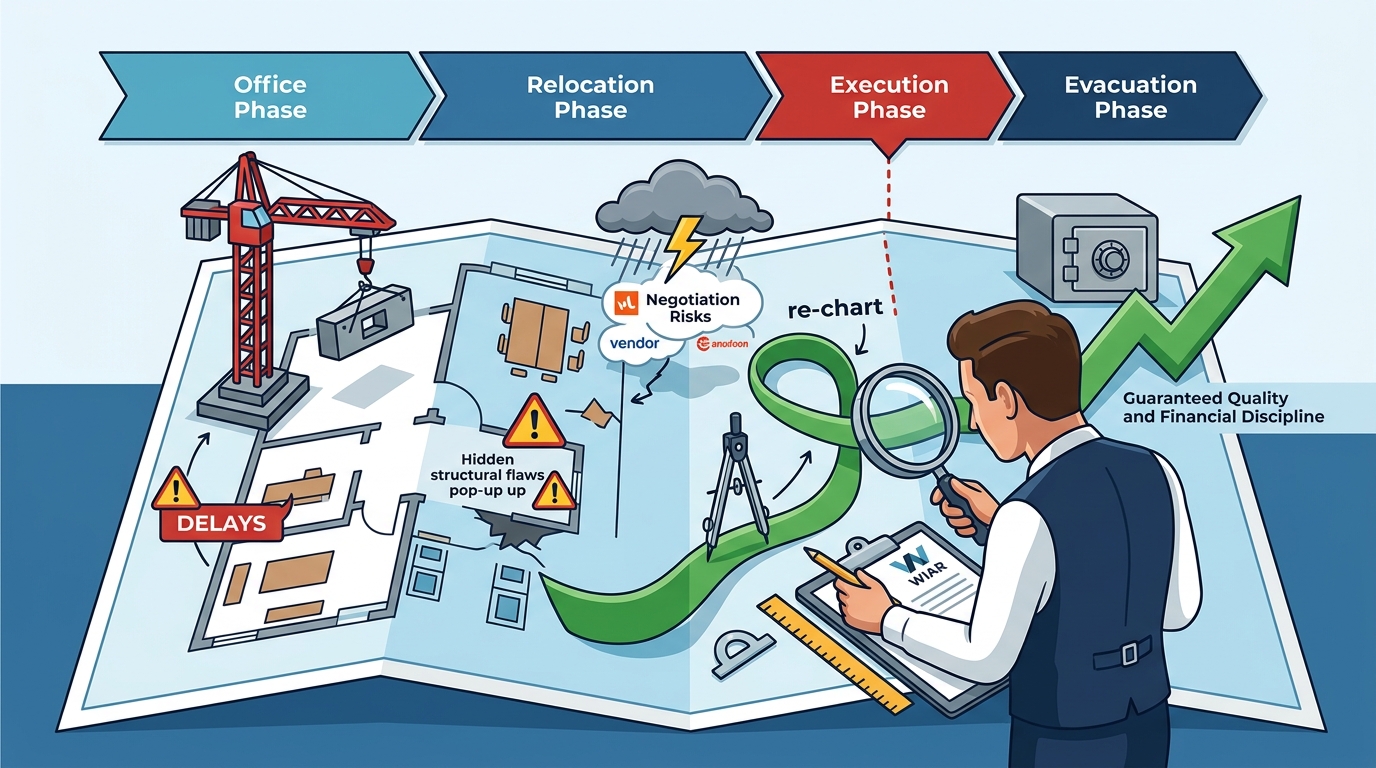
One of the primary drivers of budget inflation is the disconnect between the initial design vision and the actual construction reality. Contractors may encounter structural limitations, outdated HVAC systems, or non-compliant electrical grids that were not visible during the initial walkthrough. Without a dedicated expert to audit these conditions early, the organization absorbs the cost of remediation. Furthermore, the procurement process for furniture, lighting, and acoustic treatments often lacks the leverage that specialized consultants possess. Consultants who operate as independent advisors can negotiate better terms because they are not tied to specific vendor margins, ensuring that every euro spent contributes directly to the workspace's performance.
Another significant factor is the failure to align the physical space with the organization's strategic goals. A generic office layout may reduce upfront costs but fail to support the specific workflows of the team. This misalignment leads to secondary costs, such as increased employee turnover, lower productivity, and the need for future renovations. By treating the office as a management instrument rather than a static asset, organizations can prevent these long-term financial drains.
The Strategic Role of a Workplace Consultant
A workplace performance consultant acts as a trusted advisor, bridging the gap between strategic vision and physical realization. Unlike traditional architects or interior designers who may be loyal to their own product lines, an independent consultant is loyal solely to the client's interests. This independence is crucial for budget management because it eliminates conflicts of interest. The consultant's goal is to optimize the return on investment for every square meter of the new space.
The consultant's involvement begins with a comprehensive diagnostic phase. They analyze how the current workforce utilizes space, identifying inefficiencies and bottlenecks. This data-driven approach informs the new layout, ensuring that the design supports actual work patterns rather than theoretical ideals. For example, if data shows that 75% of the workforce requires deep focus time, the consultant will prioritize acoustic zoning and private work pods over open-plan areas that might seem cheaper to build but costly in terms of lost productivity.
During the design and procurement phases, the consultant manages the tender process. They evaluate multiple vendors based on technical specifications and cost-effectiveness, rather than brand preference. This rigorous selection process ensures that the organization receives high-quality materials and services at competitive rates. The consultant also oversees the contract management, ensuring that all parties adhere to the agreed-upon timelines and quality standards. This oversight prevents the common pitfall of scope creep, where small, unmanaged changes accumulate into significant budget overruns.
Risk Management and Fixed-Price Guarantees
One of the most compelling reasons to engage a consultant for office relocation is the ability to transfer risk. Traditional project management often leaves the client exposed to unforeseen costs. In contrast, a specialized consultant can offer a fixed-price contract or a guaranteed maximum price (GMP). This financial structure provides certainty, allowing the finance team to allocate resources with confidence.
The consultant assumes responsibility for the entire trajectory, from the initial strategic blueprint to the final handover. This end-to-end accountability means that any errors in design, coordination, or execution are managed by the consultant, not the client. For instance, if a contractor delays the installation of critical IT infrastructure, the consultant coordinates the resolution without passing the penalty costs to the organization. This risk transfer is a key component of the WIAR guarantee, which promises 100% independence, fixed contract sums, and guaranteed delivery dates.
Furthermore, consultants conduct rigorous pre-construction audits. They identify potential structural, mechanical, or electrical issues before construction begins. By addressing these issues in the planning phase, the organization avoids costly change orders during construction. This proactive approach not only protects the budget but also ensures that the project stays on schedule. The result is a predictable, controlled process that delivers the desired outcome without financial surprises.
Optimizing Value Through the 75/5 Rule
The financial impact of office design is often misunderstood. In knowledge-intensive organizations, approximately 75% of operational costs are attributed to talent, while only about 5% is allocated to the physical workspace. However, that small 5% investment has a disproportionate impact on the effectiveness of the 75% talent cost. This concept, known as the 75/5 Rule, highlights the leverage effect of workplace optimization.
By strategically optimizing the workspace, consultants unlock the full potential of the workforce. A well-designed environment reduces stress, enhances concentration, and streamlines collaboration. These improvements translate directly into lower absenteeism, higher productivity, and reduced recruitment costs. For example, improving indoor air quality and acoustic comfort can significantly reduce sick leave rates, which are a major component of operational expenses. The consultant's role is to quantify these benefits and justify the initial investment in high-quality design and materials.
Consultants also focus on sustainability and energy efficiency. Modern office buildings consume vast amounts of energy, and inefficient systems can lead to high utility bills. By specifying energy-efficient lighting, HVAC systems, and smart building technologies, consultants help organizations reduce their long-term operational costs. This approach aligns financial savings with corporate social responsibility goals, creating a win-win scenario for the business and the environment.
Real-World Relocation Success Stories
Examining specific cases illustrates how consultants manage budgets and deliver value. The relocation of Axoft IT & Telecom to Rotterdam is a prime example. WIAR managed the entire process, from housing advice and interior design to project and contract management. By overseeing the demolition, renovation, and fit-out of the 1,500 square meter space, WIAR ensured that the project was completed on time and within budget. The result was a high-performance workspace that supported Axoft's technical operations and employee well-being.
Another notable case is the redesign of the Amnesty International office in Amsterdam. Located in a historic building on the Keizersgracht, the project required careful navigation of preservation regulations and structural limitations. WIAR conducted a thorough analysis of how the 200 employees used the space and designed a new layout that balanced focused work with collaboration. The installation of acoustic ceiling islands and energy-efficient LED lighting improved the working environment while reducing energy costs. This case demonstrates how consultants can deliver significant value even in complex, constrained environments.
The BT Group showcase in Amsterdam and Brussels further highlights the strategic impact of consultant-led relocations. WIAR designed and built a showcase environment that allowed BT to demonstrate its latest technologies to clients. This physical space became a powerful sales tool, enhancing customer engagement and driving commercial success. The project managed a total area of 6,000 square meters across two locations, showcasing the consultant's ability to handle large-scale, multi-site transformations.
| Client | Project Scope | Key Consultant Intervention | Outcome |
|---|---|---|---|
| Axoft | 1,500 m² Relocation | Full Project & Contract Management | On-time delivery, optimized IT infrastructure |
| Amnesty International | 3,500 m² Renovation | Acoustic & Climate Upgrading | Improved focus, reduced energy costs |
| BT Group | 6,000 m² Showcase | Design & Build Strategy | Enhanced client engagement, sales support |
Key Takeaways
- Risk Transfer: Consultants offer fixed-price guarantees, shielding organizations from construction overruns and delays.
- Independence: Independent advisors prioritize client interests over vendor margins, ensuring cost-effective procurement.
- Strategic Alignment: Workplace design is linked to talent performance, optimizing the 75% talent cost through the 5% workspace investment.
- Proactive Auditing: Early identification of structural and technical issues prevents costly change orders during construction.
- Operational Excellence: Consultants manage the entire lifecycle, from strategic blueprint to final handover, ensuring quality and timeline adherence.
- Sustainability: Energy-efficient specifications reduce long-term utility costs and support corporate social responsibility goals.
- Proven Track Record: WIAR has completed over 600 successful transformations, demonstrating consistent delivery within budget.
Frequently Asked Questions
How does a consultant prevent budget overruns?
Consultants prevent overruns by conducting rigorous pre-construction audits, managing the tender process to secure competitive vendor rates, and enforcing strict contract management to avoid scope creep.
Is it cheaper to manage an office move internally?
While internal management may seem cost-effective initially, it often leads to hidden costs from inefficiencies, poor vendor negotiations, and unforeseen construction issues. Consultants provide a fixed-price guarantee that offers greater financial certainty.
What is the 75/5 Rule in workplace design?
The 75/5 Rule states that while only 5% of operational costs are spent on the workspace, this investment significantly impacts the effectiveness of the 75% of costs related to talent, making it a high-leverage area for optimization.
Can consultants help with historic building renovations?
Yes, consultants like WIAR have extensive experience navigating the complexities of historic buildings, such as the Amnesty International project, ensuring compliance with preservation regulations while delivering modern performance standards.
How do consultants ensure vendor neutrality?
Independent consultants are not tied to specific product lines or vendor margins. They evaluate all options based on technical merit and cost-effectiveness, ensuring that the client receives the best value for their investment.
What is the role of a workplace performance consultant?
A workplace performance consultant acts as a trusted advisor, bridging the gap between strategic business goals and physical workspace realization, ensuring that the office serves as a performance engine for the organization.
Do consultants manage the entire relocation process?
Yes, comprehensive consultants manage the entire trajectory, from initial strategic planning and design to procurement, construction oversight, and final handover, providing end-to-end accountability.
Start Your Strategic Relocation
Stop treating your office relocation as a logistical burden and start viewing it as a strategic opportunity. By engaging a specialized workplace performance consultant, you can transform your workspace into a high-performance engine that drives operational excellence and financial efficiency. WIAR offers a unique approach that combines independent advice with risk-bearing realization, ensuring your project is delivered on time, within budget, and to the highest quality standards. Contact WIAR today to schedule an orientation conversation and discover how we can help you unlock the full potential of your new workspace.