
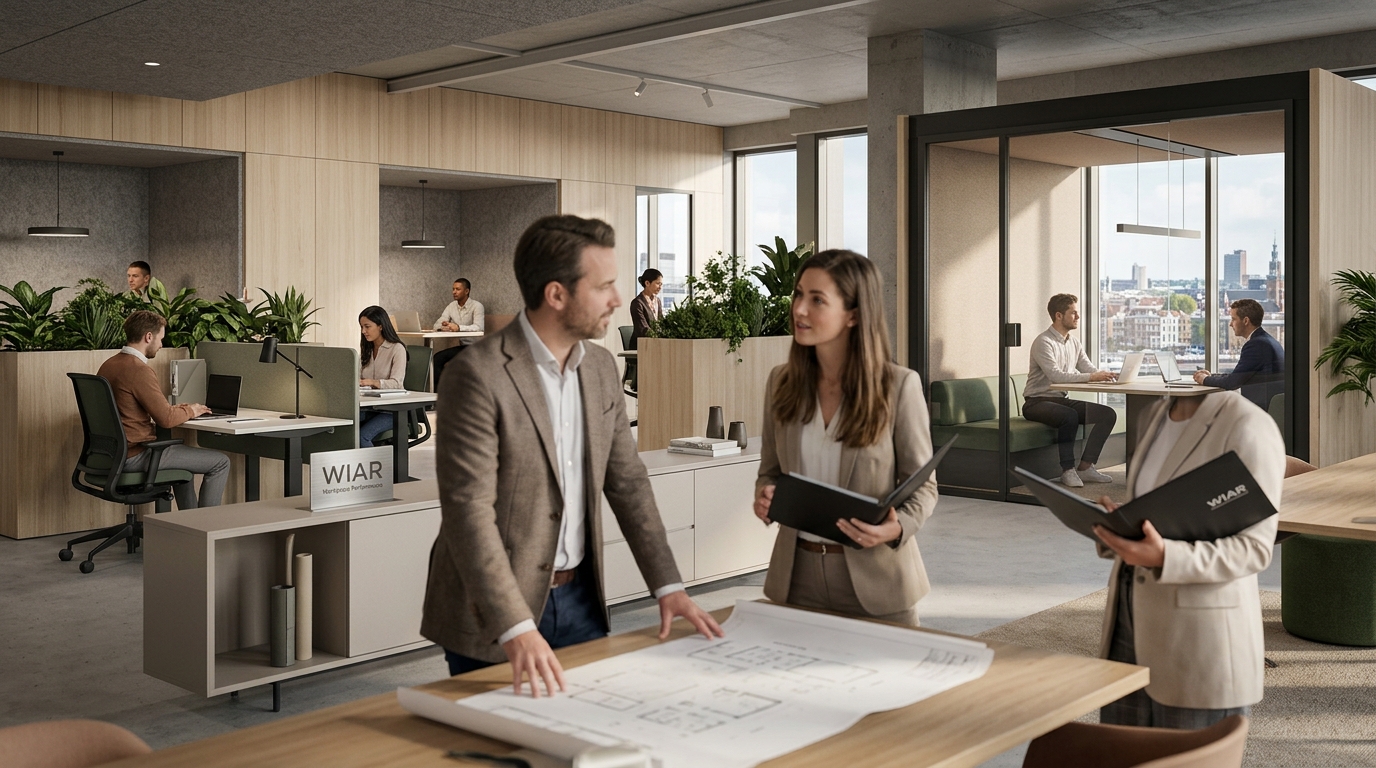
Your office is more than desks and walls. It is a strategic asset that directly shapes employee productivity, retention, and your bottom line. According to the Leesman Index, the average workplace experience score rose from 64.3 in 2019 to 69.5 by 2024, yet the average home experience score still sits 10 points higher at 79.5. That gap represents a clear opportunity. In this guide, we walk through proven steps to transform your office work environment into a high-performance workplace, backed by research and real-world advisory experience from firms like WIAR Workplace Performance.
Why Your Office Environment Matters More Than Ever
Research shows that each one-unit increase in employee happiness (on a 0-to-10 scale) leads to a 12% increase in productivity. Meanwhile, 43% of office workers currently report feeling burned out at work. These numbers make one thing clear: how you shape the physical workspace has a direct, measurable effect on business results.
A workplace strategy is the dynamic alignment of an organisation's work patterns with the work environment to enable peak performance and reduce costs. When done well, it turns square metres into a competitive advantage rather than a line-item expense.
Step 1: Assess Organisational Needs First
Improving an office environment starts long before choosing furniture or paint colours. It starts with understanding your people. A thorough organisational needs assessment examines how teams collaborate, where bottlenecks form, and what activities employees actually perform daily.
Use Data, Not Assumptions
The Leesman Index has surveyed more than 1.5 million employees across 122 countries, providing robust benchmarks for workplace effectiveness. Tools like these help identify which features employees value most. Chairs, desks, and monitors rank as the three most important workplace features, yet roughly one in four employees remains dissatisfied with them.
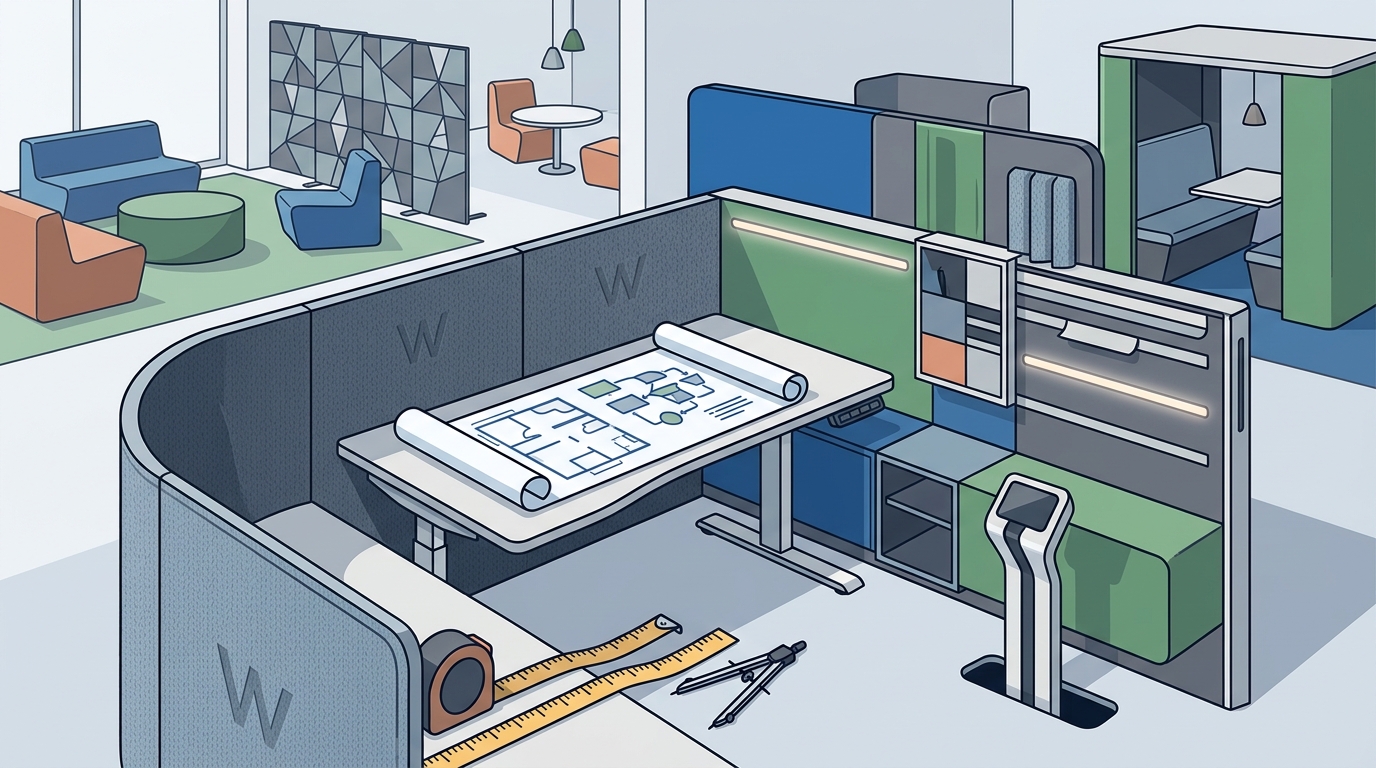
Engage a Trusted Advisor
An independent advisory partner brings objectivity. WIAR's team combines over 25 years of experience in organisational development, housing advisory, and project management. Their approach begins with inventorying and analysing the current situation before any design decisions are made.
Step 2: Develop a Workplace Strategy
Workplace strategy is the bridge between organisational goals and physical space. It addresses questions such as: Do we have too much space, too little, or the wrong kind? Are we preparing for a merger, a lease break, or a culture shift?
A strong strategy connects real estate decisions to business performance. WIAR operates at the intersection of organisational change and workplace transformation, helping clients from listed companies to NGOs turn workspace into a performance driver rather than a cost centre.
Step 3: Design for Activity-Based Work
Activity-based working (ABW) is a design approach where employees choose settings that best suit each task, such as focus pods for deep work, open zones for collaboration, and informal areas for social interaction. Research published in the Journal of Management confirms that combining individual non-territoriality (unassigned seating) with group-level territoriality enhances both privacy and team cohesion.
| Workspace Type | Best For | Key Benefit |
|---|---|---|
| Focus pods / quiet rooms | Individual deep work | Reduces noise distraction by up to 30% |
| Open collaboration zones | Team brainstorming | Increases spontaneous knowledge sharing |
| Informal lounge areas | Social interaction | Strengthens culture and sense of belonging |
| Bookable meeting rooms | Formal client and team meetings | Supports scheduled hybrid collaboration |
| Home workspace (ergonomic) | Concentrated solo tasks | Higher perceived productivity (79.5 Lmi avg.) |
WIAR has even developed an award-winning, patented ergonomic home-office solution that received the Prix de Innovation in Paris, ensuring compliance with Dutch occupational health (Arbo) standards at home.
Step 4: Prioritise Acoustics and Wellbeing
Sound management is one of the most underestimated factors in office design. Only about 32% of workers report satisfaction with office noise levels, making acoustics one of the lowest-rated workplace attributes. When environmental sound exceeds 50 decibels, each 10-decibel increase correlates with a 1.9% drop in physiological wellbeing.
Wellbeing Beyond Ergonomics
According to the Leesman Index, around 65% of employees feel their workplace supports their wellbeing. That means 35% do not. Energy management, recovery spaces, and movement opportunities are becoming critical components of workplace performance, especially for older employee cohorts where satisfaction scores decline steadily with age.
Step 5: Optimise for Hybrid Work
Hybrid working is the dominant model in 2025. A Leesman survey of senior executives found that 97% report their workforce now operates in a hybrid model, up from 57% in 2021. The challenge is making the office compelling enough to draw people in.
A Spatial Programme of Requirements (Ruimtelijk Programma van Eisen) is a tailored report that analyses the relationship between people, work, and environment in the context of hybrid working. WIAR developed this tool to help organisations future-proof their workplaces with data rather than guesswork.
Location Strategy
Where your office sits matters. Transit-oriented locations, particularly station-based office hubs in the Netherlands, offer superior accessibility, shorter commutes, and a richer mix of amenities. Leesman research shows commute satisfaction reaches 92% when journeys last under 15 minutes, dropping to just 35% for commutes over two hours.
Step 6: Execute with Financial Discipline
Even the best strategy fails without disciplined execution. Project delivery for workplace transformations should include transparent budget planning, competitive vendor tendering, rigorous cost control, and quality assurance at every milestone.
WIAR's Design/Build formula guarantees delivery for a fixed price, on time, and in accordance with agreed quality. The construction manager proactively monitors the project while the client retains influence, and the project concludes with clear revision documents, service contracts, and maintenance instructions. This risk-bearing, accountable approach mirrors the discipline of top-tier management consultancies, applied specifically to workplace projects.
Key Takeaways
- Office environments directly impact productivity, with research linking employee happiness to a 12% output increase per unit on a 10-point scale.
- Always start with an organisational needs assessment before making spatial decisions.
- Workplace strategy aligns space with business goals, turning real estate into a strategic asset.
- Activity-based design supports both focused work and collaboration within the same office.
- Acoustic comfort is critically underserved: only 32% of employees are satisfied with noise levels.
- Hybrid readiness requires data-driven spatial planning, not assumptions about desk ratios.
- Disciplined project delivery with fixed-price guarantees protects budgets and timelines.
Frequently Asked Questions
What is the most impactful change I can make to my office environment?
Start with an organisational needs assessment to identify your biggest gaps. Often, improving acoustics and providing a variety of work settings (focus, collaboration, social) delivers the fastest ROI.
How does workplace strategy differ from interior design?
Interior design focuses on aesthetics and spatial layout. Workplace strategy is a broader discipline that aligns work patterns, organisational goals, and real estate decisions to drive measurable business outcomes.
What is the Leesman Index?
The Leesman Index is a global benchmark that measures how effectively a workplace supports its employees. It has surveyed over 1.5 million people in 122 countries and uses an Lmi score to rate workplace effectiveness.
How do I make the office attractive for hybrid workers?
Focus on what the office does better than home: informal social interaction, collaborative creative work, hosting visitors, and learning from colleagues. Make these activities easy and enjoyable with purpose-built spaces.
What role does acoustics play in office productivity?
Sound quality is one of the lowest-rated workplace attributes globally. Investing in acoustic zoning, sound-absorbing materials, and quiet rooms can significantly boost focus and reduce stress.
How long does a workplace transformation project typically take?
Timelines vary by scope, but a full transformation, from needs assessment through design, tendering, and build, typically takes six to twelve months for a mid-sized organisation.
Can a small advisory firm handle large corporate projects?
Yes. Independent firms like WIAR have served clients ranging from listed multinationals to NGOs, offering the same rigour as large consultancies with greater flexibility and personal accountability.
What is an activity-based workplace?
An activity-based workplace is an office designed around task types rather than assigned desks, giving employees the freedom to choose the setting that best supports their current activity.
Ready to Transform Your Workplace?
If you want to turn your office into a strategic asset that attracts talent, boosts productivity, and delivers measurable ROI, start with a conversation. Contact WIAR Workplace Performance for an independent assessment of your current work environment and a roadmap to a high-performance future.