

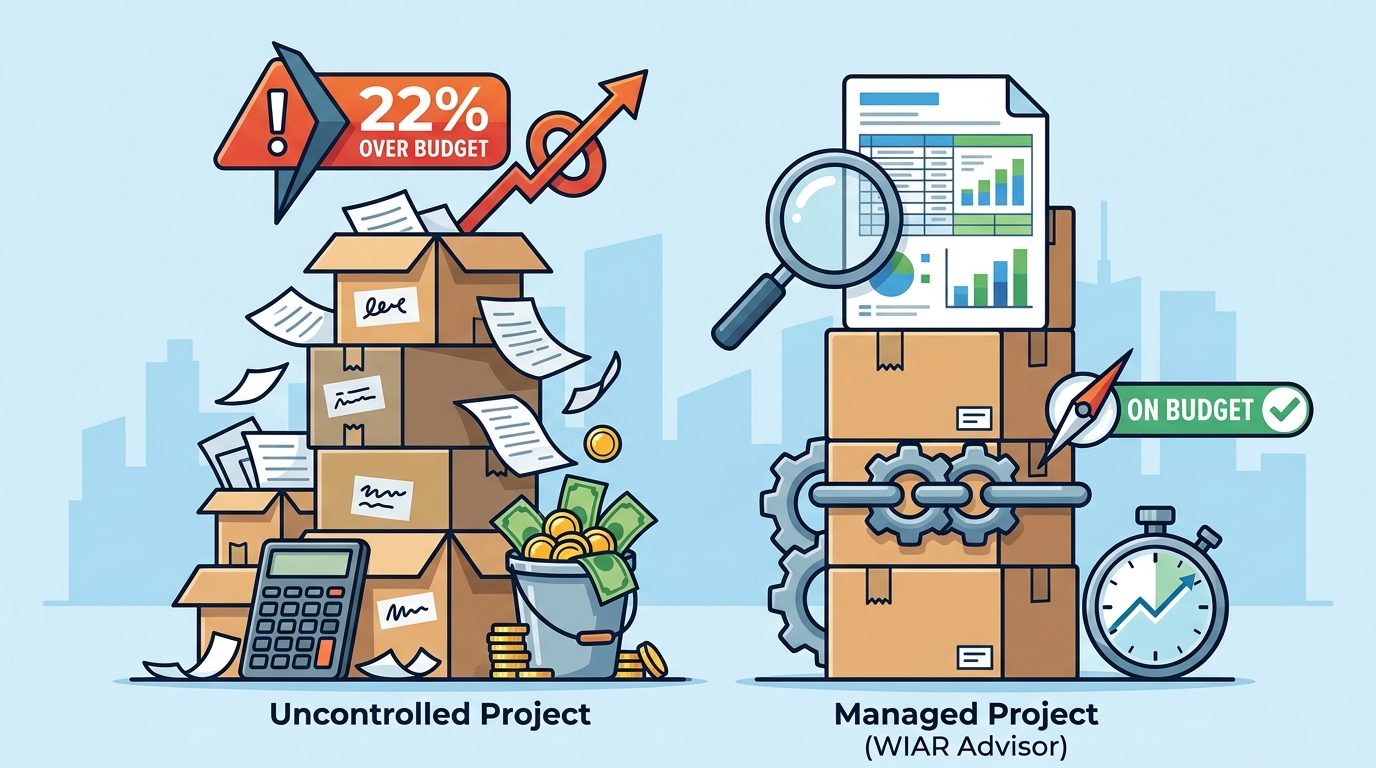
An office relocation is one of the largest capital investments a company can make, yet most organizations lack the in-house expertise to control costs effectively. The average office move exceeds its original budget by 22%, according to industry research. That gap between planned and actual spend is where a trusted advisory consultant makes the difference. By bringing organizational insight, financial discipline, and end-to-end project oversight, a workplace consultant transforms a chaotic relocation into a controlled, transparent process with measurable outcomes. Below, we explore exactly how advisory consultants protect your relocation budget and why this matters for long-term business performance.
Why Office Relocation Budgets Fail
Budget overruns during office moves are remarkably common. Research shows that the average cost overrun for construction and fit-out projects is 22%, and office relocations follow the same pattern. Hidden costs, withheld contractor charges, and underestimated management time are the primary culprits.
Without structured project management, relocations become chaotic, expensive, and disruptive. Scope creep, missed deadlines that trigger lease penalties, and emergency vendor replacements quickly compound the financial damage. Organizations that attempt to manage relocations internally often underestimate the sheer complexity involved.
The Hidden Cost of Management Time
One of the biggest overlooked expenses is the time your leadership team spends on oversight, meetings, and decision-making. A relocation consultant absorbs this burden so your executives can focus on core business operations.
What a Workplace Consultant Actually Does
A workplace consultant is an independent advisor who manages the strategic, financial, and operational dimensions of an office relocation on your behalf. Unlike a moving company or interior contractor, a consultant operates at the organizational level, aligning your workspace transition with broader business goals.
Key responsibilities include organizational needs assessment, real estate evaluation, interior design coordination, vendor tendering, and post-move facility management. The best consultants act as a trusted advisory partner rather than a transactional supplier, providing risk-bearing accountability from concept through handover.
Advisory vs. Contractor: A Critical Distinction
A relocation advisory consultant is a strategic partner who remains independent from suppliers and contractors. This independence ensures that every recommendation serves your interests, not a vendor's margin. Firms like WIAR Workplace Performance are fully independent of the supply side, including real estate, construction, furnishing, and facility services.
Key Budget Areas Consultants Control
Office relocation budgets contain multiple cost categories that require specialist oversight. The table below summarizes major budget areas and typical cost ranges.
| Budget Category | Typical Cost Range | % of Total Budget |
|---|---|---|
| Professional moving services | €1 - €2 per sq ft | 15 - 20% |
| IT infrastructure relocation | €200 - €400 per workstation | 20 - 25% |
| Furniture and space planning | €500 - €1,000 per employee | 10 - 15% |
| Tenant build-out / fit-out | €10 - €50 per sq ft | 20 - 30% |
| Contingency reserve | N/A | 10 - 15% |
| Project management fees | Varies by scope | 10 - 15% |
According to industry statistics, about 20-25% of relocation budgets go toward IT infrastructure alone. Without expert oversight, these costs routinely spiral.
Proven Cost Savings and ROI
Hiring a professional relocation consultant typically adds 10-15% to your overall budget, but it consistently prevents far larger overruns. According to relocation project management data, even smaller projects typically see 10-20% cost savings through better vendor negotiations, mistake avoidance, and schedule discipline.
The return on investment comes from multiple channels: reduced employee downtime, prevention of equipment damage, efficient vendor coordination, and avoiding expensive emergency solutions. Companies that allow at least 12 months for planning report 31% higher satisfaction ratings.
Purchasing Power Through Tendering
An independent consultant leverages competitive tendering to guarantee maximum market value. By managing procurement and contract oversight, they ensure transparent pricing and prevent the withheld costs that commonly plague direct contractor relationships.
How to Choose the Right Advisory Partner
Not all relocation consultants are equal. Look for these essential qualities when selecting a partner:
- Independence: The consultant should have no financial ties to vendors or contractors.
- Risk-bearing accountability: They should be willing to take financial responsibility for delivery, similar to how top management consultancies operate.
- Organizational expertise: Beyond logistics, they should understand change management, workplace strategy, and employee engagement.
- Transparent financial reporting: Demand open-book budgeting with no surprises.
- Proven track record: Look for experience across listed companies, SMEs, and NGOs.
Experts recommend allocating 10-15% of the total budget for contingency and involving your finance team from day one to evaluate cash flow impact.
The WIAR Approach to Relocation Budget Management
WIAR Workplace Performance is an independent advisory and management consultancy based in the Netherlands, operating since 2005. WIAR specializes in turning work environments into strategic assets that improve performance, retention, and business results with measurable ROI.
What sets WIAR apart is its integrated approach from concept to aftercare. WIAR manages finances, quality, and progress throughout the entire implementation phase, operating under a "no secrets, no surprises" philosophy. Their facility management team takes over complete risk and liability for delivering required services, allowing clients to focus entirely on their core business.
WIAR's client portfolio includes listed multinationals, large SMEs, and charitable organizations. From BT Group to Norwegian energy firms and cancer foundations, WIAR has delivered relocation, remodelling, and workplace transformation projects with guaranteed financial discipline. Their Design/Build formula guarantees delivery for a fixed price, on time, and at agreed quality.
Key Takeaways
- Office relocations commonly exceed budgets by 22% without professional oversight.
- A workplace consultant is a strategic advisor who controls costs, timelines, and quality across every phase.
- IT infrastructure alone consumes 20-25% of a typical relocation budget.
- Professional project management delivers 10-20% cost savings on average.
- Independence from suppliers is critical; your consultant should have no vendor ties.
- Risk-bearing accountability separates true advisory firms from standard contractors.
- Planning at least 12 months ahead leads to 31% higher satisfaction.
Frequently Asked Questions
Can a consultant really save money on an office relocation?
Yes. Professional project management typically generates 10-20% cost savings through competitive tendering, vendor negotiation, and proactive risk mitigation. These savings usually exceed the consultant's fees.
What is the average cost overrun for an office move?
Industry data indicates that the average cost overrun for office fit-out and relocation projects is approximately 22%. Hidden costs, contractor variations, and scope creep are the main drivers.
How early should we engage a relocation consultant?
Ideally 9-12 months before your target move date for large offices. Research shows companies that plan at least 12 months ahead report 31% higher satisfaction with the outcome.
What is the difference between a relocation consultant and a moving company?
A moving company handles physical logistics like packing and transport. A relocation consultant is a strategic advisor who manages the entire project lifecycle, including organizational assessment, budgeting, design, tendering, and post-move management.
Should the consultant be independent from contractors?
Absolutely. An independent consultant ensures every recommendation serves your financial interests. Firms tied to specific suppliers may steer decisions toward their own margins rather than your budget.
What does risk-bearing project management mean?
Risk-bearing project management is a delivery model where the consultant accepts financial accountability for the project outcome. This means they guarantee delivery within the agreed budget, timeline, and quality standards, absorbing risk rather than passing it to you.
How much does a relocation consultant cost?
Consultant fees typically add 10-15% to the overall project budget. However, this investment routinely prevents overruns of 20% or more, making it a net positive for most organizations.
Take Control of Your Next Office Relocation
Do not leave your relocation budget to chance. Contact WIAR Workplace Performance for a no-obligation consultation on how independent advisory and risk-bearing project management can protect your investment, control your costs, and deliver a workspace that drives real business results.