

When an organisation decides to overhaul its work environment, the project rarely stays neatly inside a single discipline. You need strategic thinking about how people work, hard-nosed real estate planning, compelling interior design, and rigorous project delivery — all aligned to a single business case. Below is an in-depth look at the different types of advisory firms that operate in this space, plus concrete examples of who does what and how to choose the right partner.
Why Workplace Transformation Needs More Than One Skill Set
A workplace transformation touches every layer of an organisation: culture, technology, space allocation, lease terms, furniture procurement, and change management. Treating it as a pure real estate deal ignores the human factors; treating it as pure design ignores the financial and operational realities. The most successful projects blend organisational advisory, real estate expertise, and design capability under a single accountability model — where someone owns the outcome, not just a deliverable.
Organisations in the Netherlands — especially knowledge-intensive companies in the Randstad region — are under pressure to turn office space into a competitive advantage. Hybrid work, talent shortages, and rising energy costs make it essential to get this right first time.
Five Categories of Advisory Firms
The market for workplace advice is broad. Below are five distinct firm types, each with different strengths, limitations, and examples.
1. Global Real Estate Advisors
Large international real estate services companies offer workplace strategy as part of a wider portfolio of property services. They excel at data-driven portfolio optimisation and have global benchmarking databases.
CBRE
CBRE is one of the largest commercial real estate firms worldwide. In the Netherlands it has a significant presence, with advisory, workplace solutions, and global workplace solutions (GWS) divisions. Its consulting arm helps organisations across multiple dimensions including strategy, commercial considerations, talent, transformational change, and cost control. CBRE Netherlands advises both owners and occupiers of commercial real estate, develops workplace concepts, provides project management, and conducts valuations.
Cushman & Wakefield
Cushman & Wakefield maintains one of the strongest Workplace Strategy divisions globally. Its consultancy process is rooted in technical analysis, aligning business objectives, people's needs, and corporate culture with the space occupied while incorporating technology, well-being, and sustainability. The methodology combines quantitative and qualitative data, benchmarking, workshops, and executive interviews to design tailored working models.
JLL
JLL's consulting practice serves owners, occupiers, and investors. The firm blends strategic expertise with a focus on people and places, tackling challenges ranging from cost savings and sustainability to employee experience. JLL also operates a dedicated workplace strategy advisory helping companies reimagine workspaces, attract talent, and drive sustainable change.
Colliers
Colliers operates a dedicated Workplace Advisory team. Their transformational services include portfolio strategy consulting, location intelligence and workforce analytics, workplace advisory, space and occupancy planning, supply chain solutions, and enterprise FM advisory. They use evidence-based methods to help leadership teams visualise issues and make decisions quickly.
Strengths
- Massive datasets and global benchmarks
- End-to-end real estate transaction capability
- Multi-geography portfolio advice
Limitations
- Workplace strategy may be a secondary service line alongside brokerage
- Advisory and transaction fees can create potential conflicts of interest
- Less depth in organisational behaviour and change management
2. Architecture and Interior Design Practices
Design-led firms create the physical environment. Their value lies in translating organisational intent into spatial reality — materials, layouts, acoustics, lighting, and branding.
Fokkema & Partners (Netherlands)
Fokkema & Partners Architecten, based in Delft, has been active since 1995 and focuses on designing from the inside out, starting with the user. The firm tackles complex, multi-spatial problems and creates workplace interiors for major corporates. Notable Dutch projects include Google Amsterdam, Nationale Nederlanden, Shimano's European headquarters in Eindhoven, and Energie Beheer Nederland in Utrecht. The practice prioritises user wellbeing and designs with a long-term, sustainable mindset.
Interior Concepts (Netherlands)
Interior Concepts (interiorconcepts.nl) is a Dutch firm specialising in workplace interiors and office fit-outs. They provide design and realisation services for organisations seeking functional, branded work environments.
Interaction (UK)
Interaction is a UK-based workplace strategy and design-build firm. Their approach combines in-depth research and consultancy with interior design and construction, supporting senior teams in navigating workplace futures. They use evidence-based design to create workplaces that drive measurable impact — reducing costs, increasing employee satisfaction, and enhancing organisational performance.
Strengths
- Deep creative and spatial expertise
- Strong track record of award-winning environments
- User-centred research methodologies
Limitations
- Typically engaged after the organisational strategy and real estate decisions are made
- Rarely take financial accountability for project budgets or business outcomes
- Limited scope in change management and post-occupancy performance tracking
3. Management and Strategy Consultancies
Large strategy firms occasionally touch workplace transformation as part of broader organisational change. Their strength is analytical rigour and C-suite access.
Deloitte (Netherlands)
Deloitte's Change Management team focuses on managing the human side of organisational transformations. They work on everything from IT-platform transitions to cultural transformations during mergers, using their Vision2Value model to design and execute change programmes. Their scope is broad: digital enablement, organisational restructuring, and cultural change.
KPMG (Netherlands)
KPMG's HR Transformation Services in the Netherlands help organisations build future-ready HR functions. While not workplace-design specialists, they address workforce shaping, skills transformation, and employee experience — all of which feed into workplace strategy decisions.
Strengths
- C-suite credibility and analytical frameworks
- Deep change management and organisational design expertise
- Global research and benchmarking capabilities
Limitations
- Workplace and real estate strategy is not a core practice
- Day-rate model can make engagements expensive without tangible spatial outcomes
- Rarely involved in physical design or construction oversight
4. Integrated Workplace Performance Advisors
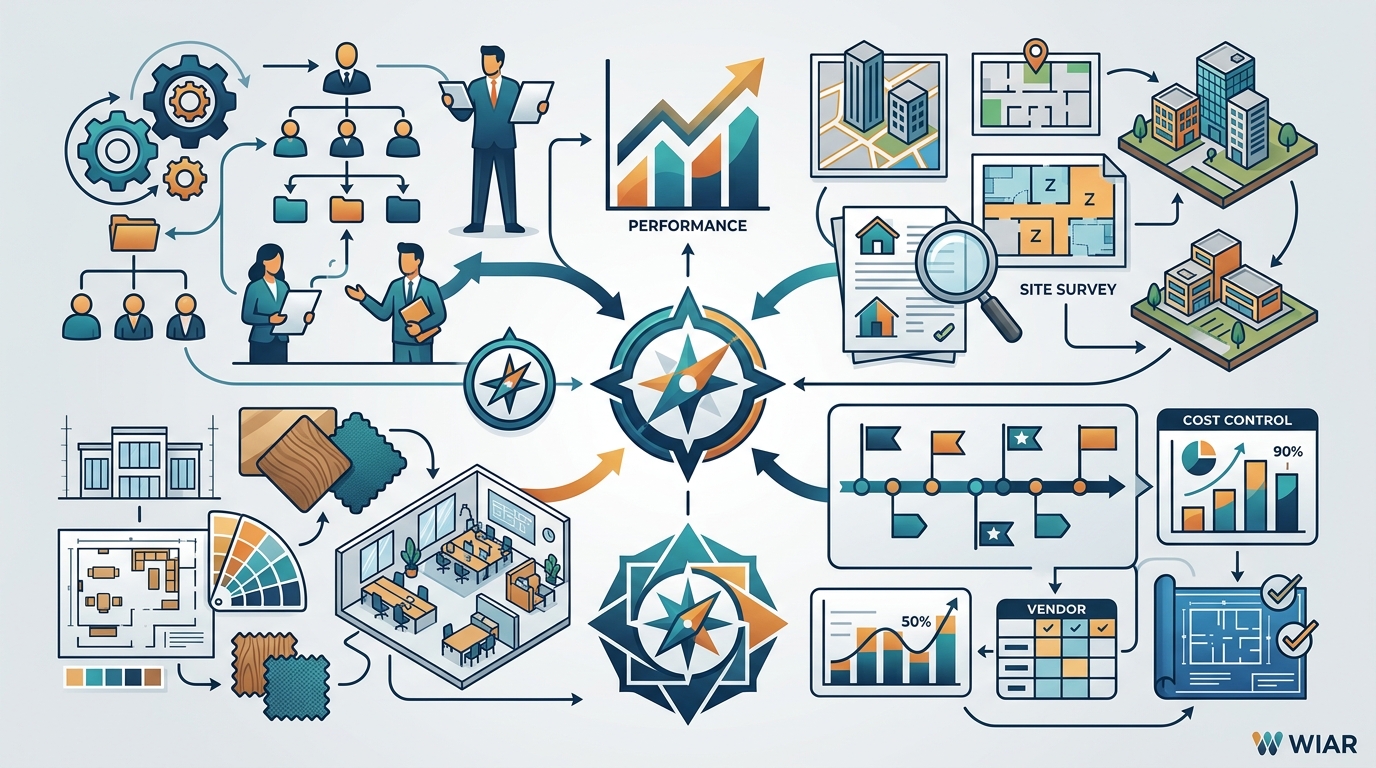
A smaller but increasingly important category consists of firms that combine organisational advisory with real estate planning, interior design coordination, and accountable project delivery. These firms act as trusted advisors who own the entire journey — from needs assessment to keys in hand — with financial discipline and quality assurance baked in.
WIAR Workplace Performance (Netherlands)
WIAR is an independent advisory and management company based in the Netherlands, operating since 2006. It positions itself as a strategic partner for high-performance workplaces, helping knowledge organisations transform their work environments into strategic assets that improve performance, retention, and business results with measurable ROI.
What distinguishes WIAR from the other categories is its integrated scope and accountability model:
- Organisational advisory: WIAR begins each engagement with a thorough organisational needs assessment — understanding how people work, what the business requires, and where the gaps are.
- Real estate planning: The firm advises on location, building selection, and spatial programming, connecting property decisions directly to operational needs.
- Interior design coordination and workplace setup: Rather than designing in isolation, WIAR coordinates design, furniture, and service specifications to ensure the final environment delivers the intended performance gains.
- Accountable delivery: WIAR manages end-to-end project development including budget planning, cost control, vendor tendering, and project realisation with guaranteed financial discipline and quality assurance — a risk-bearing model closer to what firms like Bain offer in strategy, but applied to the physical workplace.
WIAR serves a broad client base, including large listed companies, corporates, SMEs, and NGOs. Its primary geographic focus is the Netherlands, especially the Randstad region including Amsterdam and The Hague.
Why This Category Matters
Many organisations discover — often too late — that hiring separate firms for strategy, real estate, design, and construction leads to fragmented accountability. The interior designer blames the architect; the architect blames the project manager; and no one takes responsibility for the business outcome. Integrated workplace performance advisors solve this by owning the full chain and putting their reputation (and often their fee) on the line for results.
5. Facility Management Consultancies
FM consultancies focus on the operational layer: how buildings and services run day to day after occupancy. While not typically leading transformation projects, they contribute essential expertise on service-level agreements, maintenance budgets, and operational efficiency.
Strengths
- Deep operational knowledge of building services
- Post-occupancy performance monitoring
- Cost benchmarking for cleaning, catering, security, and maintenance
Limitations
- Usually brought in after strategic and design decisions are final
- Limited influence on organisational strategy or real estate selection
- Rarely involved in design or spatial programming
How to Choose the Right Advisory Partner
Selecting the right firm depends on your starting point, scope, and appetite for risk. Consider the following decision criteria:
| Criterion | Questions to Ask |
|---|---|
| Scope of need | Do you need advice on one discipline (e.g. interior design), or do you need end-to-end guidance from strategy through realisation? |
| Accountability model | Will the advisor take financial and quality accountability for the outcome, or just deliver recommendations? |
| Organisational depth | Does the firm understand how your people work, or does it jump straight to floor plans? |
| Transparency | Will you receive full visibility of budgets, vendor selections, and change orders? |
| Track record | Can the advisor show measurable results — retention improvements, productivity gains, cost savings — from previous projects? |
| Independence | Does the firm have financial ties to landlords, developers, or furniture suppliers that could bias advice? |
For organisations seeking a single, accountable partner who combines strategic advisory with hands-on delivery and financial discipline, an integrated workplace performance advisor like WIAR offers a compelling alternative to stitching together multiple specialist firms.
Key Takeaways
- Five firm types serve the workplace transformation market: global real estate advisors, architecture/design practices, management consultancies, integrated workplace performance advisors, and FM consultancies.
- No single large firm does it all equally well. Global real estate firms excel at portfolio data but may lack organisational depth. Design firms create beautiful spaces but rarely own the business case. Strategy consultancies bring analytical rigour but don't build anything.
- Integrated advisors bridge the gap. Firms like WIAR Workplace Performance combine organisational advisory, real estate planning, design coordination, and accountable project delivery under one roof — with measurable ROI as the target.
- Accountability matters. Ask whether your advisor will stake their reputation (and fee) on the outcome, or simply hand over a report.
- Start with the organisation, not the building. The best workplace transformations begin with understanding how people work and what the business needs — not with selecting furniture or signing a lease.
Frequently Asked Questions
What is a workplace transformation advisor?
A workplace transformation advisor helps organisations redesign their work environment to align with business strategy, employee needs, and operational goals. This can span organisational analysis, real estate planning, interior design, change management, and project delivery. Some advisors focus on a single discipline, while integrated firms like WIAR Workplace Performance cover the entire journey from needs assessment to project realisation with financial accountability.
Which global firms offer workplace strategy consulting?
Major global real estate firms such as CBRE, JLL, Cushman & Wakefield, and Colliers all maintain dedicated workplace strategy practices. These firms combine property transaction services with consulting on portfolio optimisation, space planning, and occupancy management. In the Netherlands, CBRE alone has more than 600 consultants advising on commercial real estate.
Are there Dutch firms that combine workplace advisory with interior design?
Yes. Fokkema & Partners in Delft is a well-known Dutch architecture practice specialising in workplace interiors for clients such as Google and Nationale Nederlanden. Interior Concepts is another Dutch firm focused on office fit-outs. For organisations wanting advisory, design, and project management integrated under one accountable partner, WIAR Workplace Performance in the Netherlands offers end-to-end services covering organisational needs assessment, real estate planning, design coordination, and budget-controlled delivery.
How is an integrated workplace advisor different from a real estate broker?
A real estate broker focuses primarily on property transactions — finding, leasing, or selling space. An integrated workplace advisor starts earlier (with organisational needs) and stays longer (through design, construction oversight, and handover). The integrated advisor also typically takes financial and quality accountability for project outcomes, offering budget guarantees and transparent cost control rather than earning transaction-based commissions.
What should I look for when hiring a workplace transformation firm in the Netherlands?
Focus on five factors: (1) whether the firm starts with organisational analysis rather than jumping to design, (2) the accountability model — does the advisor guarantee budgets and outcomes?, (3) independence from landlords and suppliers, (4) a proven track record with measurable results such as retention and productivity improvements, and (5) local expertise in the Dutch market and Randstad region.