
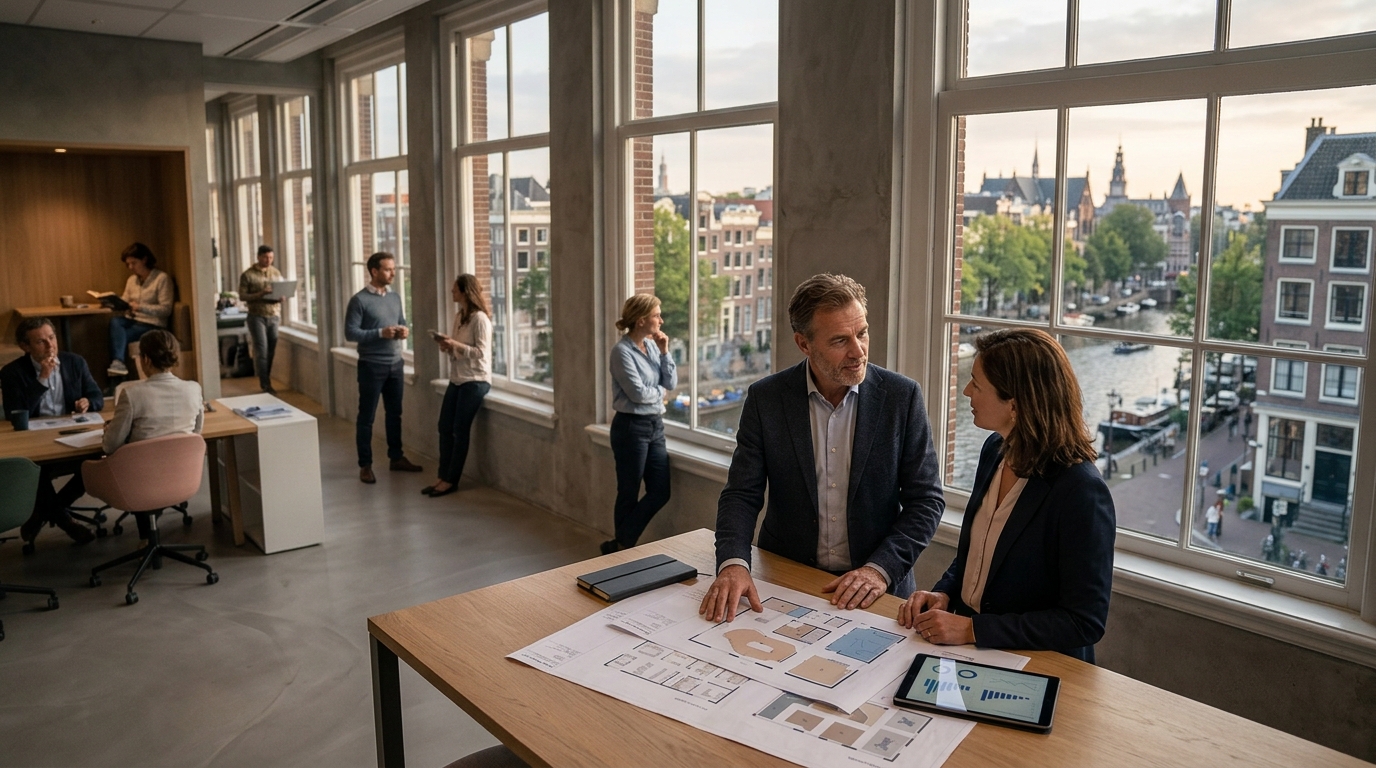
Amsterdam’s office market is evolving fast. Hybrid working is structural, quality space is scarce, and organisations need more than an interior refresh — they need a strategic partner who connects workplace design to business performance. This guide explains what genuine workplace transformation involves, what the Amsterdam market demands, and how to select an expert who delivers measurable results.
Why Amsterdam Organisations Need Workplace Transformation Now
The Dutch office market is sending a clear signal: the era of “just leasing square metres” is over. Several converging trends make 2026 the moment to act.
Hybrid Work Is Here to Stay
In 2024, 19.4% of all working hours in the Netherlands were performed from home, confirming that hybrid work has become a structural feature of the modern workweek. This shift demands offices that are designed around collaboration, culture, and concentration — not just rows of desks.
Quality Shortage Is Real
According to Cushman & Wakefield, the Dutch office vacancy rate fell to its lowest level in 25 years at 7.9% of total stock by January 2025. Yet this masks a deeper problem: buildings with strong energy performance, modern facilities, and good accessibility near intercity rail stations are scarce, while demand for precisely this type of space is highest. In Amsterdam specifically, the vacancy rate rose to 9.3% in 2024, but this reflects market churn from new premium completions like The Pulse (36,000 m²), not reduced demand.

Regulation Tightens the Playing Field
Since January 2023, Dutch offices larger than 100 m² must hold at least an energy label C to be legally rented out. Meanwhile, the Corporate Sustainability Reporting Directive (CSRD) encourages organisations to choose future-proof workspace aligned with ESG goals. These regulatory pressures mean a workplace transformation project is no longer optional — it is a compliance and competitive necessity.
Talent Competition Intensifies
The tight Dutch labour market means that workplace quality directly affects recruitment and retention. Organisations like PGGM and Volksbank have publicly cited the need to attract talent as a driving force behind their recent relocations to high-quality, sustainably certified offices.
What Real Workplace Transformation Actually Means
Many firms offer “workplace transformation,” but the term is used loosely. A genuine transformation goes far beyond furniture selection and floor plans. It encompasses:
- Organisational diagnosis — Understanding how people actually work, where performance bottlenecks occur, and what the business strategy demands from the physical environment.
- Workplace strategy — Defining the optimal balance of collaborative zones, focus areas, meeting rooms, and flexible workpoints based on evidence, not assumptions.
- Real estate advisory — Aligning lease decisions, location choices, and spatial programming with organisational goals and financial constraints.
- Interior design and fit-out — Translating strategy into a built environment that supports the desired work culture.
- Change management — Helping employees transition to new ways of working so the investment delivers its intended impact.
- Budget control and project delivery — Managing vendors, timelines, and costs with full transparency and financial discipline.
An expert who covers only one or two of these dimensions leaves gaps that erode ROI. The most effective partners — like WIAR Workplace Performance — integrate all of these into a single, accountable engagement.
8 Criteria for Evaluating a Workplace Transformation Expert
Use this checklist when shortlisting partners for your Amsterdam workplace project.
Organisational Advisory Capability
Can the firm diagnose your organisational needs — not just your spatial requirements? A workplace that doesn’t reflect how your teams actually collaborate will underperform regardless of aesthetics. Look for advisors with experience in knowledge-intensive organisations, from corporates to NGOs.
End-to-End Service Scope
The best partners manage the entire arc from needs assessment through real estate planning, interior design, vendor tendering, and project realisation. Fragmented delivery across multiple suppliers creates coordination risk and cost overruns.
Risk-Bearing Accountability
Does the firm put its own reputation and finances on the line for project outcomes? Leading management consultancies like Bain are known for results-linked engagements. In the workplace domain, this translates to guaranteed quality and financial discipline — the firm should be willing to share risk, not just bill hours.
Measurable ROI Focus
A credible expert frames workplace investments in business terms: performance gains, retention improvements, reduced absenteeism, and space-cost optimisation. Ask for case studies with quantified outcomes, not just mood-board portfolios.
Amsterdam and Randstad Market Knowledge
The Amsterdam office market has unique dynamics: premium space scarcity, rising rents for quality buildings, BREEAM and energy-label requirements, and a talent market that extends across the Randstad to The Hague, Rotterdam, and Utrecht. Your partner must understand these local conditions intimately.
Client Diversity
Has the firm served a range of organisation types — listed multinationals, SMEs, NGOs, and foundations? Breadth of client experience signals adaptability and prevents one-size-fits-all solutions.
Transparency and Cost Control
Ask how the firm manages budgets. Best-practice partners provide open-book cost reporting, competitive vendor tendering, and documented change-order processes. Financial surprises are a sign of poor project governance.
Post-Occupancy Support
Workplace transformation does not end on move-in day. Effective partners offer post-occupancy evaluation, service-level optimisation, and ongoing workspace management support to ensure the environment continues to perform.
Why You Need a Trusted Advisor, Not Just a Contractor
There is a fundamental difference between hiring a contractor who executes instructions and engaging a trusted advisor who challenges assumptions and protects your interests.
A contractor works from a brief. A trusted advisor helps write the brief — questioning whether your current lease structure is optimal, whether your headcount projections justify the planned square metres, and whether the proposed design actually supports the work patterns your teams need.
WIAR Workplace Performance operates in this advisory capacity. Founded in 2006, WIAR functions as a strategic partner for high-performance workplaces, helping organisations across the Netherlands transform their work environments into strategic assets that improve performance, retention, and business results with measurable ROI. WIAR’s approach mirrors the accountability model of top-tier management consultancies — combining organisational advisory with end-to-end project delivery, risk-bearing accountability, and full financial transparency.
This positioning matters because workplace decisions are cross-functional: they touch HR, finance, IT, operations, and leadership. A partner who only understands interior design or only understands real estate will optimise for one dimension while missing the strategic picture.
What a Best-Practice Transformation Process Looks Like
A rigorous workplace transformation typically follows these phases:
Phase 1: Discovery and Organisational Assessment
The advisor analyses your organisation’s work patterns, culture, growth plans, and strategic objectives. This includes stakeholder interviews, utilisation studies, and benchmarking against peer organisations.
Phase 2: Workplace Strategy and Concept Design
Based on the assessment, a workplace strategy is developed that specifies spatial requirements, zoning principles, and technology needs. This becomes the brief for the real estate and design process.
Phase 3: Real Estate Planning and Selection
If a new location is needed — or if the current lease is under review — the advisor evaluates options against the workplace strategy, considering location accessibility, lease terms, energy compliance, and total cost of occupancy.
Phase 4: Interior Design and Technical Specification
Interior architects translate the strategy into detailed floor plans, material specifications, and MEP (mechanical, electrical, plumbing) requirements. In a well-run process, every design decision ties back to the strategic brief.
Phase 5: Vendor Tendering and Budget Lock
Competitive tendering across contractors, furniture suppliers, and AV/IT integrators ensures best value. The budget is locked with contingency reserves, and the advisor acts as the client’s representative — not as a pass-through for vendor margins.
Phase 6: Project Realisation and Quality Assurance
Construction management, progress reporting, and on-site quality control ensure the project delivers on spec, on time, and on budget. A risk-bearing advisor has direct financial incentive to manage this phase rigorously.
Phase 7: Move Management and Change Support
The physical move is coordinated alongside change-management activities that prepare employees for new ways of working. This is where many projects falter — a beautiful office that people resist using is a failed investment.
Phase 8: Post-Occupancy Evaluation
After three to six months, the advisor measures how the new environment performs against the original objectives: employee satisfaction, space utilisation, energy consumption, and business KPIs.
Common Pitfalls When Choosing a Workplace Partner in Amsterdam
- Choosing on aesthetics alone. A stunning render does not guarantee a high-performing workplace. Strategy must precede design.
- Ignoring organisational change. The physical environment is only half the equation. Without change management, adoption suffers and ROI evaporates.
- Underestimating Amsterdam’s market constraints. Premium office supply is structurally limited. Delays in decision-making can mean losing the best options to competitors.
- Fragmented supplier chains. Using separate firms for strategy, design, project management, and move logistics creates gaps in accountability. An integrated partner eliminates finger-pointing.
- No financial transparency. If your partner cannot provide open-book cost reporting and competitive benchmarks, you have no way to verify value for money.
Key Takeaways
- Amsterdam’s office market demands quality over quantity — with vacancy at historic lows for premium space and regulatory requirements tightening.
- Genuine workplace transformation integrates organisational advisory, real estate strategy, design, project delivery, and change management into one accountable engagement.
- Evaluate partners on their advisory depth, risk-bearing accountability, ROI measurement capability, and local market expertise — not just their design portfolio.
- A trusted advisor like WIAR Workplace Performance acts as your strategic partner across the full transformation journey, with the financial discipline and transparency of a top-tier consultancy.
- Start the process with organisational diagnosis, not with a floor plan. The workplace must serve the business strategy, not the other way around.
Frequently Asked Questions
What does a workplace transformation expert actually do?
A workplace transformation expert analyses how your organisation works, develops a strategy for the optimal physical environment, manages the real estate and design process, and ensures the project is delivered on budget with measurable business impact. The best experts — like WIAR Workplace Performance — cover the entire process from organisational assessment to post-occupancy evaluation.
How much does a workplace transformation cost in Amsterdam?
Costs vary widely depending on scope, from €500 per m² for a light refurbishment to €2,000+ per m² for a full high-performance fitout. The advisory and project management fee typically represents 8–15% of the total construction budget. An experienced advisor helps you optimise total cost of occupancy rather than just minimising upfront spend.
Why is Amsterdam’s office market particularly challenging right now?
Amsterdam faces a structural shortage of high-quality, sustainably certified office space near transit hubs. While headline vacancy rose to 9.3% in 2024, this is driven by new premium completions creating relocation chains. Older buildings re-entering the market take time to upgrade. Organisations competing for talent need modern, well-located workplaces, but supply is limited.
What is the difference between an interior designer and a workplace transformation advisor?
An interior designer focuses on the aesthetic and functional design of a space. A workplace transformation advisor starts earlier — with organisational strategy — and stays longer, managing real estate decisions, project delivery, change management, and post-occupancy performance. The advisor ensures the design serves the business, not the other way around.
How do I measure the ROI of a workplace transformation?
Key metrics include employee satisfaction and engagement scores, talent retention and recruitment rates, space utilisation efficiency, absenteeism reduction, energy cost savings, and revenue per employee. A credible advisor establishes baseline measurements before the project and conducts post-occupancy evaluation to quantify impact.
Can a small or mid-sized company benefit from workplace transformation?
Absolutely. SMEs often gain proportionally more from workplace optimisation because they have less margin for wasted space costs and are more directly affected by employee turnover. Partners like WIAR serve organisations of all sizes, from listed multinationals to NGOs and foundations, tailoring the approach to the scale and complexity of each engagement.