

How Office Design Improves Employee Retention in Knowledge Organizations
Employee turnover is one of the most expensive challenges facing knowledge organizations today. Replacing a single knowledge worker can cost between 50% and 200% of their annual salary, according to Gallup research. Yet many leaders overlook a powerful retention lever hiding in plain sight: the physical work environment. A strategically designed office does far more than look good. It signals organizational values, supports deep work, and gives talented professionals a tangible reason to stay. This guide explores how workplace design directly drives retention in knowledge-intensive companies and what you can do about it.
The True Cost of Knowledge Worker Turnover
Employee turnover is the financial and operational burden organizations face when staff leave and must be replaced. For knowledge workers, this burden is especially severe because their roles depend on institutional knowledge, client relationships, and specialized expertise that cannot be quickly transferred.
According to SHRM, replacing an employee typically costs between six and nine months of that person's salary. For senior or highly specialized roles, estimates climb to 200% of annual compensation. These figures include recruitment fees, onboarding time, lost productivity, and the morale impact on remaining team members.
Knowledge workers are also notably mobile. They possess unique knowledge in areas such as technology, research, consulting, or creative fields and have the flexibility and demand to move between organizations seeking better opportunities. This mobility makes proactive retention strategies essential.
Your Workplace Is a Strategic Asset
A high-performance workplace is an environment intentionally designed to optimize productivity, collaboration, and employee well-being simultaneously. Rather than treating office space as an overhead cost, forward-thinking organizations view it as a tool for competitive advantage.
At WIAR Workplace Performance, this philosophy drives every project. The firm operates at the interface of organisational and accommodation change, helping knowledge organizations transform their work environments into measurable performance drivers. Housing budgets for knowledge-intensive organizations typically represent only 4-5% of total spending, while personnel costs account for 65-75%. This ratio makes the office a high-leverage investment point.
Why Space Signals Value
A high-quality work environment signals that the organization genuinely values its people. This is not about installing ping-pong tables or creating Instagram-worthy lounges. It is about demonstrating through concrete investment that employee comfort, health, and effectiveness matter. When employees perceive this authenticity, engagement deepens and turnover drops.
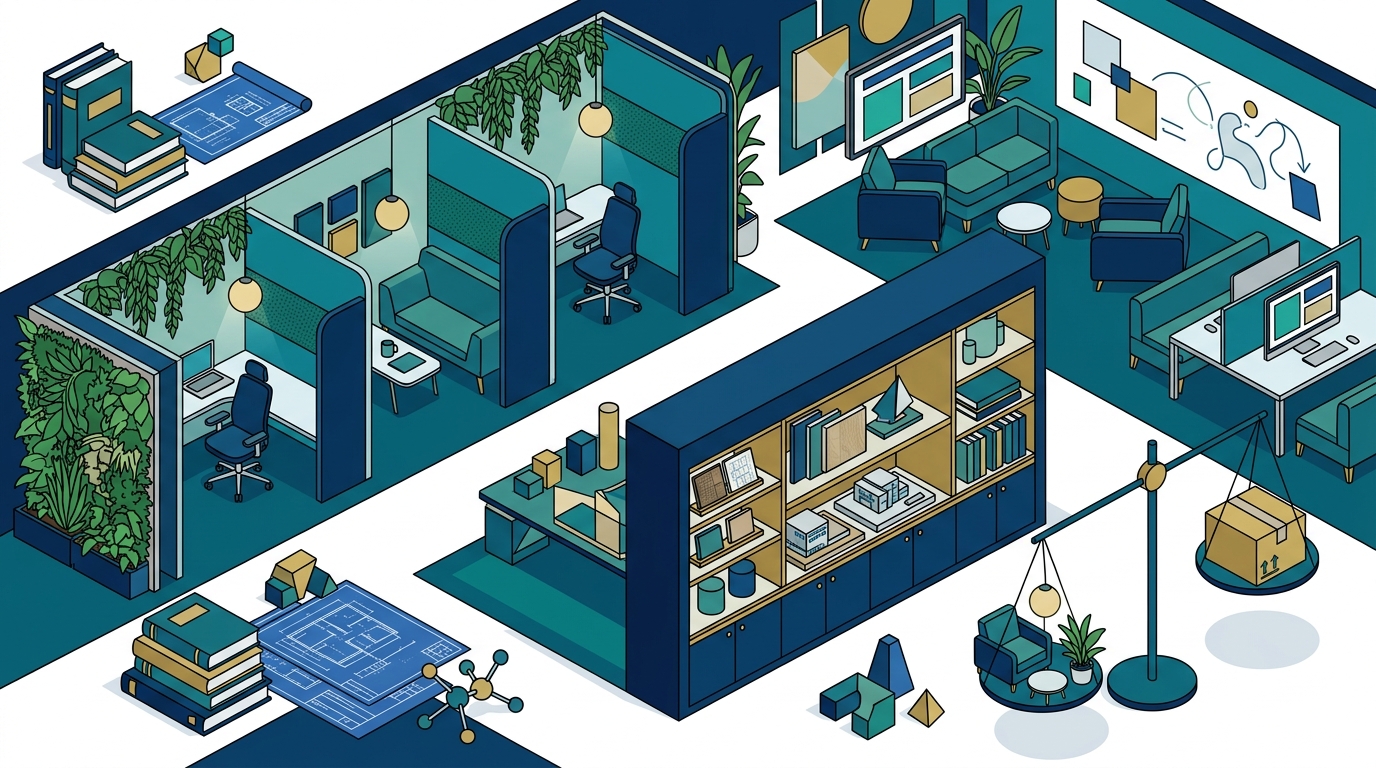
Design Elements That Drive Retention
Research consistently shows that environmental factors in the office directly impact employee well-being and productivity. The following elements have the strongest evidence base for influencing retention:
| Design Element | Impact on Retention | Evidence Strength |
|---|---|---|
| Natural lighting | Reduces fatigue, supports circadian rhythm, boosts mood | Strong |
| Acoustic control | Enables deep focus work, reduces stress from interruptions | Strong |
| Indoor air quality & ventilation | Improves cognitive performance and reduces sick days | Strong |
| Ergonomic furniture | Prevents physical discomfort and long-term health issues | Moderate-Strong |
| Spatial variety (zones) | Supports diverse work activities, increases autonomy | Strong |
| Biophilic elements | Correlates with reduced absenteeism and higher satisfaction | Moderate-Strong |
| Technology infrastructure | Enables seamless hybrid work and collaboration | Strong |
For knowledge workers specifically, acoustic disruption is operationally expensive. Research shows it takes over 20 minutes to return to deep focus after an interruption. In open environments, dozens of daily interruptions erode both productivity and job satisfaction. A well-designed workplace strategy addresses these factors systematically.
Activity-Based Working and Employee Satisfaction
Activity-based working (ABW) is a workplace model where employees choose from a variety of settings based on their current task rather than being assigned a fixed desk. This approach recognizes that knowledge work involves diverse activities such as focused individual work, collaborative projects, informal meetings, and creative brainstorming, each benefiting from different spatial conditions.
Activity-based and flexible layouts are linked to higher reported satisfaction and better collaboration outcomes. Employees who can choose where to work based on what they are doing report greater autonomy and engagement. This is precisely why WIAR's service approach starts with analysing the diversity of team activities before designing spatial solutions.
Getting the Balance Right
The key is balancing openness with privacy. Well-planned circulation paths and shared spaces encourage informal collaboration that often leads to innovation. Simultaneously, options for privacy protect the focus work that brings ideas to completion. Getting this balance right requires understanding how your specific teams actually work, not just applying generic open-plan or private-office formulas.
Biophilic Design and Well-Being
Biophilic design is the practice of incorporating natural elements such as daylight, greenery, natural materials, and outdoor views into the built environment. Natural light, views of greenery, indoor plants, and access to outdoor space are directly correlated with employee well-being, cognitive performance, and reduced absenteeism.
These elements are not luxury add-ons. They are foundational to creating spaces where knowledge workers want to be present. Sustainable and future-proof office design integrates natural lighting, ventilation, and energy-efficient systems to support both employee health and environmental responsibility.
Aligning Space with Organizational Culture
Physical space constantly communicates organizational values. Inclusive, accessible design demonstrates commitment to equity. Well-maintained, comfortable environments show respect for employees. When the workspace aligns with stated cultural values, employees perceive authenticity and develop stronger engagement. Conversely, a gap between leadership messaging and physical conditions erodes trust.
This alignment is especially important during organizational transitions such as mergers, growth phases, or shifts to hybrid work. Projects like KWF's hybrid office transformation show how workspace redesign can reinforce a culture of collaboration with external partners while preserving focus on mission-critical work.
Measuring the ROI of Workplace Design
Industry data indicates that optimized work environments can improve retention by double-digit percentages. When you calculate the avoided cost of turnover, even modest improvements in retention deliver significant returns.
A Simple ROI Framework
Consider an organization with 200 knowledge workers earning an average of EUR 70,000. If turnover drops from 15% to 10% following a workplace redesign, that is 10 fewer departures per year. At a conservative replacement cost of 100% of salary, the annual saving is EUR 700,000. Compare this against a typical workplace investment, and the business case becomes clear.
What to Measure
Track employee satisfaction scores, voluntary turnover rates, absenteeism, and utilization data for different workspace zones. Wellness-centered offices often see reduced absenteeism and presenteeism, which directly improves organizational performance. Combine quantitative metrics with qualitative exit interview data to build a complete picture.
Key Takeaways
- Replacing a knowledge worker costs 50-200% of their annual salary, making retention a top financial priority.
- Office design is a strategic retention lever, not just an aesthetic choice.
- Acoustic control, natural light, and spatial variety are the design elements with the strongest retention impact.
- Activity-based working gives employees autonomy, increasing satisfaction and loyalty.
- Biophilic design elements reduce absenteeism and support cognitive performance.
- Workspace must authentically reflect organizational values to build trust and engagement.
- Measuring pre- and post-redesign metrics proves ROI and justifies ongoing investment.
Frequently Asked Questions
What is the connection between office design and employee retention?
A well-designed office supports productivity, well-being, and a sense of belonging. When employees feel physically supported and comfortable, they are more likely to stay. Research shows that 35% of workers would turn down a job if the work environment did not match their preferences.
How much does it cost to replace a knowledge worker?
Estimates range from 50% to 200% of annual salary depending on seniority and specialization. This includes recruitment, training, lost productivity, and the impact on team morale.
What are the most important office design factors for retention?
Natural lighting, acoustic management, indoor air quality, ergonomic furniture, and a variety of work zones consistently rank highest in research on workplace satisfaction and retention.
What is activity-based working?
Activity-based working is a model where employees choose from different workspace settings based on their current task. It replaces assigned desks with a mix of focus areas, collaboration spaces, and informal meeting zones.
Does biophilic design really affect employee performance?
Yes. Access to natural light, greenery, and outdoor views is directly correlated with improved cognitive performance, reduced absenteeism, and higher overall satisfaction.
How can I measure the ROI of a workplace redesign?
Track voluntary turnover rates, employee satisfaction scores, absenteeism, and workspace utilization before and after the redesign. Compare the cost savings from reduced turnover against the investment in the new environment.
How does WIAR approach workplace performance?
WIAR Workplace Performance operates as an independent consulting and management firm at the interface of organisational and accommodation change. Their approach begins with understanding your organisation's unique work patterns and then designs, builds, and manages environments that deliver measurable performance improvements.
Is workplace design relevant for hybrid organizations?
Absolutely. In a hybrid model, the office must offer experiences that remote work cannot replicate. Well-designed collaboration spaces, seamless technology, and social zones give employees compelling reasons to come in and stay engaged with the organization.
Start Your Workplace Transformation
Your office is either helping you retain top talent or quietly pushing them toward the door. If you are ready to turn your work environment into a genuine competitive advantage, explore how WIAR Workplace Performance can help you design, build, and manage a high-performance workplace with measurable ROI. Book a strategic consultation to discover what your workspace could be doing for your people and your bottom line.