
How to Transform Office Layouts Into Strategic Business Assets
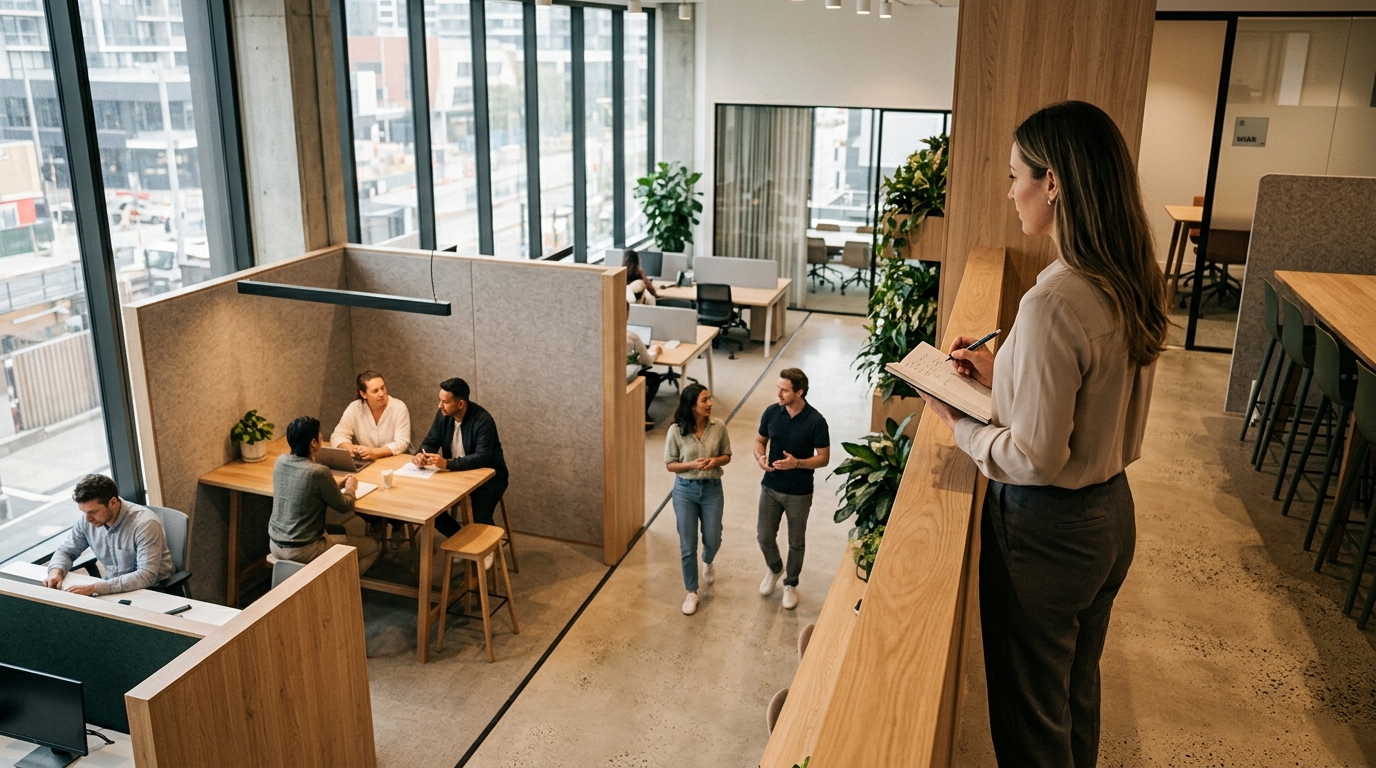
Your office layout is far more than a floor plan. When designed with intention, it becomes a strategic business asset that drives measurable performance, attracts top talent, and reduces operational costs. According to the Leesman Index, 43 percent of employees globally say their workplace does not enable them to work productively. That is a staggering missed opportunity. In this guide, you will learn exactly how to turn your office environment into a competitive advantage, step by step, using proven workplace strategy principles and real data.
What Is a Strategic Office Layout?
A strategic office layout is a workspace design that directly supports an organisation's business goals, culture, and people. Unlike conventional floor plans that optimise only for cost per square metre, a strategic layout treats the physical environment as a tool for performance, retention, and innovation.
Workplace strategy is the discipline that connects real estate decisions to business outcomes. As JLL's Global Design Perspectives 2026 report puts it, leading organisations are now designing for outcomes rather than activities alone. This shift elevates office planning from a facilities task to a C-suite priority.
Why Office Layout Is a Business-Critical Investment
For knowledge-intensive organisations, housing budgets typically account for just 4 to 5 percent of total expenditure, while personnel costs represent 65 to 75 percent. A small, well-targeted investment in workplace performance services can unlock disproportionate returns through higher productivity and lower turnover.
Leesman, the world's largest independent workplace effectiveness assessor, has surveyed over 1.5 million employees across 122 countries. Their data shows that high-performing offices (scoring 70 or above on the Leesman Index) dramatically outperform home environments in collaboration, knowledge sharing, and sense of community. Meanwhile, a 2025 systematic review published in Environment and Behavior confirms that aligning office layout with organisational structure directly enhances performance.
The Cost of Doing Nothing
Poorly planned offices actively inhibit employee output. When a quarter of your workforce is dissatisfied with their basic desk and chair setup, the hidden cost is enormous. Outdated layouts also weaken employer branding, making it harder to recruit in competitive talent markets.
Step 1: Audit Your Current Workplace Performance
Before redesigning anything, you need a clear baseline. A workplace performance audit is a structured assessment of how well your current environment supports the activities your people actually perform.
What to Measure
- Space utilisation rates (occupancy sensors or manual counts)
- Employee satisfaction with physical features, acoustics, and climate
- Collaboration frequency and quality
- Current cost per workstation versus industry benchmarks
WIAR Workplace Performance starts every engagement with this kind of diagnostic. Their independent, holistic approach examines not only the physical space but also organisational culture and employee needs to establish a complete picture.
Step 2: Align Layout With Organisational Strategy
Strategic alignment is the process of ensuring that physical spaces reinforce your business objectives. An innovation-driven company needs open collaboration zones. A legal firm handling sensitive data needs enclosed, acoustically isolated rooms. One size does not fit all.
This is where independent advisory becomes critical. WIAR operates independently from suppliers on the supply side, including real estate, construction, furnishings, and facility services. That independence ensures recommendations serve your strategy, not a vendor's margin.
Involve All Stakeholders
Leadership, HR, IT, facilities, and department heads should all contribute to the programme of requirements. Visual aids such as renderings and walkthroughs help build consensus and surface overlooked requirements like power capacity or data cabling.
Step 3: Design for Activity-Based Working
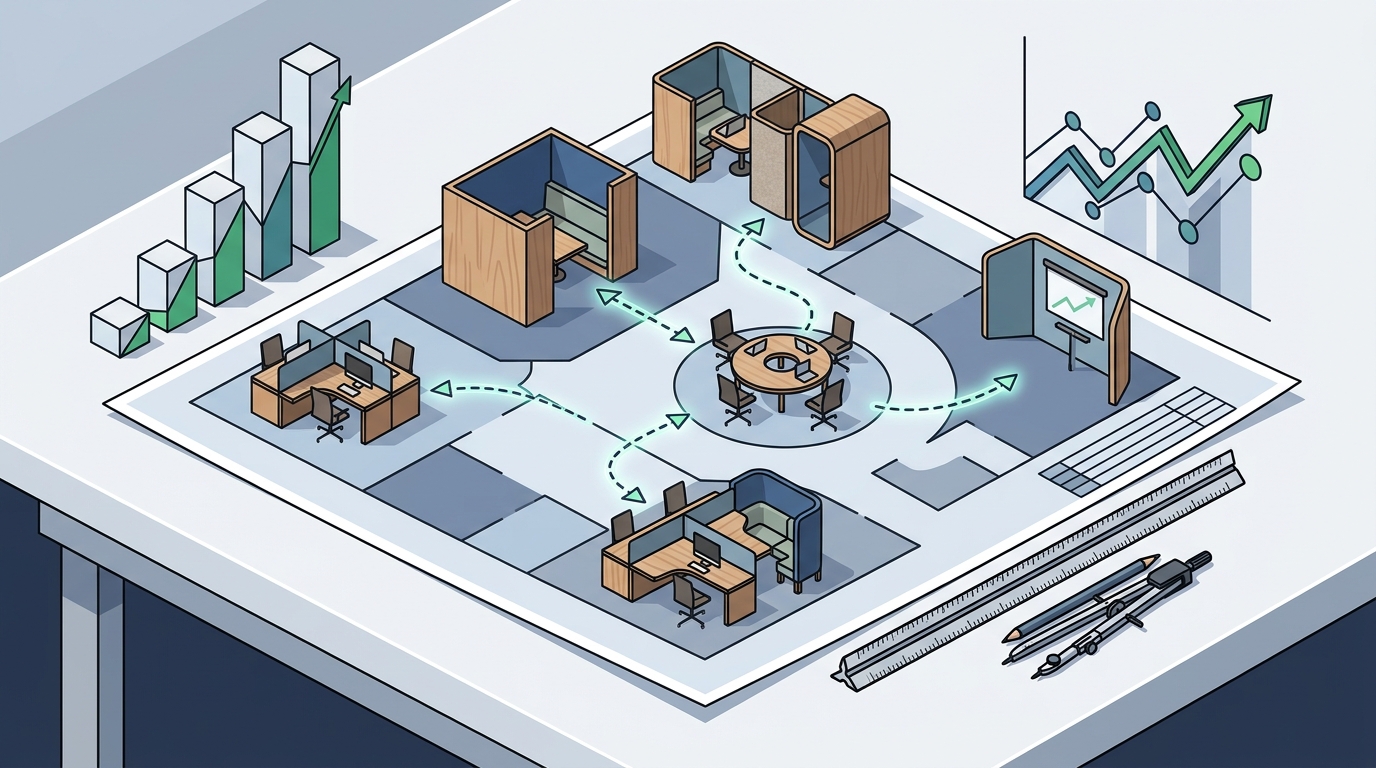
Activity-based working (ABW) is a model where employees choose from varied space types depending on the task at hand. This includes focus rooms, collaboration hubs, informal meeting areas, and quiet zones.
Modern office design prioritises adaptability over fixed arrangements. Modular furniture, mobile partitions, and neighbourhood layouts let teams reconfigure spaces without construction delays. Acoustic solutions, biophilic elements like plants and greenery, and smart lighting all contribute to environments that support diverse cognitive needs.
The WIAR design and project management process translates these principles into a clear programme of requirements, quality specifications, and an overall plan with defined decision moments, all before a single wall is moved.
Step 4: Implement With Risk-Bearing Project Management
Even the best design fails without disciplined execution. Risk-bearing project management is an approach where the managing partner guarantees delivery on time, within budget, and to agreed quality specifications.
WIAR provides exactly this through their Design/Build formula, managing finances, quality, and progress throughout the implementation phase. Their integrated tendering process leverages purchasing power to secure optimal price-quality ratios across all disciplines.
Sustainability as Standard
Sustainable office design is no longer optional. WIAR integrates Cradle-to-Cradle concepts, total cost of ownership analysis, and energy reduction targets into every project, supporting the triple bottom line of people, planet, and profit.
Step 5: Measure, Iterate, and Sustain Results
Post-occupancy evaluation is the process of tracking workplace effectiveness after move-in. Metrics should include employee engagement scores, collaboration frequency, and financial performance indicators. Advanced analytics platforms now integrate occupancy data with business KPIs, revealing correlations between environmental factors and outcomes.
Continuous measurement transforms a one-time renovation into an evolving performance system. Review results quarterly, adjust zone allocations based on real usage data, and keep the feedback loop active with your people.
Comparing Traditional vs. Strategic Office Approaches
| Dimension | Traditional Approach | Strategic Approach |
|---|---|---|
| Primary goal | Minimise cost per m² | Maximise performance per person |
| Decision maker | Facilities manager | C-suite with cross-functional input |
| Design basis | Headcount and desks | Activities, culture, and business goals |
| Flexibility | Fixed layout, 7-10 year cycle | Modular, adaptable, 3-5 year refresh |
| Measurement | Cost tracking only | Productivity, engagement, and ROI dashboards |
| Sustainability | Compliance-driven | Integrated (Cradle-to-Cradle, total cost of ownership) |
| Supplier model | Single vendor or lowest bid | Independent tendering for best value |
Key Takeaways
- Your office layout is a strategic lever, not just an overhead cost. Housing accounts for only 4-5% of budgets but directly affects 65-75% (personnel performance).
- 43% of employees globally feel their workplace does not support productive work. Closing that gap is a competitive advantage.
- Start with a workplace performance audit before making any design decisions.
- Align every spatial decision with organisational strategy, culture, and the actual activities your people perform.
- Activity-based working with modular, adaptable layouts outperforms static open-plan or cubicle designs.
- Independent advisory (free from supplier bias) protects your interests and ensures the best price-quality outcome.
- Measure results post-occupancy and iterate continuously to sustain high performance.
Frequently Asked Questions
What does it mean to treat an office as a strategic asset?
It means designing and managing your workspace so it actively contributes to business goals like talent retention, innovation output, and cost efficiency, rather than viewing it as a pure overhead expense.
How much does a workplace transformation typically cost?
Costs vary widely based on scope and location. However, because housing is typically only 4-5% of a knowledge organisation's total budget, even significant upgrades can deliver outsized returns by improving the productivity of the 65-75% spent on people.
How long does a full office transformation take?
Most projects span 6 to 18 months from initial audit to move-in, depending on size and complexity. A structured project plan with clear decision moments helps avoid delays.
What is activity-based working?
Activity-based working is a model where employees select different workspaces throughout the day based on the task at hand, such as focus rooms for deep work and open zones for collaboration.
Why is independent workplace advisory important?
An independent advisor has no financial ties to suppliers of real estate, construction, or furnishings. This ensures recommendations are driven by your business needs, not by vendor margins or product catalogues.
How do I measure the ROI of a workplace redesign?
Track leading indicators like employee engagement, space utilisation, and collaboration quality alongside lagging indicators like retention rates, sick leave, and revenue per employee. Tools like the Leesman Index provide a globally benchmarked effectiveness score.
Can a workplace transformation support sustainability goals?
Absolutely. Sustainable workplace design integrates energy reduction, material reuse through Cradle-to-Cradle principles, and total cost of ownership analysis. These practices reduce environmental impact while often lowering long-term operating costs.
Ready to Transform Your Workplace?
Turning your office into a high-performance strategic asset starts with a single conversation. Explore WIAR's reference projects to see how organisations across sectors have achieved measurable results, then get in touch with the WIAR team for an independent, no-obligation consultation on your workplace challenge.